Hugging Face Spring 2026: What the Open Source AI Boom Means for You
Something big has quietly happened in artificial intelligence. The most interesting work in AI is no longer locked inside a handful of giant labs. It is out in the open, being built, shared, and remixed by thousands of people every single day. Our spring 2026 look at the state of open source on Hugging Face makes one thing clear: the open model world has moved from a curiosity to a real engine of the AI economy.
That shift matters to more than just engineers. It changes what AI costs, who can build with it, what kinds of products show up on your phone, and how much control a company has over the technology running its business. Here is the plain-English version of what is going on and why you should care.
Open Source Stopped Being the Underdog
For years, the story went like this: the best AI came from a few well-funded labs, and everyone else got the leftovers. That story is now out of date.
What we are seeing on Hugging Face is a platform that has become the default front door for open AI. It is part model library, part marketplace, part classroom, and part testing lab. When a research team or a startup releases a model, this is where it lands. When a developer wants to try something out, this is where they look first.
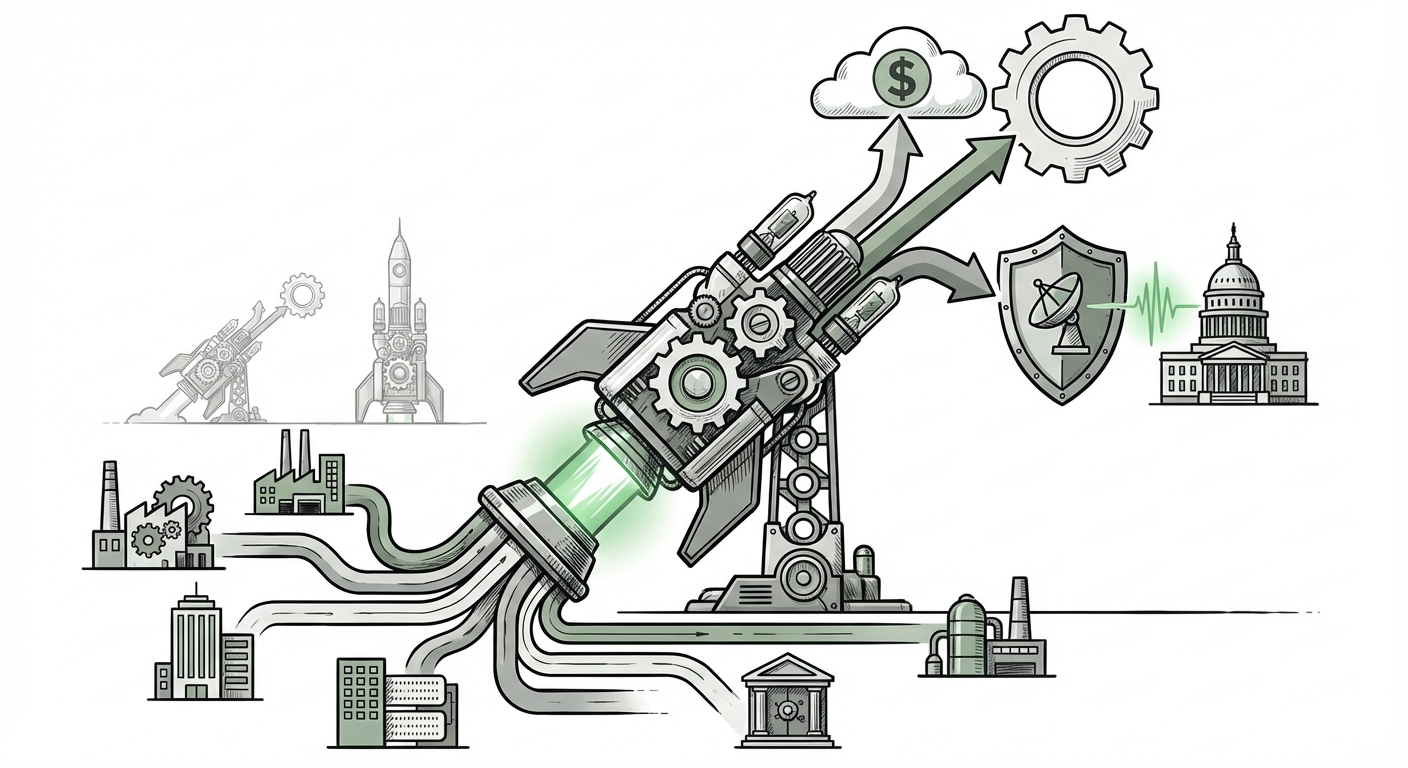
The result is a flywheel. A model gets published. Other people download it, fine-tune it, fix its weak spots, and publish a better version. That version gets downloaded and improved again. Each turn of the wheel is faster than the last. Closed labs have to pay for every step of that process. The open community gets it for free, from volunteers and competitors alike.
The deeper meaning is simple. AI is becoming a shared utility instead of a private product. That does not mean the biggest models are irrelevant. It means the floor has risen dramatically. A small team today can start from a strong open base model and reach something useful in weeks, not years.
What Is Actually Driving the Growth
Three forces are pushing the open ecosystem forward at the same time.
1. The tooling got good
Sharing a model used to be painful. You needed the right files, the right libraries, and the right docs, and even then it often broke. Today, a model card travels with the model. You can see what it does, what it was trained on, what it is bad at, and how to run it, all in one place. That sounds boring, but it is the single biggest reason open AI spread. When the boring parts get easier, more people show up.
2. Fine-tuning became normal
Most companies do not need to build a model from scratch. They need a model that understands their invoices, their product catalog, their legal language, or their customers' slang. The open ecosystem is built for exactly that. You take a strong base, feed it your own data, and end up with something specific and small. This is where most real business value is being created right now.
3. The community turned into a quality filter
With so much available, the hard question is no longer "is there a model?" It is "which one should I trust?" Open communities solve this with signals: download counts, likes, leaderboards, benchmark results, discussion threads full of people reporting real failures and real wins. That social layer is now as valuable as the models themselves. It is a reputation system for AI.
The Small Model Story Is the Big Story
If you only follow headlines, you might think progress means bigger and bigger models. In the open world, the opposite is often true.
A lot of the most active work is on smaller, specialized models. Why? Because they are cheap to run, fast to respond, easy to fine-tune, and private by design. You can run them on your own hardware. You do not have to send your customer data to someone else's server. For a hospital, a bank, or a manufacturer, that is not a nice-to-have. It is a dealbreaker.
This is quietly reshaping how AI gets used. Instead of one giant model answering everything, companies are assembling teams of small models, each one a specialist. One reads documents. One sorts support tickets. One watches a camera feed. One drafts emails. A thin layer of software routes each task to the right specialist.
That architecture is cheaper, faster, and easier to audit than a single all-purpose system. Expect to see a lot more of it.
From Demos to Real Deployments
The most telling change in this spring 2026 snapshot is not how many models exist. It is what people are doing with them.
The era of the demo is ending. A demo proves a model can do something once, in a controlled setting. A deployment has to work every time, for real users, at real speed, with real consequences when it is wrong. The open ecosystem is now crowded with the unglamorous pieces that make deployment possible: evaluation tools, safety filters, quantized versions that run on modest hardware, and ready-made pipelines for common jobs like search, summarization, and speech.
That shift pulls open source out of the research lab and into the operations budget. And once something is in the operations budget, it stops being a science project and becomes infrastructure.
Licensing and Trust: The Grown-Up Problems
Open does not mean simple. Anyone planning to build on open models has to answer two questions that did not matter much a couple of years ago.
The license question. Different open models come with different terms. Some are permissive and allow almost anything. Others carry conditions, usage limits, or rules about commercial use. Reading the license is no longer optional. A legal review before launch is now standard practice, and it should be part of your plan from day one, not a scramble at the end.
The trust question. An open model can be modified by anyone. That is its strength and its risk. A model pulled from a random repository might behave differently than its description suggests, or might have been trained on data you would not approve of. The defense is process: prefer models with clear documentation, active maintenance, and visible community discussion. Test before you trust. Keep records of what you used and why.
Neither of these problems is a reason to avoid open AI. They are simply the normal costs of working with a technology that has grown up.
What This Means for Businesses
If you run a company, the strategic takeaway is uncomfortable but clear. AI capability is no longer a moat. AI execution is.
When anyone can download a strong model, the model itself stops being your advantage. Your advantage shifts to the things that are hard to copy: your data, your workflows, your distribution, your brand, and your ability to ship and support a product people actually want.
That is mostly good news for smaller companies. A ten-person team with a sharp idea and clean data can now build something that would have required a research department a few years ago. It is also a warning for large ones. Slow procurement and long approval chains are a bigger risk than any competitor's model choice.
The practical implication: stop asking "which model is best?" and start asking "which model is best for this job, at this cost, under these rules?" That is a much more useful question, and it is one the open ecosystem is built to answer.
Actionable Insights
Here is what we would do with this information, whether you are a solo developer or leading a team.
- Start with a small, well-documented open model. Prove the use case cheaply before spending on anything large. Most first deployments do not need a frontier model.
- Build a test set from your own data first. Do this before you pick a model. A model that scores well on public benchmarks can still fail badly on your specific domain. Your test set is the only score that matters.
- Read the license before you build. Check commercial use, redistribution, and any usage restrictions. Loop in legal early.
- Prefer models with active communities. Look for recent updates, real discussion, and clear documentation. A maintained model with modest scores often beats a static model with great ones.
- Design for a mix. Plan on multiple specialized models rather than one general one. Route tasks. Keep the routing layer simple and observable.
- Track provenance. Record which model, which version, and which dataset went into each system. When something goes wrong, and eventually it will, you will want that trail.
- Watch the specialization trend. The specialized small models shipping today are becoming tomorrow's building blocks. Knowing what exists is a real competitive edge.
The Road Ahead
The open AI ecosystem is no longer a protest movement against the big labs. It is a parallel economy, and in many categories it is setting the pace. The next few cycles will likely bring better evaluation, clearer licensing norms, and more tooling aimed at the messy middle of deployment, which is where most of the real work still happens.
For the people building with these tools, the message is straightforward. The raw materials are abundant and getting better. The differentiator is no longer access. It is judgment: knowing which model to use, how to test it, when to trust it, and what problem is actually worth solving.
That is a harder skill than downloading a model. It is also the one that will still matter in five years.