NVIDIA Kumo Forecast: Pretrained Time-Series AI That Shows Its Work
Most forecasting tools have a trust problem. They spit out a number, next month's demand, tomorrow's power load, next quarter's cash flow, and then they go quiet. Nobody can see why the number came out the way it did, so nobody bets real money on it.
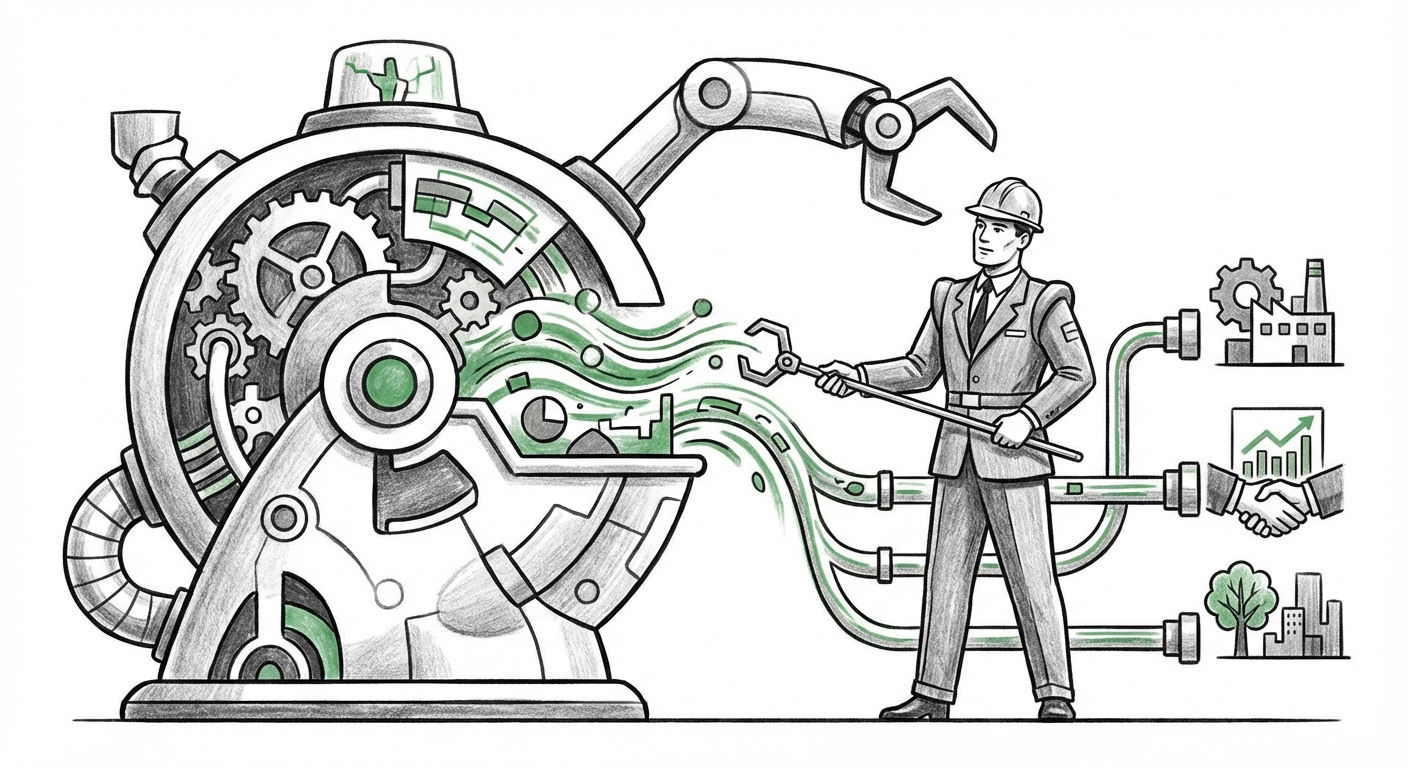
NVIDIA Kumo Forecast takes a different path. It combines three ideas that have been circling each other for years but rarely land in one system: pretrained time-series representations, retrieval of historical patterns, and interpretability. Put simply, the model learns the general shape of how numbers move over time, looks up similar stretches of the past when making a call, and then explains which past moments drove the answer.
That combination matters far beyond one product. It points to where enterprise AI is heading: away from one-off black boxes and toward models that carry general knowledge, cite evidence, and can be questioned.
The Problem With Old-School Forecasting
Traditional forecasting models are built one dataset at a time. You gather a few years of sales or sensor data, train a model on that single series, and hope the future looks like the past. This works fine when you have lots of clean history and the world stays steady. It falls apart when you are launching a new product, entering a new region, or when a supply shock rewrites the rules.
There is a second, quieter problem: the black box. A planner gets a forecast with no reasoning attached. When the number looks wrong, there is no way to check it. So teams either ignore the model or quietly override it with a spreadsheet guess. Either way, the AI is not really running the show.
Kumo Forecast targets both problems at once. The three-part design is worth unpacking piece by piece.
Part One: Pretrained Representations for Time-Series Data
A pretrained representation is a model that has already spent time learning from huge amounts of data before it ever sees your specific problem. Language models work this way, they learn the structure of language first, then get pointed at a task. Time-series models are now following the same route.
What does a model learn from watching millions of series? It picks up the grammar of change: seasonality, trend, holiday spikes, gradual drift, sudden breaks, the way a promotion lifts sales and then fades. Call it a feel for how numbers behave over time.
The payoff is practical. A business with only a few months of history, or a new product line with almost no data, can still get a usable forecast because the model already understands the general patterns. That is a big shift from the old rule that you need years of clean data before forecasting is worth doing.
Why this changes the economics
Building a forecasting model used to mean a data scientist, a long pipeline, and weeks of tuning, per series. When the base model already knows the general shape of time-series data, the work shifts from construction to configuration. Thousands of low-volume item-level series that were never worth modeling individually suddenly become cost-effective to forecast. That is where a lot of the real business value sits: not in the headliner product, but in the long tail nobody had time for.
Part Two: Retrieval of Historical Patterns
The second piece is the one that makes the system feel almost human. When faced with a new situation, Kumo Forecast searches history for similar stretches and uses them as evidence.
Think about how an experienced planner actually works. They do not run a regression in their head. They say, "This looks like the spring of two years ago when we had that shipping delay" and reason from there. Retrieval gives a model that same move. It finds the moments in the past that most resemble right now and uses them to shape the forecast.
This is the forecasting cousin of retrieval-augmented generation, the technique that made AI assistants more reliable by grounding answers in real documents instead of memory alone. Here, the "documents" are historical patterns, and the grounding is empirical rather than statistical.
Three things retrieval buys you
- Better handling of rare events. A model trained on averages smooths out the unusual. Retrieval lets the system point to a specific past disruption and weigh it.
- Faster adaptation. When conditions shift, the system can lean on the closest historical analogues instead of waiting for a full retrain.
- Built-in evidence. The retrieved patterns become the receipts behind the forecast, which leads directly to the third pillar.
Part Three: Interpretability as a First-Class Feature
Interpretability is usually bolted on after the fact, a chart here, a feature-importance bar there. In Kumo Forecast it is part of the core design, because retrieval naturally produces an explanation. The system can show which past periods it leaned on and why the current situation looked similar.
That changes the conversation in the room. Instead of "the model says 12,400 units," you get "the model says 12,400 units, and here are the three historical periods that drove that call." A planner can look at those periods and say, "That comparison is wrong, we changed our pricing since then." Now you have a real dialogue instead of a yes-or-no vote on a mystery number.
This is also the feature that gets projects past risk, audit, and compliance teams. In regulated industries, a forecast that cannot be explained is a forecast that cannot be used, no matter how accurate it is.
What This Means for the Future of AI
Step back and a bigger pattern appears. The most useful AI systems are converging on the same three-layer recipe: general knowledge from pretraining, specific evidence from retrieval, and transparency about the reasoning path. Kumo Forecast applies that recipe to numbers over time, but the shape is familiar from language, search, and code.
Three implications stand out.
1. Prediction becomes accountable
The next wave of enterprise AI will not be judged on accuracy alone. It will be judged on whether a human can check its work. Models that can cite their evidence will win procurement fights against models that cannot, even when the black box scores slightly better on a benchmark. Trust, not raw error rate, is the real bottleneck.
2. Foundation-model thinking spreads to every data type
Pretraining started with text, moved to images and audio, and is now settling into structured, numerical, time-stamped data, the backbone of how businesses actually operate. As that happens, the "train one model per problem" era starts to close. Expect pretrained backbones for sensor streams, transaction logs, and operational metrics to become as normal as pretrained language models are today.
3. Forecasts become tools that agents can call
AI agents are increasingly expected to plan and act. An agent that schedules deliveries or reorders stock needs forecasting it can trust and audit. A forecast that arrives with retrieved evidence and a readable rationale is far easier to plug into an automated workflow, because the system downstream can check the reasoning instead of blindly accepting a number.
How It Will Be Used in Practice
The obvious near-term applications are the ones where time-series data is already the lifeblood of the business.
- Retail and consumer goods: item-level demand forecasts for thousands of SKUs, including new products with thin history.
- Supply chain and logistics: volume and lead-time planning that can point to past disruptions as the reason for a cautious call.
- Energy and utilities: load forecasting where operators need to see which historical conditions drove a peak warning.
- Manufacturing: sensor-based signals for equipment behavior, where an unexplained alert gets ignored on the floor.
- Finance and operations: cash flow, staffing, and capacity planning where auditors will ask why.
Notice the common thread. These are not settings where a clever prediction is enough. They are settings where a human has to sign off, and sign-off requires a reason.
Actionable Insights for Teams
If you run forecasting or planning, here is what to do with this shift.
- Audit your time-series inventory. Count how many series you have and how many you actually forecast. The gap is your opportunity.
- Write down your explainability requirements first. Decide what a planner, auditor, or regulator needs to see before you evaluate any vendor or model. It shapes everything.
- Pilot where patterns repeat. Start with a domain that has strong seasonality and clean history. Prove the workflow before chasing the hardest cases.
- Design a review loop. Build a process where planners can flag a bad historical comparison. That feedback is gold for improving retrieval quality.
- Govern your history. Retrieval is only as good as the archive it searches. Messy, duplicated, or poorly labeled history will produce confident but wrong analogues.
- Measure decisions, not just error. Track forecast accuracy alongside inventory turns, waste, stockouts, and overtime. The business metric is the real scoreboard.
Limits Worth Watching
No approach is a cure-all, and it is worth being clear about the edges. Retrieval depends on history, so genuinely unprecedented situations remain hard. A good explanation is not the same as a cause, an interpretable forecast can still be interpretably wrong. And pretrained models carry the biases of their training data, which means validation on your own domain stays mandatory.
The honest framing is that Kumo Forecast makes forecasting more usable, not infallible. It moves the human from guessing at a black box to reviewing evidence, which is a real upgrade in how decisions get made.
The Bottom Line
For years, the promise of AI forecasting ran into a wall of distrust. The numbers might have been decent, but nobody could see inside them, so they sat unused while spreadsheets did the real work. Combining pretrained time-series knowledge with historical pattern retrieval and built-in interpretability attacks that wall directly.
The larger lesson is about direction. The AI systems that will matter in the next few years are not just the ones that predict best. They are the ones that can show their sources, survive a skeptical question, and earn a place in a decision that a human has to own. NVIDIA Kumo Forecast is a clear signal that time-series AI is moving in exactly that direction.