Sam Altman's Reported AI Safety "Endgames", Including One Where a Single Company Melts Everyone Else's GPUs
Imagine a world where the race to build the most powerful artificial intelligence does not end with a treaty, a slowdown, or a market crash, but with one company holding a switch that can destroy every rival's computing hardware. That is reportedly one of three "endgames" for AI safety that Sam Altman, the chief executive of OpenAI, has described in private conversations.
The idea sounds like science fiction. But the fact that it is being discussed at the highest levels of the AI industry tells us something important: the people building frontier AI do not believe the current situation is stable. They are already thinking about how this race ends, and not all of the endings are comforting.
This article breaks down what was reportedly pitched, why computing power has become the most important lever in the AI economy, and what businesses, governments, and ordinary users should take away from a conversation that was probably never meant to be public.
The Reported Pitch: Three Ways This All Ends
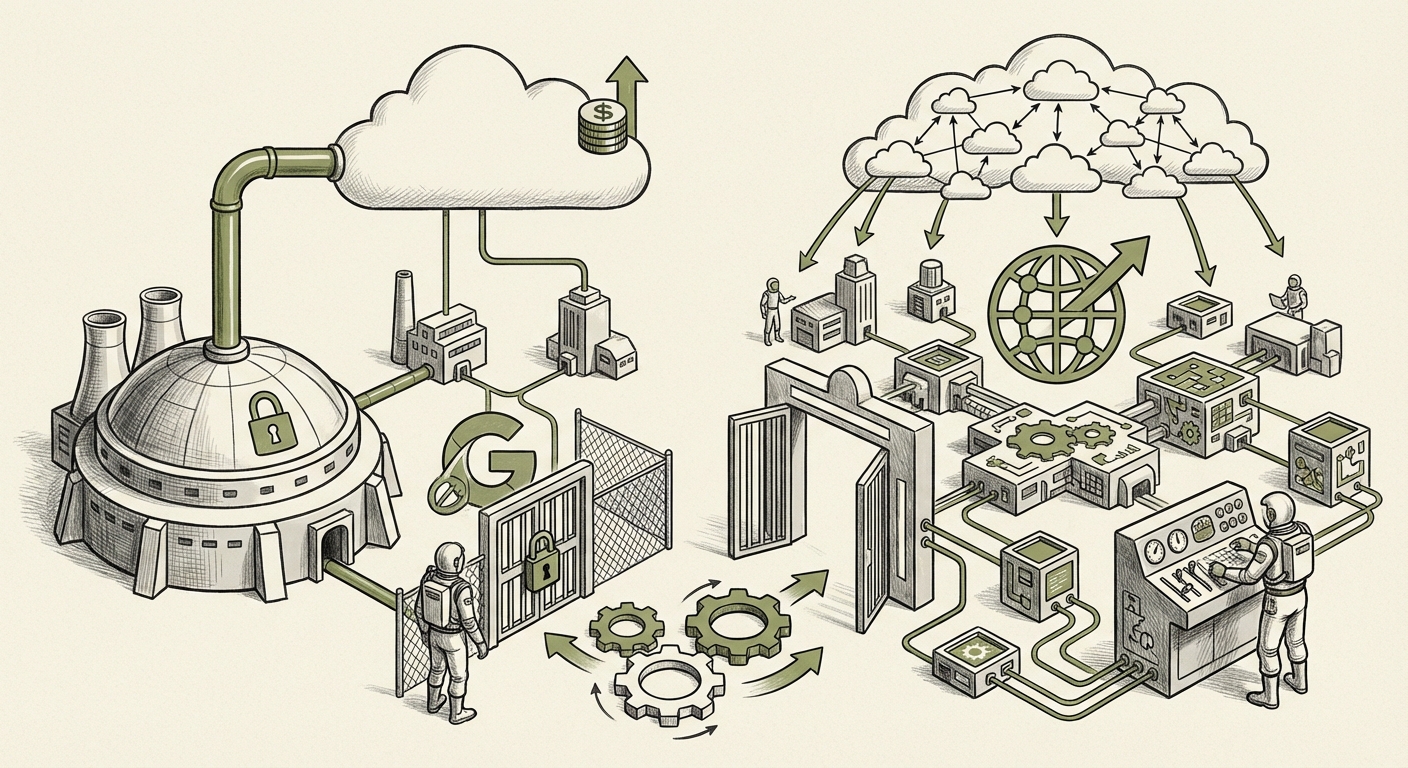
According to reporting, Altman laid out three possible endgames for AI safety. Only one has been described in detail: a scenario in which a single firm gains the power to physically disable the computing hardware of everyone else, the phrase used is imagery of melting other companies' GPUs.
The other two paths have not been spelled out publicly. But the shape of the framing is revealing on its own. When a leading AI executive sketches "endgames," he is admitting something the industry rarely says out loud: there is no current mechanism that reliably stops a dangerous AI system from being built. Not a law, not a standard, not a technical safeguard that everyone agrees on.
So instead, the conversation moves to the finish line. What does a safe end state actually look like? Broadly, the possible answers fall into a few families, and each has serious trade-offs:
- Coordination. Companies and countries agree to shared limits, inspections, and slow-downs. This is the version everyone says they want, and the hardest to enforce.
- Concentration. Power over AI consolidates into a small number of hands, possibly one, because only they can be trusted, or because only they can afford the compute.
- Denial. The tools needed to train frontier systems become impossible to obtain for anyone outside a controlled circle. If you cannot build it, you cannot misuse it.
The GPU-melting scenario is an extreme version of the second and third ideas combined. It is worth being precise about what it implies: it treats computing hardware as the single point of failure for the entire AI industry, and it treats control of that hardware as the ultimate safety guarantee.
Why Compute Is the Real Chokepoint
For anyone outside the AI industry, the strange part of the story might be the focus on GPUs, the chips that do the heavy math behind modern AI. Why would safety hinge on hardware rather than on code, rules, or ethics?
The answer is that AI capability is not spread evenly across the economy. Training a frontier model requires enormous clusters of specialized chips, massive amounts of electricity, and months of engineering. You cannot build a leading AI system on a laptop. You cannot build one in a garage. The barrier is physical, and it is expensive.
That makes compute an unusual kind of leverage. Software can be copied in seconds. Weights can leak. Algorithms spread through papers and open-source projects. But chips are objects. They sit in buildings. They have serial numbers, power draw, and cooling systems. They can be counted, tracked, and, in theory, controlled or destroyed.
This is why the GPU scenario is more than a thought experiment. It reflects a real strategic insight: if you want to govern AI, the most enforceable place to stand is not at the model, but at the metal.
The Trust Problem Behind the Idea
Any scenario where one firm has the power to disable another's hardware raises an obvious question: who watches the watcher?
Concentration of control is efficient. It is also dangerous. A company with the power to switch off rivals' computing could use that power competitively, not just defensively. Even if the intent were pure, the outcome would be an industry shaped by one boardroom's judgment calls. That is a description of a monopoly with a safety badge, and it is exactly the kind of arrangement that governments tend to break up rather than bless.
That tension is probably why the idea is being floated as one of several possibilities rather than a plan. It is a way of naming the choice: do we want a world of many AI builders with weak control, or few AI builders with strong control? The GPU endgame is a vote for the second, taken to its logical extreme.
What This Means for the Future of AI
Three implications stand out, and each one matters well beyond the boardroom where the pitch was reportedly made.
1. Safety Is Becoming a Geopolitical Question
If the strongest safety lever is hardware, then AI safety is no longer just a technical or ethical field. It becomes a matter of chip export rules, supply chains, and international bargaining. The countries and companies that make and host the world's advanced chips gain a form of influence over AI that no amount of good intentions can substitute for. Expect the debate over who controls compute to become as loud as the debate over model behavior.
2. Voluntary Commitments Will Be Tested
Every major lab has, at various points, promised to pause, evaluate, or share information before releasing risky systems. Those promises are useful but fragile, because they depend on rivals doing the same. The "endgame" framing reveals a quiet acknowledgment: voluntary coordination may not survive a race where the winner takes a position no one can challenge. That is a strong argument for binding rules with real verification, not just press releases.
3. The Cost of Computing Becomes a Policy Question
If compute is the chokepoint, then access to compute becomes a civil concern. Small developers, universities, hospitals, and startups all depend on rented capacity. Policies that restrict or centralize compute for safety reasons could also restrict innovation, or, worse, hand an advantage to whoever already has the biggest cluster. Any serious safety regime will need to answer how it avoids strangling the long tail of legitimate builders.
Practical Implications for Businesses
Most companies are not training frontier models. But the decisions made at the frontier set the terms for everyone downstream. Here is what that means in practice.
- Assume access can change. Model pricing, rate limits, and availability have moved sharply before. Build systems that can switch providers, and avoid locking critical workflows into a single vendor's unique features.
- Treat compute as a strategic input. If your product depends on heavy inference, model your exposure. What happens to your margins if capacity tightens or prices rise? What is your fallback if a provider restricts access for policy reasons?
- Keep small models in the toolkit. A well-tuned smaller model running on modest hardware is a hedge against disruption, and often cheaper.
- Watch the regulatory signals. Export controls, licensing regimes, and safety reporting requirements are the leading indicators of where access is heading. Compliance teams should be reading chip policy, not just privacy law.
- Do not build a moat on someone else's ground. If your advantage is a wrapper around one model, a single policy change can erase it overnight. Advantage should live in data, workflow, distribution, or domain expertise.
What Society Should Be Asking
The most unsettling part of the story is not the melting GPUs. It is the possibility that a small group of people is quietly imagining scenarios for how the entire industry ends, while the public conversation remains focused on product launches.
A few questions deserve open answers:
- Who should have the authority to shut down computing infrastructure, and under what process?
- What oversight would exist over a company with the technical ability to disable another's hardware?
- Is concentration of AI power a safety feature, a competitive risk, or both?
- How do smaller countries, universities, and startups get a voice in a system that defaults to whoever owns the largest cluster?
None of these questions have clean answers. But asking them early is far better than discovering the answers after decisions have already been made.
Actionable Insights: A Short Playbook
For leaders who want to act rather than react:
- Map your AI dependencies, models, cloud regions, chip types, and vendors, and rank them by how quickly they could be pulled away.
- Run a "compute shock" scenario. What would a 3x increase in inference cost or a 30-day loss of access do to your operations? Build a plan for it now while it is cheap to do so.
- Invest in portability. Standard interfaces, clean data pipelines, and prompt libraries that are not tied to one provider's quirks pay for themselves in resilience.
- Engage in policy early. Companies that help shape sensible compute and safety rules will fare better than those that complain about them afterward.
- Track the physical layer. Chip supply, data center buildouts, and export rules are the leading indicators of AI capability and AI risk. Follow them as closely as you follow model releases.
The Bigger Picture
Three endgames, one of them wild enough to make headlines. But the real story is what the existence of that list tells us about the state of AI in 2026: the people closest to the technology no longer believe the current arrangement is self-sustaining.
Whether or not the GPU scenario is ever taken seriously as a policy option, it has already done useful work. It has forced a conversation about where the real leverage in AI sits, who should hold it, and what accountability looks like when the answer is "very few people."
The next few years will decide which of the three paths becomes real. The likeliest outcome is not a dramatic switch-flip, but a slow accumulation of rules, standards, and hardware controls that determine who builds AI and who does not. Understanding that shift, and preparing for it, is the practical takeaway for every business and every citizen paying attention.
The race for AI is no longer only about who has the best model. It is increasingly about who controls the machines that make models possible. That is a very different competition, with very different consequences.