Tektonic Brings Back Symbolic AI to Run Business Processes With Agents, and Raises New Funding
For the last few years, the AI conversation has been dominated by one idea: bigger models, more data, less structure. Large language models can write, summarize, and chat. But ask one to reliably run a multi-step business process, checking inventory, approving a refund, filing a compliance report, and things get shaky. Models guess. They drift. They sometimes invent steps that don't exist.
Now a company called Tektonic is betting that the fix is not a bigger model. It is a much older idea, dressed for a new era. Tektonic is reviving symbolic AI, the rule-based, logic-driven branch of artificial intelligence that predates today's neural networks, and combining it with modern AI agents to execute real business processes. The company announced the move and a new round of funding on June 9, 2024.
The pitch is simple and, for many enterprise leaders, appealing: let AI agents do the work, but let a rigid logic layer decide what is allowed to happen.
What Symbolic AI Actually Is, and Why It Is Coming Back
Symbolic AI is the original approach to machine intelligence. Instead of learning patterns from huge piles of data, it encodes human knowledge as explicit rules, facts, and relationships. If condition A is true and B is true, then do C. Every step is traceable. Every decision can be explained.
For decades, this approach powered expert systems, workflow engines, and business rule management tools. Then deep learning arrived, and symbolic AI was pushed to the sidelines. Neural networks were better at messy, unstructured problems like recognizing images or understanding language, and they did not require a human to hand-write thousands of rules.
But the pendulum is swinging back, for a very practical reason. When you put an AI agent in charge of a real business process, explainability stops being a nice-to-have and becomes a requirement. A regulator, an auditor, or a customer will ask: why did the system do that? A pure neural network struggles to answer. A symbolic rule engine answers instantly.
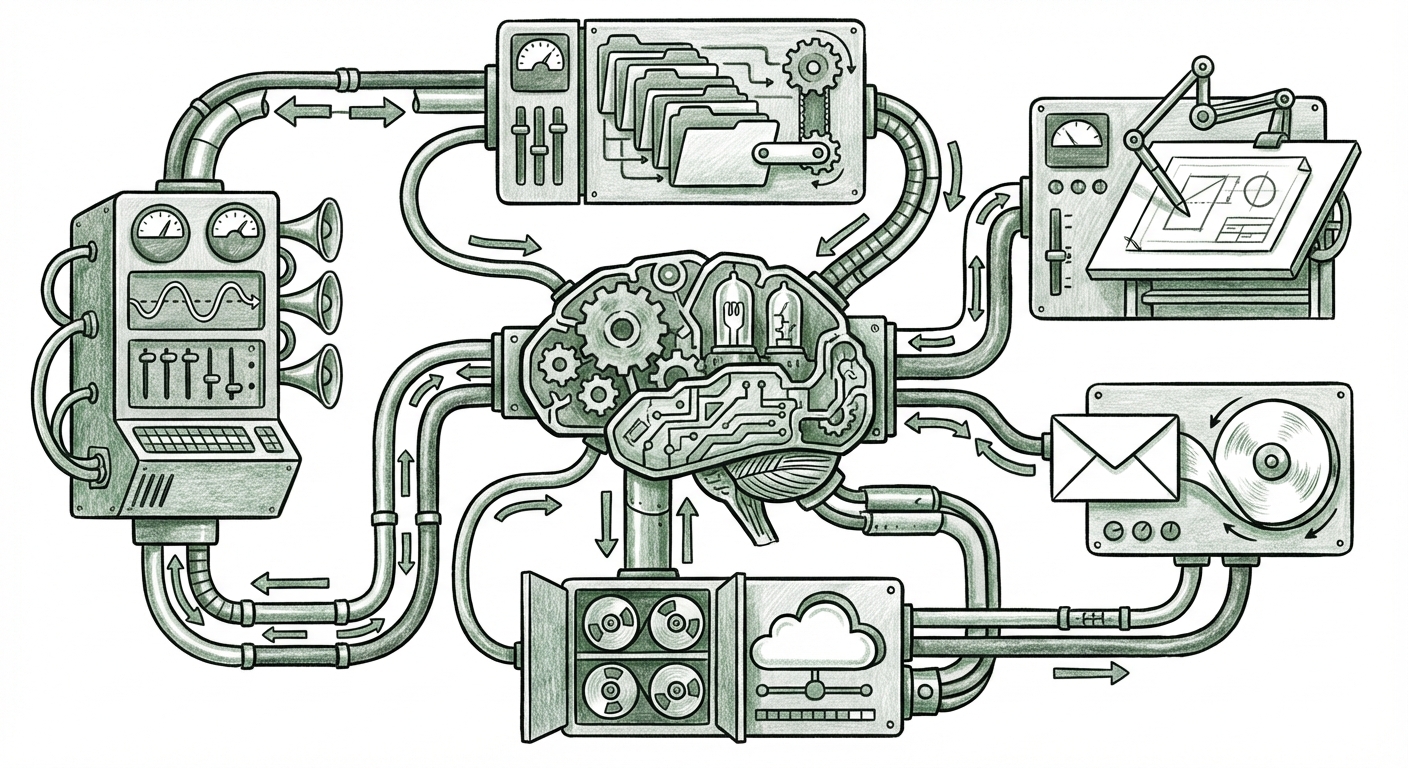
Tektonic's approach appears to be a hybrid. Agents handle the flexible, language-heavy parts of a task, reading an email, interpreting a request, pulling context. The symbolic layer handles the structure: what steps are permitted, in what order, under what conditions, and with what guardrails. The agent proposes; the logic disposes.
Why Agent-Led Process Execution Is the Real Story
The phrase "agent-led process execution" sounds like jargon, but it describes a meaningful shift. Traditional automation, robotic process automation, or RPA, follows a script. It clicks the same buttons in the same order every time. It breaks the moment a screen changes or a case is unusual.
Agent-led execution is different. An AI agent can look at a situation, decide which path fits, and act. That flexibility is exactly what businesses have wanted for years. It is also exactly what makes CIOs nervous. A flexible system with no boundaries is a liability.
Tektonic's answer is to keep the flexibility but wrap it in structure. Think of it like a highway system. The agent is the driver, free to choose lanes and speed. The symbolic layer is the road itself, the guardrails, the lane markings, the exit signs. The driver cannot invent a new road mid-journey.
Three practical benefits businesses will notice
- Auditability. Every decision the system makes can be traced to a rule. That matters for finance, healthcare, insurance, and any industry where regulators ask hard questions.
- Consistency. Two identical cases get two identical outcomes. Language models alone cannot promise this.
- Safer failure. When an agent encounters something it does not understand, the symbolic layer can stop the process and escalate to a human instead of improvising.
The Funding Signal: Investors Want Reliability, Not Just Intelligence
Tektonic's new funding round is notable less for its size, which was not disclosed, than for what it says about where investor attention is moving. For two years, capital flowed toward model builders and raw capability. The new question is different: who makes this stuff trustworthy enough to run the business?
That is a harder problem, and arguably a more durable business. Foundation models are converging. The differentiation is moving up the stack, toward orchestration, governance, and the connective tissue between AI and existing enterprise systems. Companies that solve reliability, not just intelligence, are the ones that get renewed contracts.
Tektonic is positioning itself in precisely that layer. It is not trying to build a better chatbot. It is trying to become the execution layer where AI agents actually do work inside an organization, under rules that the organization controls.
What This Means for the Future of AI
If Tektonic's bet pays off, it points toward a broader correction in how the industry thinks about AI progress. The future is unlikely to be pure neural networks or pure symbolic rules. It is likely to be a blend, sometimes called neuro-symbolic AI, where each approach does what it is best at.
Neural models are excellent at ambiguity. Symbolic systems are excellent at certainty. Business processes need both. A claims adjuster's assistant must read a messy police report (neural) and then apply the exact coverage rules from a policy (symbolic). Neither half works alone.
This also reframes the debate about AI risk. Much of the public conversation focuses on models being too capable. The more immediate enterprise problem is models being too unpredictable. Symbolic guardrails are a practical answer to that problem, and they do not require waiting for a research breakthrough.
Practical Implications for Businesses
For leaders watching this space, Tektonic's move offers a useful template. A few takeaways stand out.
1. Separate judgment from authority
Let AI agents exercise judgment within a defined scope, but keep authority, the power to approve, commit money, or take irreversible action, in a deterministic rule layer. This is a design pattern, not a product. It can be applied with almost any agent framework.
2. Inventory your rules before you automate
Symbolic systems require explicit knowledge. Many organizations discover, painfully, that their business rules live in the heads of long-tenured employees or in undocumented spreadsheets. Before deploying agents, write the rules down. That exercise alone often delivers value.
3. Demand traceability from every vendor
Ask any AI agent vendor one question: show me why the system took this action. If the answer is a confidence score with no reasoning trail, that is a gap. In regulated industries, it may be a disqualifying one.
4. Start with processes that have clear boundaries
Refund approvals, invoice matching, onboarding checks, compliance filings. These processes have defined inputs, known exceptions, and measurable outcomes. They are ideal first targets because the symbolic layer is easy to specify and the agent's value is easy to prove.
Risks and Open Questions
The hybrid approach is not a cure-all. Symbolic systems can become brittle as rules pile up, and maintaining a large rule base is its own kind of technical debt. There is also a real integration challenge: connecting modern agent frameworks to legacy rule engines is unglamorous, difficult work.
And there is a cultural hurdle. Many AI teams are staffed by machine learning specialists with little exposure to knowledge representation or logic programming. Reviving symbolic AI means reviving a skillset the industry has partly let lapse.
Tektonic's funding gives it room to solve these problems, but the market will judge it on one metric: whether customers can point to processes that run more reliably with agents than without them.
The Bigger Picture
What makes the Tektonic story worth watching is that it reframes the AI race. The question is no longer only how smart a model can be. It is how much of a business a model can safely be trusted to run.
That shift favors companies that treat AI as an engineering discipline rather than a magic trick. Rules, boundaries, and audit trails may sound boring next to the excitement of generative models. But boring is exactly what enterprises buy when the stakes are real.
If symbolic AI makes a genuine comeback, it will not be because the old approach was right all along. It will be because the new approach needed a foundation it could stand on. Tektonic is betting that foundation is logic, and that the next wave of AI will be judged not by what it can say, but by what it can reliably do.