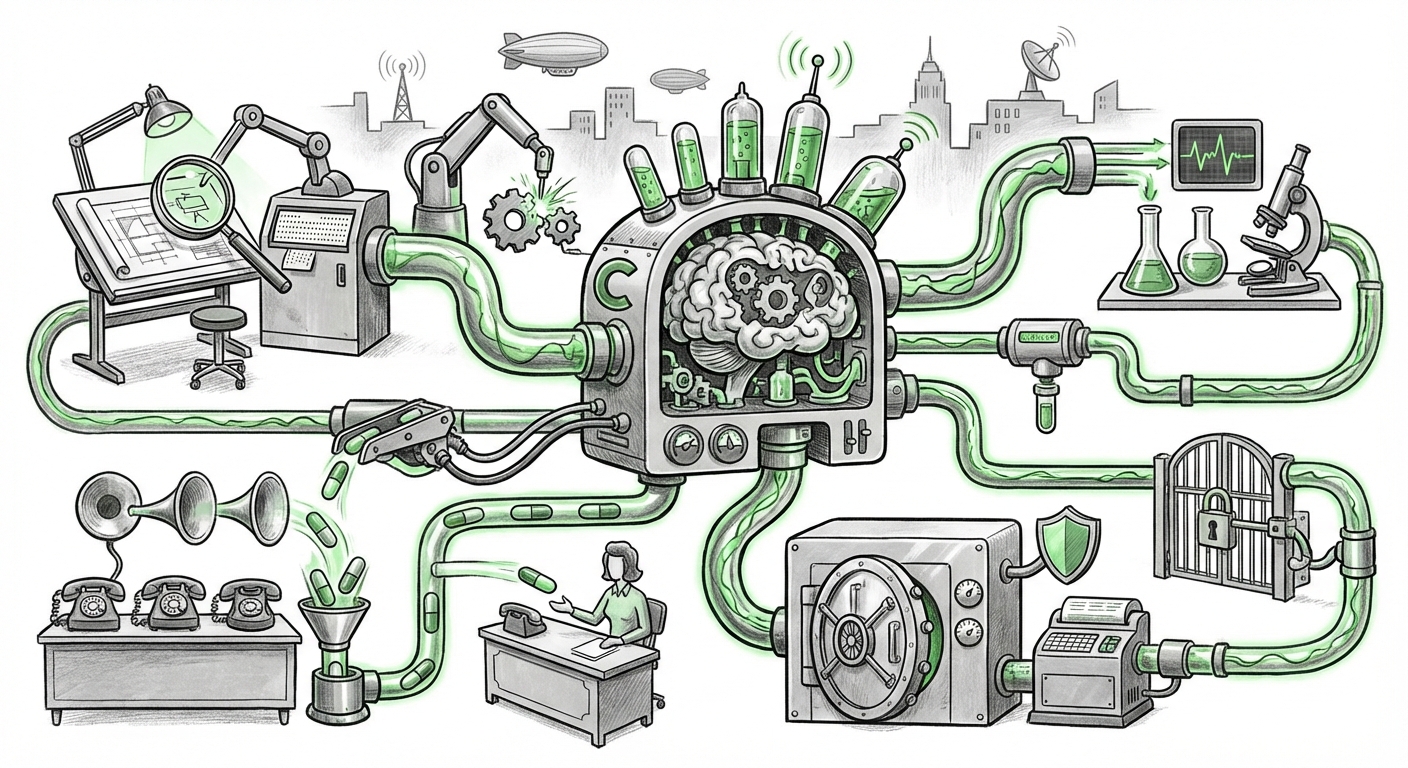
The Router Already Knows: Why AI Model Routing Is the Next Big Thing in Enterprise AI
Every time a person types a question into an AI product, something happens before the answer appears. A piece of software looks at the request and decides what to do with it. Which model should answer? Should a tool be called first? Is this a simple question that deserves a fast, cheap answer, or a hard one that needs the biggest brain available? Should a person be looped in?
That decision-maker is the router. And it is quietly becoming the most important part of any serious AI system.
The phrase worth sitting with is this: the router already knows. Long before a question is fully answered, the request itself carries the clues needed to route it well. Length, wording, ambiguity, format, risk, the user's history, the time of day, the data attached, all of it is signal. The hard part of AI is no longer just building a smarter model. It is building a smarter switchboard.
What an AI Router Actually Does
The word "router" comes from networking, where a router looks at each packet of data and forwards it toward the right destination. In AI, the job is similar in spirit but much richer in judgment.
An AI router sits between the user and a pool of possible destinations. Those destinations might include:
- A small, fast model for simple or high-volume requests
- A large reasoning model for complex, multi-step problems
- A specialized model tuned for code, images, translation, or a particular domain
- A tool or API, a calculator, a search index, a database lookup
- A cached answer from a nearly identical earlier request
- A human, when the stakes are high or confidence is low
The router's job is to pick the cheapest, fastest path that still meets the quality bar. Get it right and the system feels effortless while costs drop. Get it wrong and you get either slow, expensive overkill or fast, cheap failure.
Why Routing Suddenly Matters So Much
The AI model landscape has fragmented. There is no longer one model that wins on every task. There are tiny models that run cheaply and instantly, mid-sized models that balance quality and cost, and large frontier models that are remarkable but expensive and slow to respond.
That creates a real design tension. Send every request to the biggest model and you get great answers with a bill and a delay that few products can survive. Send every request to the smallest model and your product will confidently get things wrong in ways users notice immediately.
The answer is not to pick one model. The answer is to pick per request. That is routing. And routing is now the single biggest lever most teams have over the cost, speed, and reliability of an AI product, often a bigger lever than tweaking prompts or fine-tuning.
The Core Insight: The Signal Is Already in the Request
Here is why the router can be trusted more than people expect. You do not need to solve a problem to classify it.
A router can look at a request and immediately see things like:
- How long and how tangled the question is
- Whether it contains code, math, a table, or a document
- Whether it asks for a creative output or a precise fact
- Whether it is ambiguous enough to need clarification
- Which language it is in, and which region the user is in
- What happened in previous turns of the conversation
- How sensitive the data is, and which rules apply to it
- Who the user is, and what level of service they are entitled to
None of that requires understanding the answer. It only requires reading the request carefully. That is a much easier machine learning problem, and it is one that small, cheap models solve well.
This is where routing becomes powerful: the router can assign a difficulty score and a confidence score before any expensive compute is spent. If difficulty is low, take the fast path. If confidence is high, keep the cheap answer. If confidence is shaky, escalate.
The Cascade Pattern
The most practical version of this is a cascade. A request goes to a cheap model first. The system checks how confident the answer looks, using the model's own uncertainty signals, a verifier model, or a consistency check. If the answer passes, it ships. If it fails, the request is escalated to a stronger model.
Done well, a cascade lets the majority of traffic take the cheap path while protecting quality on the hard cases. Done badly, with a weak confidence check, it becomes an expensive way to be wrong twice.
Three Generations of Routing
1. Static Rules
The first generation is hand-written logic: if the prompt is longer than a certain length, or contains a certain keyword, send it to a particular model. Simple, transparent, and brittle. Rules written for last quarter's traffic quietly rot.
2. Learned Routers
The second generation trains a classifier to predict which model will succeed on which request, at what cost. Instead of human guesses, the router learns from logged outcomes, which answers users accepted, which got retried, which got complaints. This is where most serious teams are heading.
3. Agentic Routing
The third generation goes further. The router is no longer just picking a model; it is planning. It breaks a task into steps, decides which steps need a tool, which need a strong model, and which can be handled by something small. It re-routes mid-task when a step fails. At this point the router has effectively become the brain of the system, and the models become interchangeable workers beneath it.
What This Means for Businesses
Cost control becomes architectural, not behavioral. Most cost savings in AI come from not spending compute you did not need. Routing is how that happens automatically, rather than through a memo asking employees to use the cheap model.
Latency becomes a design choice. Users abandon slow products. A router that sends simple requests to fast models makes the whole product feel quicker without changing the interface.
Reliability improves through failover. When one provider has an outage or a bad day, the router can send traffic elsewhere. That turns a single point of failure into a manageable one.
Vendor lock-in loosens. If your product's logic lives in the router rather than in one model's quirks, you can swap the model underneath without rewriting the product. That is a strategic advantage in a market where the leader changes every few months.
Governance gets a physical home. Compliance rules have to be enforced somewhere. The router is that place. Sensitive data can be pinned to approved models. Regulated regions can be kept in-region. High-stakes requests can be forced to a human. Instead of writing policy documents, you write routing policy.
The Risks Nobody Talks About Enough
Silent drift. Model providers update their models. A route that worked last month may quietly degrade. Without per-route monitoring, you find out from angry customers.
Stale training data. A learned router trained on old traffic will confidently make the wrong call on new kinds of requests. Routers need retraining, not just deployment.
Feedback loops. If the router sends hard questions to the big model and easy ones to the small model, your evaluation data becomes skewed. You can end up "proving" the small model is fine because it only ever sees the easy cases.
Debuggability. A system with five models, three tools, and a planner is hard to reason about when something breaks. You need logs of every routing decision and why it was made.
Security surface. The router sees every request and holds the keys to every model. It is a high-value target, and it is also a place where a crafted input could try to manipulate the routing decision itself. Guardrails belong at this layer, not bolted on afterward.
Accountability. When the router picks wrong and a customer gets a bad answer, who owns that? The answer has to be defined in advance, or nobody will.
Actionable Steps for Teams Building With AI Today
- Inventory your tasks. Group real requests by type. Most systems have a long tail of easy work and a small head of hard work, the ideal shape for routing.
- Build an evaluation set per task. You cannot route what you cannot measure. Keep a labeled set of real requests with known good answers.
- Start with a cascade before you build a classifier. Cheap model first, confidence check, escalate. It is simpler than it sounds and it teaches you where the quality line actually sits.
- Log every routing decision. Record the input features, the chosen path, the confidence, the cost, the latency, and the outcome. This log is your most valuable asset.
- Monitor quality per route, not just overall. An average quality score can hide a route that is failing badly.
- Always keep a fallback. A second provider or a degraded-but-working path is non-negotiable for anything customer-facing.
- Write routing policy as policy. Treat data residency, sensitivity, and escalation rules as explicit configuration, versioned and reviewed.
- Treat the router as a product surface. It deserves an owner, a roadmap, and testing, not a corner of the codebase nobody reads.
The Bigger Picture: The Router as Control Plane
The most useful way to think about the future of AI systems is to separate two things that are often confused: the models and the control plane.
Models are becoming commodities. They improve, they get cheaper, they get replaced. The control plane, the layer that decides what happens to each request, enforces policy, manages cost, measures quality, and handles failure, is where durable advantage lives.
That layer is the router. And as small models get better and cheaper, routing gets more valuable, not less, because there will be more good options to choose between. The future of enterprise AI is not one giant model answering everything. It is a smart, well-instrumented switchboard sending each request where it belongs.
There is a second-order effect worth watching. If routing becomes the control plane, then the companies that own routing own the relationship with the user. Model providers become suppliers rather than platforms. That shift will reshape pricing, procurement, and product strategy across the industry.
It also changes what "AI strategy" means. Instead of asking "which model should we use," the better question becomes "what should our router know, and how will we know when it is wrong?" That is a humbler question, and a far more useful one.
Conclusion
The most exciting AI story right now is not a new model release. It is the quiet, unglamorous layer that decides which model gets the call. Routing sounds like plumbing, but plumbing is what makes a building usable.
The router already knows more than we give it credit for. The request carries its own clues. The outcomes carry the training signal. The policy carries the guardrails. What is missing in most organizations is not intelligence, it is attention. The teams that build a real, measured, monitored routing layer will get more quality per dollar, more speed per user, and more freedom to change their minds as the model market churns.
Everyone else will keep paying top dollar to answer easy questions.