Train YOLO26 on Your Own Photos: How YOLOE-26 Auto-Labeling Is Breaking the Biggest Bottleneck in Computer Vision
Building a computer vision model used to follow a painful rule: the smarter the model, the more humans you needed to feed it. Someone had to sit down and draw a box around every car, crack, helmet, or defective part in thousands of images before training could even begin. That step, labeling, was slow, boring, expensive, and usually the reason a promising AI project quietly died in a spreadsheet.
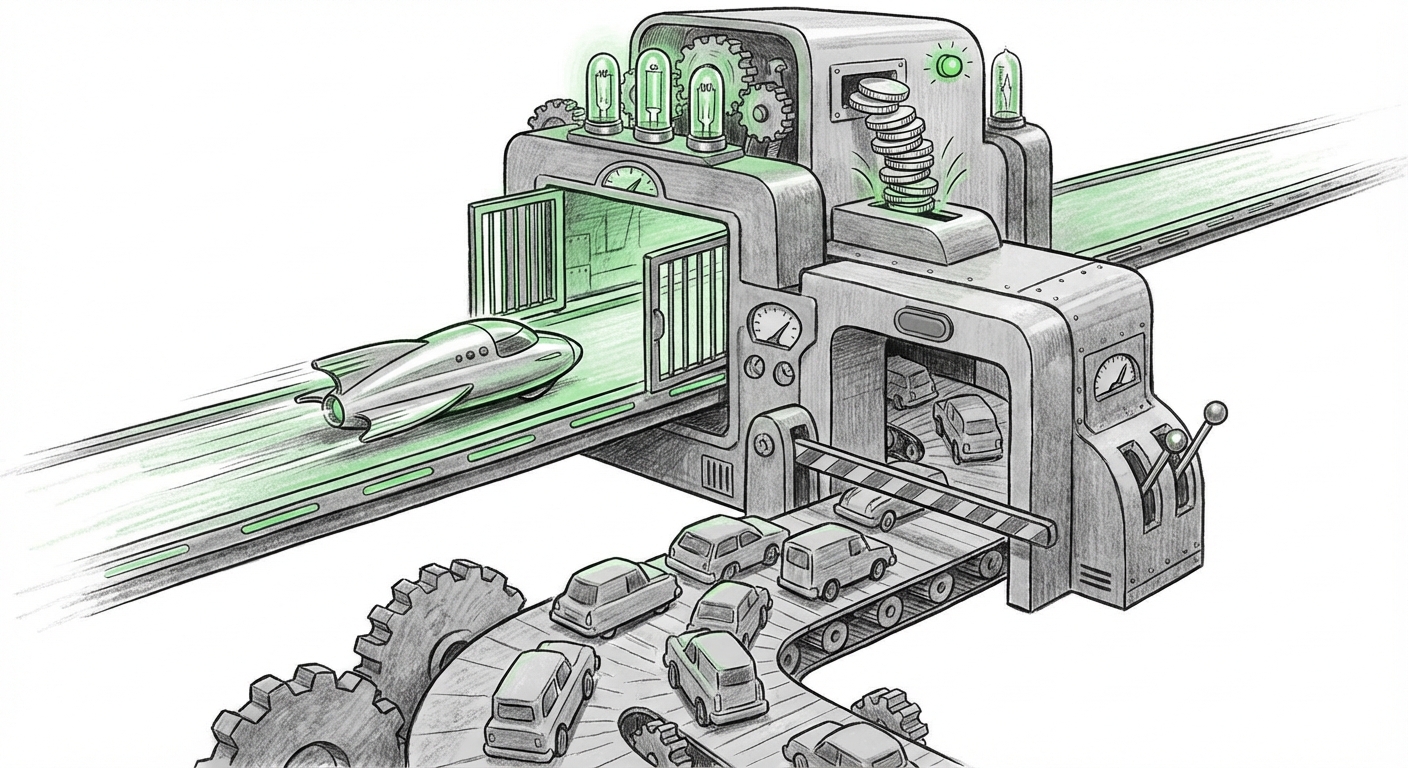
The workflow of training YOLO26 on a custom dataset with YOLOE-26 auto-labeling attacks that problem head-on. Instead of labeling every image by hand, a flexible detection model proposes the boxes first, and humans step in only to check and correct. It is a small change in process and a very large change in economics.
This is not just a nice trick for machine learning engineers. It is a signal about where applied AI is heading: away from giant, one-size-fits-all models and toward small, custom, cheap-to-build vision systems that any mid-sized business can own.
The Labeling Bottleneck, Explained Simply
Modern object detectors like the YOLO family are fast and accurate. They can spot objects in a video stream in real time on hardware that costs less than a decent laptop. The model architecture is rarely the hard part anymore.
The hard part is your data. A generic model knows what a person or a bicycle looks like because it has seen millions of examples. It has no idea what a cracked ceramic insulator looks like, or a specific brand of packaging, or a safety vest worn the wrong way. To teach it, you need pictures of those things, and each picture needs to be marked up with the right answers.
Manual labeling creates three problems at once:
- Time. Every image needs a human pass, and every correction needs a second look.
- Cost. Labeling is paid by the hour or by the box, and it scales linearly with your dataset.
- Inconsistency. Ten people labeling the same dataset will draw ten slightly different sets of boxes. Models learn those disagreements.
Auto-labeling flips the ratio. The machine does the first pass at near-zero marginal cost, and humans move from creating labels to reviewing them, a much faster and cheaper job.
What YOLO26 and YOLOE-26 Bring to the Table
The pairing in this workflow is deliberate. YOLO26 is the model you actually ship, the detector you train on your own classes and run in production. YOLOE-26 is the helper that does the labeling, built around flexible, prompt-driven detection so it can find objects it was not explicitly trained on.
That distinction matters. A classic detector can only label classes it already knows. If you are building a model to detect a niche industrial defect, the detector has nothing useful to say about those images. A prompt-driven model can be pointed at a concept in plain language and asked to find instances of it, which turns it into a rough first-pass annotator for almost anything.
Here is the practical loop that results:
Step 1: Collect a small, honest seed set
Gather a few hundred images that reflect real conditions, the actual lighting, camera angles, and clutter your system will see. Quality beats quantity here. A tidy dataset of 200 realistic images will outperform 2,000 staged ones.
Step 2: Auto-label with YOLOE-26
Run the prompt-driven model over the images and let it propose bounding boxes for the classes you care about. This gives you a draft dataset in minutes rather than weeks.
Step 3: Human review and correction
This is the step that protects quality. A person scans the draft, deletes bad boxes, fixes loose ones, and adds anything the model missed. Because reviewing is faster than drawing, throughput goes up sharply, but the human is never removed from the loop.
Step 4: Train YOLO26 on the corrected set
Now train the production detector on the reviewed labels. YOLO26 becomes your specialist: small, fast, and tuned to your exact classes.
Step 5: Bootstrap
Use the newly trained YOLO26 to pre-label the next batch of images, review, retrain. Each round the labels get cleaner and the dataset grows. This self-improving loop is the real prize. The model becomes its own annotation assistant.
Why This Matters for the Future of AI
Three shifts follow from this workflow, and each one has consequences well beyond computer vision.
1. Custom AI stops being a luxury
When the dominant cost of a vision project is human labeling, only companies with budgets can play. When labeling becomes a review task handled by one person with a laptop, the entry price collapses. Expect a wave of small, specific models: a detector for a single production line, a detector for one crop, a detector for one retail shelf. Not trillion-parameter generalists, narrow specialists that solve a real problem for a few thousand dollars.
2. The model and the labeler become one system
Historically, data work and model work were separate jobs done by separate teams. Auto-labeling merges them into one continuous loop where the trained model feeds the next round of training data. This is the same pattern showing up across AI: the model is no longer a finished product, it is a component in a cycle that improves itself. Whoever builds the tightest loop wins.
3. Small models on cheap hardware become the default
The YOLO family's whole identity is efficiency, running on edge devices, cameras, drones, and industrial controllers rather than in a data center. Custom-trained small models mean intelligence moves to where the data is created. A camera that flags a safety violation on the spot, with no video ever leaving the building, is a very different product from one that uploads everything to the cloud.
What This Means for Businesses
For business leaders, the takeaway is not "learn to train YOLO26." It is that the economics of custom vision have moved in your favor, and the excuse for not testing a use case is getting thinner.
- Start with a narrow question. "Can we detect when a pallet is stacked incorrectly?" is a good project. "Can we use AI in the warehouse?" is not.
- Budget for review, not for labeling. The cost you should plan for is the human time spent checking machine output, plus the tooling to make that review fast.
- Treat the first model as a labeling tool. Even a mediocre v1 is valuable if it cuts the labeling burden for v2.
- Plan for data drift. Lighting changes, new products, new camera positions. The loop must keep running, or the model quietly rots.
The Honest Caveats
Auto-labeling is powerful, but it is not magic, and teams that treat it as a fully automatic pipeline get burned.
The core risk is confirmation bias in data form. If the auto-labeler systematically misses small objects, or draws boxes 10% too loose, and the human reviewer rubber-stamps the output, your production model inherits those exact flaws. You have automated your mistakes.
There is also the domain gap problem. A prompt-driven model's knowledge of a concept may not match your operational definition. "Crack" in a factory means something very specific; the labeling model's idea of "crack" may be broader or narrower. That mismatch shows up as noise in your training data.
The fix is discipline rather than technology: spot-check a random sample by hand, measure reviewer agreement the way you would measure any quality process, and keep a small, fully human-labeled gold set to test against. Auto-labeling speeds up the loop and does not remove the need for standards.
Actionable Next Steps
- Pick one visual decision your team makes repeatedly and manually today.
- Collect 200–300 real images of it, captured the way a deployed camera would capture them.
- Auto-label with a prompt-driven model, then have one domain expert review everything.
- Train YOLO26 on the reviewed set and test it on images it has never seen.
- Compare the result to whatever process you use now, human, rules-based, or nothing.
- If it wins, scale the loop. If it loses, you have spent days, not a quarter.
That is the real change here. Not a better model, but a shorter distance between "we have a question" and "we have a working system."
The Bottom Line
Training YOLO26 on a custom dataset with YOLOE-26 auto-labeling looks like a technical tutorial. It is really a preview of how applied AI will be built for the next several years: small models, tight feedback loops, human judgment focused on review rather than creation, and intelligence pushed out to the edge where the work actually happens.
The organizations that win will not be the ones with the biggest model. They will be the ones that can turn a messy operational question into a working detector in a week, and then keep the loop turning.