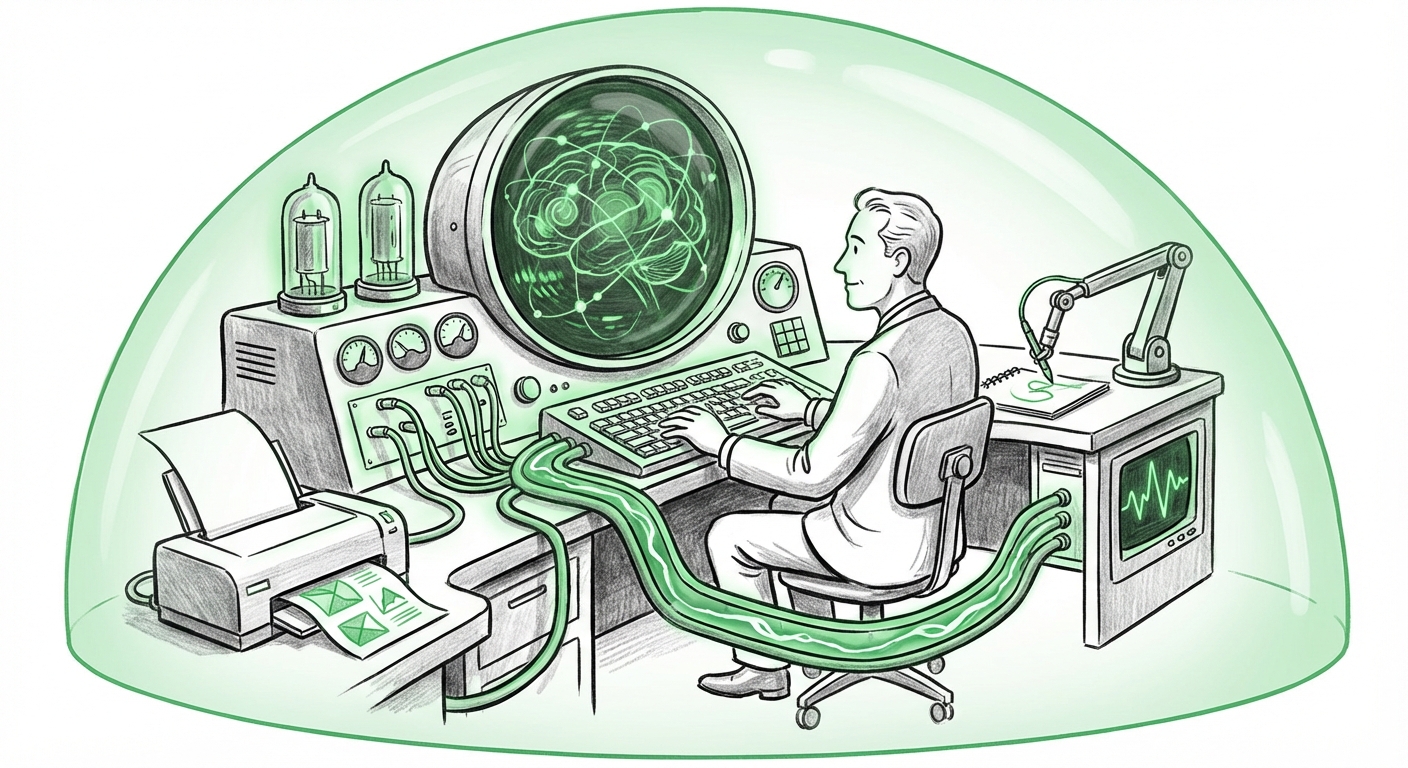
The "Vacation Test" for AI: Why Real-World Trials Beat Demos Before You Deploy
Anyone who has dated someone for a month and then booked a week-long trip together knows the feeling. The coffee dates were great. The texts were fun. And then you spend seven straight days with the same person in a new place, with delayed flights, a bad hotel room, and no easy way to go home, and you learn things no dinner conversation would ever reveal. A month of casual dating is a demo. A vacation is a production deployment.
That gap between the polished demo and the messy reality is exactly where most AI projects are living right now. Companies are spending serious money on tools that look brilliant in a fifteen-minute walkthrough, then quietly stall once they hit real customers, real edge cases, and real consequences.
The fix is not a better demo. It is a better test, an immersive, slightly uncomfortable, real-world trial that shows you who your AI really is before you sign the long-term lease.
Why Demos Are Designed to Look Good
A demo is a controlled environment. The vendor picks the questions. The data is clean. The stakes are zero. Nobody gets hurt if the chatbot gives a wrong answer about return policies in front of twelve people in a conference room.
Real life does not cooperate. Real customers type in typos, mix languages, ask for things that are slightly outside policy, get angry, paste in sensitive information, and test boundaries on purpose. Real data is missing fields. Real systems go down at 2 a.m.
In a relationship analogy, the demo is the person who is charming at a restaurant they chose. The vacation test is the person who is still kind when the rental car is cancelled and it is raining and everyone is hungry. Both versions may be genuine. Only one is useful for deciding whether to build a life together.
Translating the Vacation Test to AI
A vacation test for AI means giving the system a real job, real users, and real consequences for a defined stretch of time, with a plan for what happens if things go sideways. It has five parts.
1. A real task, not a sample task
Do not pilot the AI on cherry-picked examples. Hand it the actual queue. Let it handle the messiest 20 percent of tickets, the weirdest customer emails, the forms that always break. If it can survive the ugly part of the workflow, the clean part is easy.
2. A real audience, ideally one that does not go easy on you
Internal pilots are comfortable. They are also misleading, because employees are forgiving and will quietly fix the system's mistakes without telling anyone. The vacation test needs external users, or at least a group that does not know they are part of a test, so that you see the failures your team would have papered over.
3. Friction built in on purpose
Good trials add pressure. Time limits. Conflicting instructions. Data that arrives late. A sudden spike in volume. Anyone can behave on a calm Tuesday. The interesting information shows up when the system is stressed and the easy path is gone.
4. An exit ramp
In the original analogy, booking a refundable ticket matters. For AI, that means keeping a human in the loop, capping what the system can do without sign-off, and having a kill switch that works. A trial with no escape hatch is not a test, it is a commitment dressed up as one.
5. A debrief that is honest
The most valuable output of a trial is not a pass/fail grade. It is a list of specific behaviors: where the system was helpful, where it was confidently wrong, where it was slow, where it annoyed people, where it surprised you in a good way. That list is worth more than any benchmark.
The Agentic Shift Makes This Urgent
The reason the vacation test matters more now than it did a couple of years ago is that AI systems are moving from answering to acting. A chatbot that writes a draft email is low-stakes. An AI agent that books the flight, updates the record, issues the refund, or emails the client on your behalf is a different category of risk entirely.
When software only talks, a mistake costs a few minutes of editing. When software acts, a mistake costs money, trust, and sometimes compliance. The more autonomy you hand over, the more the vacation test stops being a nice-to-have and becomes the entire point.
This is also why the industry conversation is shifting away from "how smart is the model?" toward "how does it behave over time, in context, under pressure?" Capability benchmarks measure the restaurant conversation. Behavioral evaluation measures the vacation.
A Practical Playbook for Businesses
If you are about to move an AI tool from pilot to production, here is a workable structure.
- Pick one workflow, not five. Narrow scope produces clear signal. Broad scope produces anecdotes.
- Define what "good" looks like before you start. Write down the three or four outcomes that must be true for the trial to count as a success. Otherwise you will rationalize whatever happens.
- Set a timebox. A few weeks of real use beats six months of internal debate. Long enough to hit unusual cases, short enough to keep attention.
- Instrument everything. Log the prompts, the outputs, the human corrections, and the escalations. The corrections are the gold, they show exactly where the system's judgment diverges from yours.
- Interview the people who used it. Ask what they stopped trusting it for. That answer is usually more useful than any satisfaction score.
- Decide in advance what would make you walk away. If nothing would, you are not testing, you are justifying.
The Human Side Is the Hard Part
Trials fail for organizational reasons more often than technical ones. People resist tools that seem to threaten their role. Managers quietly route work around systems they do not understand. Teams game the metrics because the metrics are being watched.
The vacation test surfaces all of this early, which is a feature. If your customer service team hates the assistant in week one, you want to know that in week one, not after you have rebuilt your workflows around it. Treat resistance as data. Ask what would make the tool genuinely useful to the person using it, and be prepared for the answer to be "less automation, more help."
Transparency helps too. Users forgive a lot when they know they are in a trial and their feedback is being read. They forgive very little when automation is slipped in quietly and mistakes are discovered later.
What This Means for the Future of AI
As AI moves deeper into operations, the winners will not be the companies with the flashiest pilots. They will be the ones with the discipline to test in reality before they trust at scale.
Three shifts follow from that.
First, evaluation becomes a product category. The ability to simulate messy, high-pressure, real-world conditions, and to measure behavior rather than just accuracy, is becoming as important as the model itself. Companies that can prove their systems behave well under stress will have an easier time selling them.
Second, procurement gets more demanding. Buyers are learning to ask for timeboxed trials with defined exit criteria instead of signing annual contracts off the back of a demo. Vendors who welcome that scrutiny will separate themselves from vendors who avoid it.
Third, the trust gap becomes the real bottleneck. The technology is advancing faster than most organizations can absorb it. The limiting factor is not capability, it is confidence. And confidence is built the same way it is in a relationship: through shared experience, including a few bad days.
The Takeaway
A month of dating tells you whether you enjoy someone's company. A vacation tells you whether you can build a life with them. Demos tell you whether an AI system can impress a room. Trials tell you whether it can hold up on a bad Tuesday in front of a frustrated customer.
If you are evaluating AI right now, resist the urge to fall for the charming restaurant version. Book the trip. Make it refundable. Watch what happens when the flight is delayed. The things you learn will be uncomfortable, specific, and worth far more than any slide deck.