Mixture of Experts in Transformers: How Sparse AI Models Are Rewriting the Rules of Scale
For years, the story of artificial intelligence followed a simple script: bigger models, trained on more data, with more computing power, produced better results. That formula worked spectacularly, until it started hitting a wall made of electricity bills, chip shortages, and cooling systems. The transformer architecture that powers modern AI had become a victim of its own success. Every single question asked of the model forced the entire network to wake up and compute, even if most of it had nothing useful to contribute.
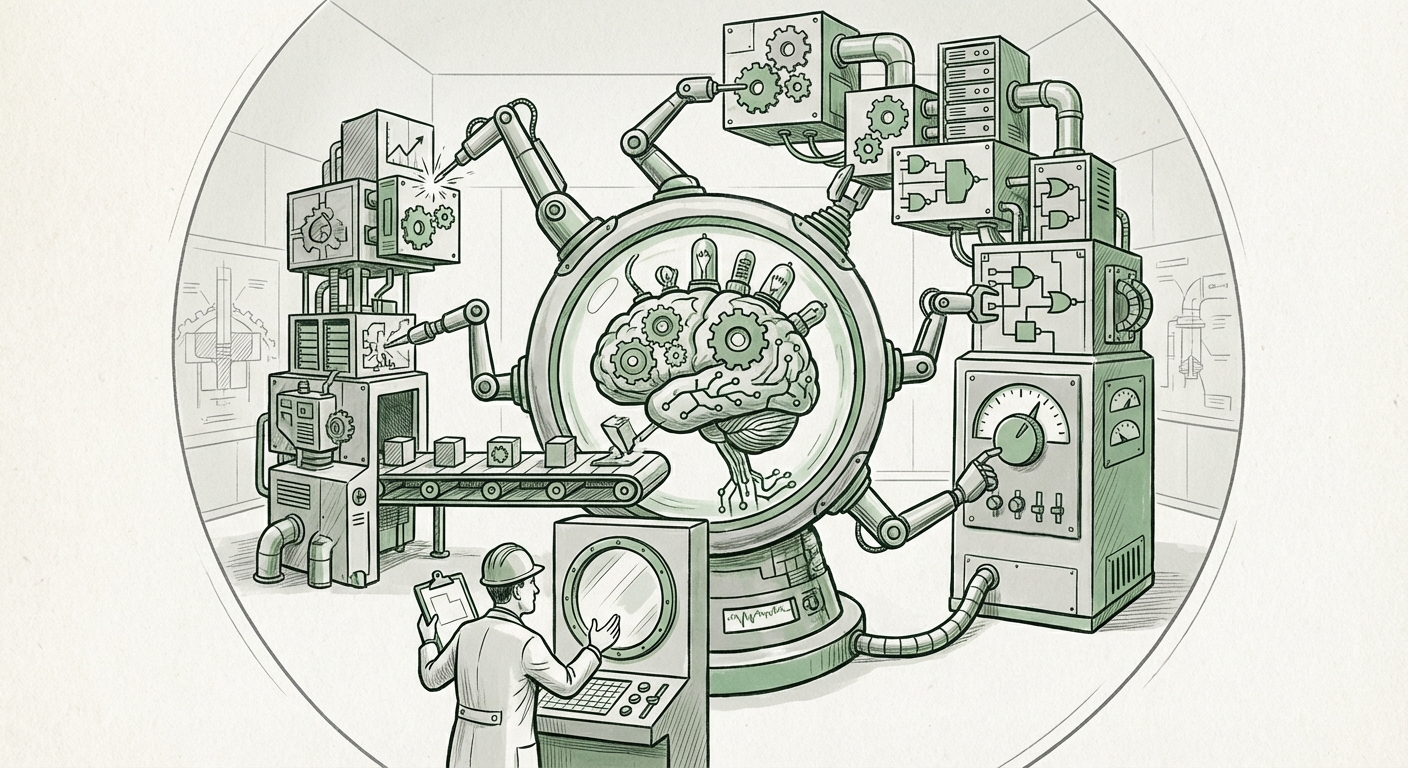
Enter the Mixture of Experts, or MoE. It is one of the most important architectural shifts in the transformer world, and it quietly changes the economics of artificial intelligence. Instead of one giant, uniformly active brain, an MoE model is a collection of specialized sub-networks, the "experts", paired with a smart dispatcher that decides who handles what. The result is a model that can hold an enormous amount of knowledge while only doing a fraction of the work for any given task.
This is not a minor tweak. It is a fundamental rethink of what it means to build a large AI system, and it has deep consequences for the future of the technology and how businesses will use it.
The Core Idea: Stop Waking Up the Whole Brain
To understand why MoE matters, start with how a standard transformer works. A conventional, "dense", model passes every input through every layer and every parameter. If the model has a billion parameters, all billion of them participate in every prediction. That is simple and predictable, but it is also wasteful. Human brains do not work that way; we route a math problem to different mental machinery than we route a joke. MoE borrows that idea.
In a Mixture of Experts layer, the standard feed-forward block inside a transformer is replaced by several parallel feed-forward blocks, the experts. Alongside them sits a small router, sometimes called a gating network. When a token (a chunk of text, roughly a word piece) arrives, the router looks at it and produces a score for each expert, essentially answering the question: "Who here is best suited for this?"
Then comes the key move. Only the top-scoring expert, or the top few, actually run. The rest stay idle. The outputs of the chosen experts are blended together, weighted by the router's confidence scores, and passed along to the next layer.
So a model might contain many billions of parameters in total, but a single token only ever touches a small slice of them. This is what people mean by sparse activation. The model is huge in storage but cheap in compute.
The Router Is the Whole Ballgame
Everything depends on that little gating network, and getting it right is genuinely hard. Two problems show up immediately.
The first is load balancing. If the router is left to its own devices, it tends to play favorites. A handful of experts get picked constantly, while the rest sit unused. That is a disaster: the model wastes capacity, and the overworked experts become a bottleneck during training. Engineers fix this with an auxiliary balancing loss, a penalty that nudges the router toward spreading tokens across experts more evenly.
The second is capacity and overflow. Each expert can only handle so many tokens at once in a batch. When more tokens are routed to an expert than it can take, the extras have to be dropped or pushed onward without expert processing. Set the limits too tight and you lose information; set them too loose and you waste memory and time. Tuning this balance is one of the unglamorous crafts of building MoE systems.
There is also the risk of what practitioners call router collapse, where the gating network becomes so confident in a few experts that the others never get a chance to learn. Once that happens, the model has effectively shrunk itself back into a dense network while paying the memory cost of a sparse one.
Why This Changes the Economics of AI
The central trade-off in modern AI has been between capability and cost. Want a smarter model? Pay for it in compute, every single time it answers. MoE breaks that link, at least partially. Parameter count, the rough proxy for how much the model can know, and compute per token, the cost of actually using it, get pulled apart.
This matters in three concrete ways.
- Training efficiency: Because each token only activates a subset of the network, a sparse model can be trained with far fewer floating-point operations per token than a dense model of comparable total size. More knowledge can be absorbed per unit of compute.
- Inference speed: At serving time, the number of active parameters drives latency. A sparse model can respond quickly even when its total size is enormous, because most of it is asleep.
- Scaling headroom: When compute is the binding constraint, sparsity is a way to keep growing capability without growing cost at the same rate. It buys time and headroom on the scaling curve.
There is a catch, and it is a big one: memory. All those experts must be stored somewhere. A sparse model can be cheap to run but expensive to host, because the full parameter set has to live in memory even if most of it is idle. That is why MoE is not a magic wand for consumer devices. It shines in data centers where memory can be pooled across many chips, with different experts physically placed on different accelerators and tokens routed between them.
That routing-over-the-network step introduces a new engineering challenge: communication. Sending tokens back and forth between chips costs time, and in some setups the chatter becomes the bottleneck rather than the math. Balancing compute, memory, and network traffic is the new art of building large models.
What This Means for the Future of AI
The shift toward sparse architectures tells us several things about where AI is heading.
1. Scale Will Be Measured Differently
Comparing models by parameter count alone will become increasingly misleading. A sparse model with a huge total parameter count but a small active footprint is not comparable to a dense model of the same total size, it is closer, in behavior and cost, to a much smaller dense model that has been given a bigger library to draw from. Buyers and builders will need to ask two questions instead of one: how much does it know, and how much does it switch on?
2. Specialization Becomes Built In
Because experts are separate blocks that learn to handle different patterns, MoE systems naturally develop internal specialization. In practice, experts tend to organize around patterns in the data rather than neat human categories like "code" or "poetry", routing is often driven by syntax and token-level features more than topic. But the principle holds: rather than one undifferentiated network, the model becomes a team of narrower specialists coordinated by a dispatcher.
That design pattern is likely to spread beyond language. Anywhere a transformer is used, vision, audio, scientific modeling, sparsity offers a way to grow capacity without growing per-item cost.
3. Efficiency Becomes the Frontier
The era of "just add more compute" is being replaced by an era of "get more out of each unit of compute." MoE is part of a broader movement in that direction, alongside quantization, distillation, better hardware utilization, and smarter data curation. The competitive advantage in AI is shifting from who can afford the biggest training run to who can engineer the most efficient one.
4. Serving Becomes a Systems Problem
For a dense model, serving is relatively straightforward: replicate the model, add capacity, done. For a sparse model, every request becomes a small logistics exercise, which experts does this batch need, are they co-located, and how do we batch requests so that routing is efficient? This raises the bar for infrastructure teams and favors organizations with strong systems engineering.
Practical Implications for Businesses
If you are choosing AI systems rather than building them, here is what actually changes.
Cost per query is no longer a simple function of model size. A large sparse model can be cheaper to serve than an equally capable dense one, but hosting costs depend heavily on memory and batching. Ask vendors about active versus total parameters, and about how they batch requests.
Fine-tuning gets more interesting, and more delicate. Because experts can be updated selectively, MoE architectures open the door to adapting only the experts relevant to a domain, which could one day make customized models cheaper. But that same modularity makes fine-tuning trickier: a badly targeted update can unbalance the router and degrade the whole model.
Latency profiles are less predictable. With routing in play, performance can vary more across different inputs. Batch composition matters. Anyone building real-time products should test under realistic traffic rather than assuming a uniform speed.
Evaluation must get more rigorous. A model can be excellent in aggregate while still having blind spots in underused experts. Teams should test on the specific edge cases that matter to their business, not just headline benchmarks.
What It Means for Society
Sparse models push capability into a regime that is cheaper to run but harder to host. On one hand, that is democratizing: lower serving costs translate into more affordable AI products and more experimentation by smaller companies. On the other hand, the memory and network requirements concentrate serious MoE deployment in large data centers, reinforcing the advantage of well-resourced operators.
There is also an interpretability angle worth watching. Routing decisions create a form of internal audit trail, a record of which experts handled which tokens. That is not full explainability, but it is a new kind of handle on model behavior that researchers can study, and it may eventually help with debugging, safety testing, and understanding why a model fails on certain inputs.
Actionable Takeaways
- Track active parameters, not just total parameters. When evaluating a model, ask what fraction of the network fires per token, it determines both cost and speed.
- Benchmark on your own traffic. Routing behavior varies with input. Test latency and quality on realistic batches, not cherry-picked prompts.
- Budget for memory, not just compute. If you self-host, sparse models change your hardware profile significantly.
- Invest in evaluation discipline. Sparse systems can hide weak spots in rarely used experts. Build targeted test sets.
- Watch the routing layer. For anyone building or fine-tuning, load balancing and expert utilization metrics are the health chart of the model.
The Bottom Line
The move to Mixture of Experts is not a small optimization. It is a structural change in how transformers scale, and it reframes the central question of AI engineering from "how big can we build it?" to "how much can we switch on?" That shift lowers the cost of capability, complicates the art of deployment, and opens a path forward when raw compute is scarce.
For the future of AI, the message is clear: the next wave of progress will not come only from bigger models, but from smarter ones, systems that know which parts of themselves to use, and leave the rest resting quietly. Understanding that idea is now essential for anyone making decisions about AI, whether they write the code or sign the invoice.