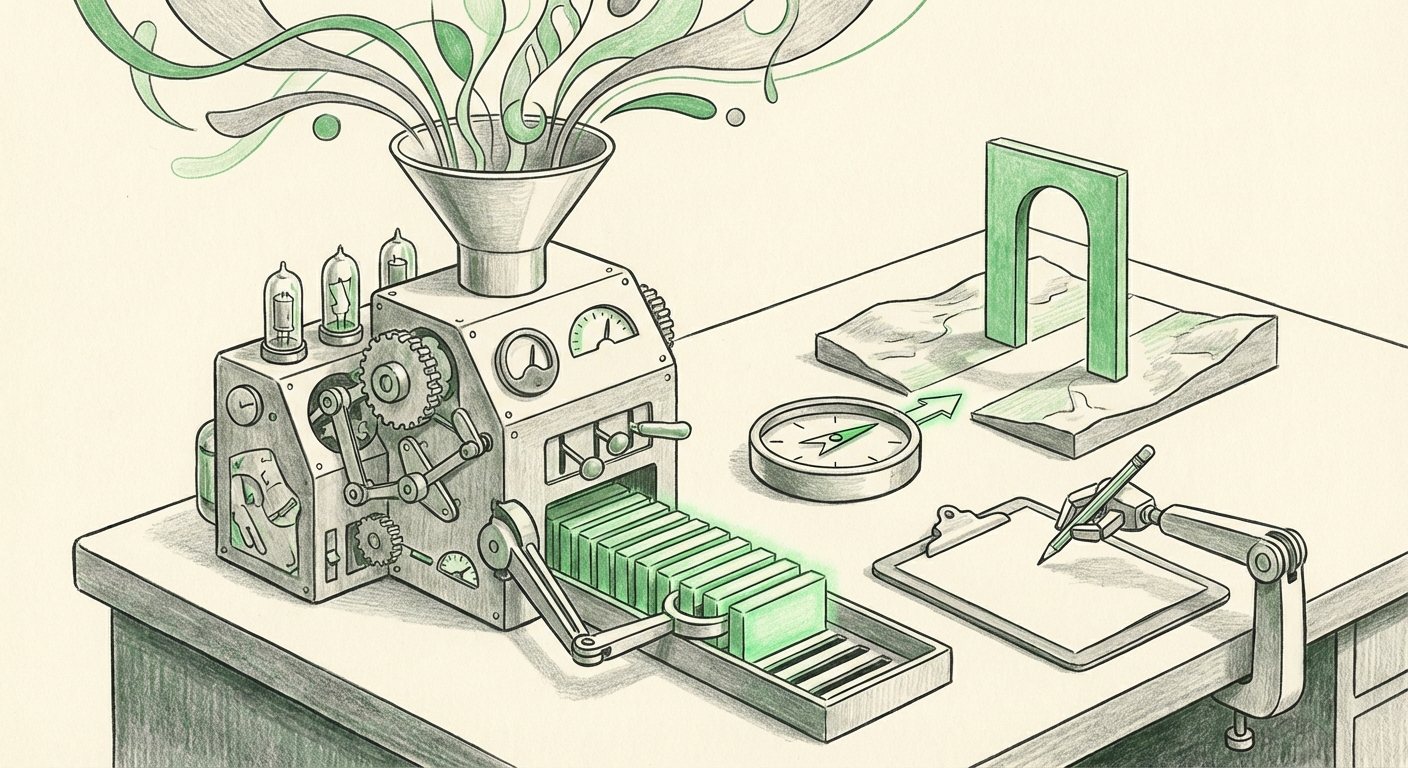
Open-Weight LLMs Are Having Their Spring: What 10 New Architectures From Early 2026 Mean for AI
For a few years now, the story of large language models has felt a bit like a long winter for anyone who wanted to build on top of open tools. The biggest, smartest models lived behind company walls. You could rent them by the token, but you could not download them, study them, run them on your own machines, or reshape them for your own problem. Then January and February 2026 arrived, and something shifted. In just two months, ten distinct open-weight architectures came out, a burst of releases that reads less like a slow thaw and more like a sudden, unmistakable spring.
The phrase people keep reaching for is "a dream of spring." It is an odd image for a technical field, but it fits. For years, open-weight models were the scrappy understudies, always a step behind, always a release cycle late. This year's early crop tells a different story. These are not stripped-down copies of last season's frontier models. They are genuinely different designs, each one making a bet about how to get more intelligence out of the same amount of computing power. And that bet, efficiency over brute force, is the single most important thing happening in AI right now.
Ten Designs, One Big Idea
Look across the ten architectures released in January and February 2026 and a pattern jumps out fast. Almost none of them try to win by being enormous. Instead, they win by being clever about what they turn on.
The dominant design choice is what engineers call sparsity. In a traditional dense model, every parameter, every tiny mathematical dial, fires for every single word the model generates. That is like waking up an entire factory floor to answer one phone call. Sparse designs, most notably mixture-of-experts layouts, keep most of the factory asleep and route each request to only the small slice of specialists best suited to handle it. The model has a huge amount of total knowledge on hand, but only a small amount of it runs at any moment.
What changed in early 2026 is that these routing systems got far better at their job. Earlier sparse models were efficient but erratic, they sometimes sent a simple question to the specialist built for quantum physics. The newer designs balance their workloads more gracefully, which means you get the knowledge of a very large model at the speed and cost of a much smaller one.
The other shared themes
- Attention that scales with context. Long documents used to be brutal for these models to read, because the cost of tracking relationships between words grew quadratically. The new architectures attack that math directly, making very long inputs practical rather than theoretical.
- Small, sharp dense models. Not every winner in the batch is sparse. Several are compact, fully dense models tuned relentlessly through better data curation and training methods. They trade total knowledge for speed and predictability, and for a lot of jobs, that is the right trade.
- Reasoning baked into training. The "think longer before answering" trend has moved from something you prompt for to something the architecture and training pipeline expect. Several of the ten are built to spend extra computation on hard problems and almost none on easy ones.
- Friendlier licensing. Open weight only matters if you can legally use the weights. The terms around this early-2026 wave are noticeably more permissive than what came before, which removes a quiet but serious barrier for businesses.
- Quantization-ready by design. Rather than being an afterthought, these models were built with the expectation that they would be compressed and run on smaller and cheaper hardware.
Why This Matters More Than Any Single Release
No one of these ten architectures is going to change the world on its own. The cumulative effect might. Here is the logic.
Every time a model gets meaningfully cheaper to run, a whole category of use cases that did not make financial sense suddenly does. When you had to send every request to a paid API, an app that quietly summarizes every email, files every support ticket, or watches every security log was a luxury. When a capable open-weight model can run on hardware you already own or rent cheaply, those same apps become ordinary infrastructure.
The metaphor that fits best is the arrival of cheap electricity. Nobody remembers which generator won. Everybody remembers what became possible once power stopped being the bottleneck. Open-weight models are doing the same thing to intelligence: they are turning it from a metered service into a utility you can pipe wherever you need it.
There is a second, quieter effect too. Open weights mean inspection. A bank, a hospital, or a government agency cannot fully audit a model it can only call over the internet. It can audit one it downloads. That matters enormously for regulated industries, and it is a large part of why this early-year wave is being taken seriously in boardrooms, not just in research labs.
What It Means for Businesses
If you run a company, the practical question is not "which of the ten is best?" It is "what does this change about how I build?" A few answers stand out.
Your data can stay home
When a model runs on your own infrastructure, sensitive information never leaves. Customer records, legal documents, medical notes, and internal strategy can be processed without a round trip to a third party. For many organizations, that single fact is worth more than any benchmark score.
Costs become predictable
Per-token pricing is easy to start with and hard to forecast. A fixed-cost model running on hardware you control behaves like a normal IT expense. Finance teams tend to prefer that, and it makes long-term product planning far simpler.
Fine-tuning turns into a real advantage
Because the weights are yours to modify, you can teach a model your specific vocabulary, your formats, your edge cases. That produces something competitors who only rent a general-purpose API cannot easily copy. The model becomes an asset on the balance sheet rather than a subscription line.
You can mix and match
Nothing forces you to pick one. A common pattern now is to use a large hosted model for the rare, genuinely hard problem and a small open-weight model for the high-volume, well-understood work. The ten-architecture wave gives teams far more pieces to assemble into that kind of system.
The Actionable Playbook
Here is what smart teams should be doing right now, while the field is still moving fast.
- Benchmark on your own work. Public leaderboards measure generic ability. Build a small test set of fifty real tasks from your business and score candidate models against it. You will often find that a smaller open model wins on your specific problem.
- Start with the cheapest model that clears the bar. Escalate only when quality actually suffers. Most high-volume work does not need the most capable model available.
- Plan for a mixed stack. Assume you will use two or three models for different jobs. Design your software so swapping one out is a config change, not a rewrite.
- Read the licence before you read the benchmark. Permissive terms are more common now, but they are not universal. Check commercial use, redistribution, and any usage restrictions before you build a product on top.
- Invest in evaluation and guardrails first. When you own the model, you also own the mistakes. A solid testing harness is worth more than a marginal point of accuracy.
- Watch the hardware bill, not just the model. Open weights shift spending from tokens to compute and engineering time. Budget for both.
The Risks Worth Naming
Spring does not mean no storms. Three concerns deserve honest attention.
First, open weights cut both ways. The same freedom that lets a hospital audit a model lets anyone strip out its safety training. The policy conversation about how to handle that is nowhere near settled, and it will get louder as these models get stronger.
Second, more models means more maintenance. Every model you run is something to patch, monitor, and eventually replace. Teams that adopt five open models without a plan for managing them often end up with five new problems.
Third, open does not mean safe by default. A model you downloaded has no one to blame but you when it produces a bad answer in front of a customer. The accountability moves in-house along with the weights, and that is a real organizational change, not a technical footnote.
What Happens Next
The most likely outcome of this early-2026 surge is not that open models replace closed ones. It is that the gap between them stops being the main story. When a capable model is available to anyone for the price of some servers, the differentiator stops being access to intelligence and starts being what you do with it, the data you feed it, the workflows you build around it, and the trust you earn from the people who use it.
That is a healthier competitive landscape. It rewards product thinking over procurement relationships. It lets a small team in a small city build something that competes with a large team in a large one. And it pushes the frontier labs to compete on genuine capability rather than on scarcity.
Ten architectures in two months is a lot to absorb. But the headline is simpler than the list. The tools got good enough, cheap enough, and open enough that the question is no longer whether you can build with AI. It is what you are going to build. That is what a spring looks like.