Right on Q: How Self-Generated Reasoning Trajectories Can Rescue Quantized AI Models
AI teams are under pressure to make models cheaper, faster, and smaller. Quantization is one of the most popular ways to do that. It compresses a model by using lower-precision numbers for its internal weights. The result can be a model that takes less memory and runs on more devices. But there is a catch: compressed models can lose some of their step-by-step thinking ability. A promising research direction focuses on fixing that gap by using self-generated reasoning trajectories. The idea is to let the compressed model practice reasoning, then use its best attempts to recover lost skills.
This matters far beyond a lab experiment. If smaller models can keep their reasoning power, AI can move into more phones, laptops, factories, clinics, and back-office tools. That could lower costs, improve privacy, and widen access. But it also raises new questions about trust, testing, and quality control. The future of AI will not be built only on bigger models. It will also be built on smarter ways to make small models think well.
The Hidden Cost of Smaller Models
Quantization is a simple idea with a big payoff. Think of it like saving a high-resolution photo as a smaller file. The picture still looks fine at a glance, but fine details can blur. For an AI model, those fine details include chains of logic, math, planning, and code. A compressed model may still answer simple questions well. But when a task needs many steps, small errors can add up.
Reasoning is not one skill. It is a stack of small steps. A model must keep track of assumptions, follow rules, and avoid contradicting itself. It must remember what it already tried. It must check its work. Compression can add noise at each step. A small mistake early on can grow into a wrong answer later. That is why a model that looks good on a short quiz can fail on a real-world task that needs careful thought.
This is not a small problem for business. A compressed model might be cheap enough to run on a laptop, but if it cannot handle multi-step customer support, financial analysis, or code review, the savings may not matter. Teams need models that are both lean and reliable. The gap between “small enough” and “smart enough” is where this new work fits.
What Self-Generated Reasoning Trajectories Actually Mean
A trajectory is a path. In AI, it means the sequence of steps a model takes to solve a problem. A self-generated trajectory is a path the model writes on its own. Instead of relying only on human-written examples, the model produces its own step-by-step solutions. Those solutions become training material.
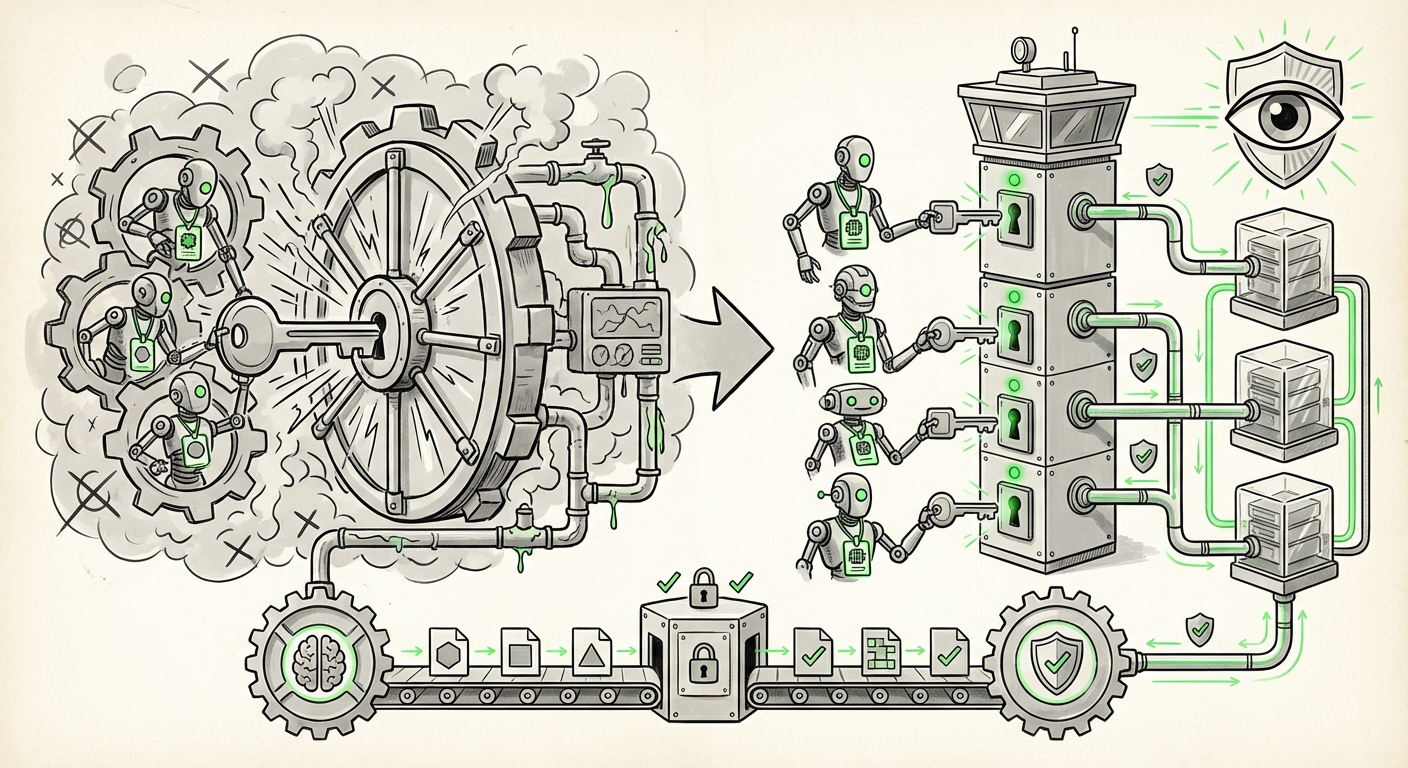
A practical version of this idea would look like a recovery loop. First, ask the compressed model to solve many problems. Second, collect its step-by-step reasoning paths. Third, keep the paths that reach correct answers or pass checks. Fourth, train the model on those good paths. The goal is not just to fix final answers. The goal is to restore the thinking process that compression damaged.
Why could this work? Because the model already has broad knowledge. Compression may weaken its ability to use that knowledge in a careful sequence, but it does not erase everything. By generating many attempts, the model can find paths that work. Those paths can then be used to fine-tune the model. In effect, the model teaches itself how to think again with fewer resources.
This is a form of self-improvement, but it is not magic. Self-generated data can be wrong. A model can produce confident but bad reasoning. So filtering and verification are essential. Good systems need checks: answer keys, unit tests, calculators, rule-based validators, or human review. Without those checks, the model may learn to repeat its own mistakes.
Why the “Trajectory” Part Matters
Many compression fixes focus on final answers. That is not enough. If a model gets the right answer by luck, it has not learned to reason. Training on the path is different. It shows the model how to break a problem into steps, how to recover from a wrong turn, and how to check its work. That is closer to how people learn. A student who only memorizes answers will struggle on a new problem. A student who learns the method can adapt.
The same is true for AI. A model trained on reasoning paths is more likely to handle new tasks. It can reuse patterns of thought. It can follow a process. That is the difference between a model that looks smart on a test and one that is useful in daily work.
Why This Matters for the Future of AI
The AI industry has spent years chasing scale. Bigger models often meant better results. But bigger models also mean bigger bills. They need expensive chips, large data centers, and lots of energy. Quantization is one answer to that problem. It lets teams run models on cheaper hardware. If reasoning can survive compression, the benefits multiply.
First, AI can move closer to the user. A model that reasons well on a phone or laptop can work offline. It can keep private data on the device. It can respond faster. That opens up uses in health, education, field work, and public services. A farmer in a low-connectivity area could use a local model to diagnose a crop problem. A nurse could use a device-based assistant without sending patient data to the cloud.
Second, costs can fall for everyone. When a model needs less memory and compute, more companies can afford to test AI. Small businesses can use AI without building a huge infrastructure. Startups can compete on product instead of only on budget. That could spread the benefits of AI beyond the largest players.
Third, the environmental footprint can shrink. Large models use a lot of energy. Smaller models that keep their reasoning ability can do more work per unit of power. That is good for cost and for sustainability. It also makes AI more practical in places where power is limited.
Fourth, the research changes how we think about model quality. The question is no longer just “How big is the model?” It becomes “How well does the model think after compression?” That is a better question for real-world use. It puts pressure on teams to test reasoning, not just short answers.
Practical Implications for Businesses
For business leaders, this trend points to a new way to evaluate AI. A compressed model is not automatically a downgrade. It can be a smart engineering choice, but only if the reasoning holds up. Companies should treat reasoning as a core quality metric, alongside speed, cost, and safety.
Customer support is a clear example. A small model that can follow a refund policy, check order history, and explain a decision is more valuable than a larger model that only sounds confident. The same is true in finance, legal review, and operations. Multi-step tasks are where value is created. They are also where compression can hurt most.
Product teams should also think about where the model runs. On-device AI can improve privacy and reduce latency. But it puts more pressure on model quality. If the model fails, the user sees it right away. That makes recovery methods like self-generated trajectories important. They can help a small model act more like a large one.
There is a cost trade-off, too. Generating reasoning paths takes compute. Filtering them takes time. But this may be a one-time or occasional cost. If it lets a cheaper model handle more tasks, the payoff can be large. The key is to measure the full picture: training cost, inference cost, accuracy, and user trust.
Actionable Insights for Teams
- Add reasoning tests to compression checks. Do not rely only on short-answer accuracy. Use multi-step tasks that reflect real work.
- Build a private evaluation set. Include problems from your own domain. Track where the compressed model fails and why.
- Pilot self-generated recovery on low-risk tasks. Start with cases that have clear checks, such as math, code, or rule-based workflows.
- Use verifiers. Pair the model with answer keys, unit tests, calculators, or human review. Good data beats more data.
- Track cost and quality together. A cheaper model that fails often is not cheaper. Measure cost per successful task, not just cost per query.
- Keep a human in the loop for high-stakes work. Reasoning recovery is promising, but it is not a guarantee. Safety and accountability still matter.
- Plan for updates. Compression and recovery are moving targets. Build a process to retest models as they change.
Limits and Open Questions
The biggest risk is self-deception. A model can generate reasoning that sounds good but is wrong. If the training loop uses bad paths, the model can get worse. That is why verification is not optional. It is the center of the method, not an add-on.
Another question is generalization. A model may learn to solve the same kinds of problems it practiced on. Will it handle new tasks? That needs held-out tests. Teams should check for memorization and look for real improvement in reasoning.
Safety is also a concern. Compression can change how a model follows rules. A model that was safe before compression may behave differently after. Recovery training should include safety checks, not just accuracy checks. Otherwise, a team could fix reasoning and weaken guardrails at the same time.
Finally, there is the question of access. If recovery methods are complex, only large teams may be able to use them. The field needs simple tools and shared benchmarks. That will help more organizations benefit from smaller, smarter models.
The Bottom Line
Quantization is here to stay. The pressure to cut costs and run AI on more devices is too strong. But compression cannot be allowed to silently strip away reasoning. The idea of recovering reasoning with self-generated trajectories offers a practical path forward. It uses the model’s own attempts as training data, then filters for quality. It turns compression from a trade-off into a tuning problem.
For the future of AI, this is a shift in mindset. We should not assume that small means shallow. With the right recovery loop, small models can think well enough for many real jobs. That could bring AI to more people, more places, and more tasks. The winners will be the teams that test reasoning carefully, verify outputs, and treat model quality as a full-stack problem. Right on Q, indeed.