World's First Round-Trip Mars Mission Has Launched, and the Real Story Is What It Demands From AI
The world's first round-trip mission to Mars has launched, a milestone that could be a transformative leap for science. That single sentence carries enormous weight. For decades, every mission to the Red Planet has been a one-way trip for the hardware, landers, rovers and orbiters that stay put or burn up. A round trip changes the equation entirely. It means something is coming back.
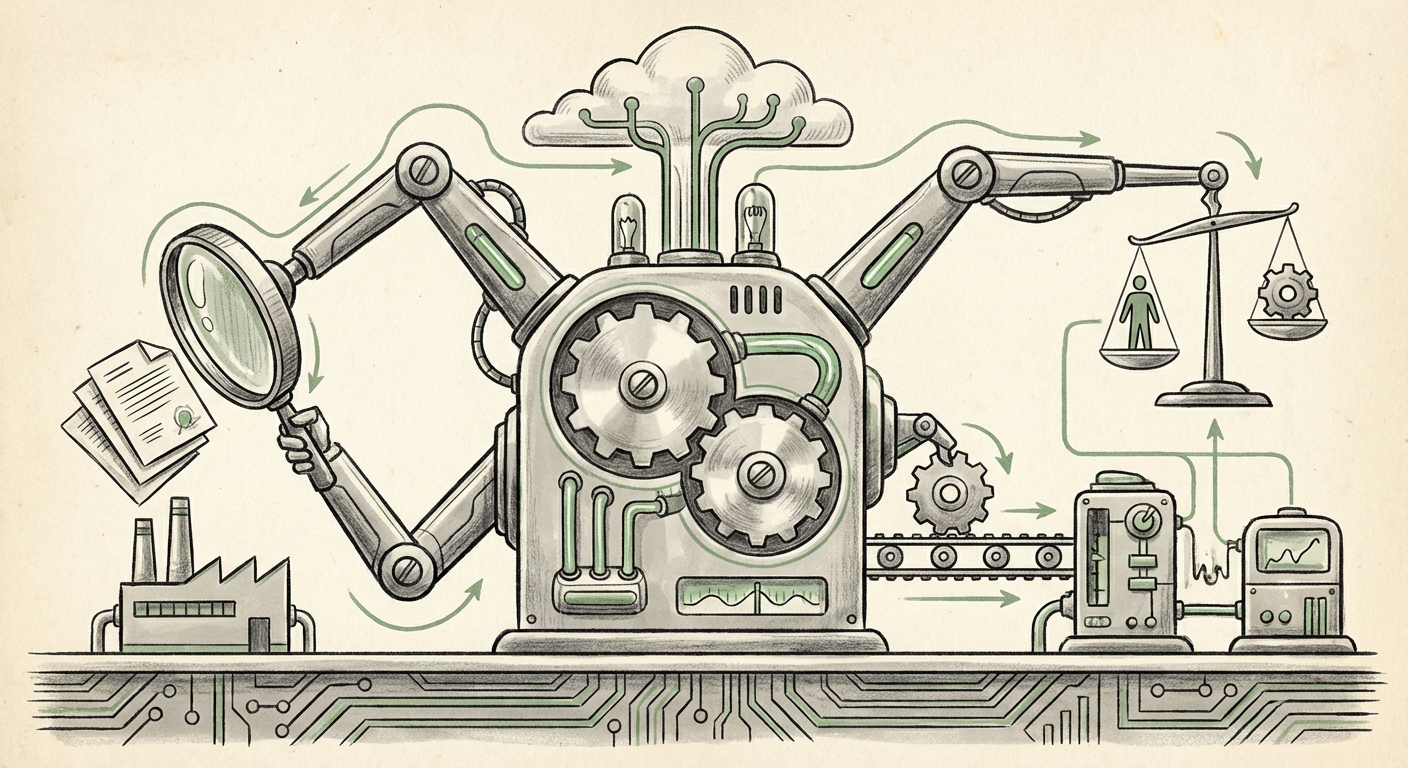
And here is the part that matters most for anyone building or buying AI systems: a mission like this is not just a triumph of rocketry. It is a stress test for machine intelligence. Every capability the mission needs, autonomous decision-making, robotic dexterity, onboard data triage, fault recovery with no human nearby, is the same capability that businesses are trying to build into factories, farms, hospitals and supply chains here on Earth. Space is where autonomy gets tested at the hardest possible setting.
This analysis looks at what the launch signals, what it will demand from AI, and what companies should take away from it.
Why a Round Trip Changes Everything
The distinction between a one-way mission and a round-trip mission is not a small engineering detail. It is a different class of problem.
A one-way mission tolerates failure more gracefully. If a rover's wheel seizes, the mission team can work around it. If a sensor drifts, they can recalibrate from the ground. The spacecraft does not have to launch itself off another planet, rendezvous with anything, or protect a precious physical sample through a violent return.
A round-trip mission has to close the loop. Something has to arrive, do its work, and come home. That means every system has to keep working at the end of the mission, not just at the beginning. Every decision made on the surface has consequences the mission cannot undo. And every hour of delay between the vehicle and the people controlling it becomes a risk multiplier.
That is why this launch is being framed as a potential transformative leap for science, and why it is equally a leap for the software and machine-learning systems that make such a mission survivable.
The Autonomy Problem: You Cannot Joystick Mars
The single biggest constraint on deep-space operations is light-speed delay. Signals take minutes to travel between Earth and Mars, and far longer when the two planets are on opposite sides of the Sun. You cannot drive a vehicle in real time at that distance. You cannot look at a picture and instantly say "go left."
Traditionally, missions solved this by moving slowly. Plan a short drive, send the instructions, wait, get the pictures back, plan again. It works, but it is painfully inefficient, and it falls apart when the vehicle must complete many complex actions within a tight window.
A round-trip mission compresses that window. There are launch opportunities, surface operations timelines, and return trajectories that do not wait for a committee on Earth to approve the next step. The vehicle has to be able to make a decision on its own and defend that decision later.
This pushes AI from a "nice to have" into the critical path. The systems involved include:
- Perception and terrain understanding. Computer vision that reads the landscape and identifies safe routes, hazards and interesting targets without a human in the loop.
- Motion planning and manipulation. Robotics that can grasp, drill, cache and load physical material with the precision of a lab technician and the caution of a bomb squad.
- Anomaly detection and fault recovery. Models that notice something is subtly wrong, a temperature creeping upward, a motor drawing more current than it should, and respond before it becomes a mission-ending failure.
- Onboard scheduling. Software that decides what to do next when plans break, weighing battery life, communication windows and scientific value in real time.
- Science triage. Algorithms that help decide which data and which physical samples are worth the cost of bringing home.
None of these are exotic research projects anymore. All of them are being built, in some form, in commercial settings right now. What is different is the cost of being wrong.
Bandwidth Is the Bottleneck, and Edge AI Is the Answer
Another constraint that a round-trip mission makes vivid is data. Sending data back from Mars is slow and expensive. You cannot stream high-definition video home. You get a trickle, not a firehose.
So the intelligence has to move closer to the source. Instead of transmitting raw sensor data and letting humans figure it out, onboard systems must compress, filter and prioritize. They must recognize the one rock formation out of ten thousand that is genuinely new, and flag it. They must throw away the boring images and keep the important ones.
This is the same problem enterprises face with connected devices, remote industrial equipment and sensor-heavy operations. Edge AI, putting models on the device rather than in the cloud, exists precisely because bandwidth and latency are expensive. The space case simply makes the trade-off impossible to ignore.
The lesson for business is direct: the organizations that win with AI will be the ones that push intelligence to the edge of their operations, not the ones that centralize everything and hope the network keeps up.
From Rover to Robot Scientist
Perhaps the most interesting shift is in how AI changes the role of the machine itself.
Early planetary robots were remote-controlled tools. Humans did the thinking; the robot did the moving. As autonomy improves, the robot becomes a collaborator, one that proposes targets, runs experiments and reports back on what it found.
That pattern is spreading fast in the commercial world. In laboratories, AI systems now propose experiments and robotic arms run them. In manufacturing, vision models flag defects and machines adjust processes without waiting for a supervisor. In logistics, planning models re-route shipments before a human even notices the weather report.
A round-trip Mars mission is the ultimate version of this pattern: a machine that must act as a scientist in the field, with limited supervision, and return with something worth the trip.
The "digital twin" dividend
Missions like this are rehearsed relentlessly in simulation. Engineers build high-fidelity virtual copies of the vehicle and its environment, then run thousands of scenarios to find failure modes before they happen in reality. That practice, the digital twin, has become a mainstream industrial technique. Companies use it to test factory layouts, power grids, aircraft and supply chains.
The launch is a reminder that simulation is not a nice-to-have. It is how you make high-stakes autonomy trustworthy. You cannot test every edge case in the real world; you have to be able to generate the edge cases virtually.
What This Means for Business and Society
It is tempting to file a Mars mission under "inspiration" and move on. That would be a mistake. Space programs have a long history of seeding technologies that later become ordinary commercial infrastructure, materials, sensors, imaging, communications, and increasingly, software.
Three practical implications stand out:
1. Autonomy is becoming a product, not a project
Every organization with remote assets, pipelines, farms, mines, warehouses, delivery fleets, is facing the same questions this mission faces. How do you let a system act on its own without letting it run wild? The answers being engineered for deep space (confidence thresholds, human-on-the-loop review, safe-stop behaviors, audit logs) translate directly into commercial governance playbooks.
2. Reliability engineering is the new AI differentiator
For a while, the race was about model capability. Increasingly, it is about dependability. A model that is right 95% of the time is impressive in a demo and useless in an operation that cannot tolerate a 5% failure rate. Expect more investment in verification, uncertainty estimation, red-teaming and runtime monitoring, the unglamorous work that makes autonomy deployable.
3. Small, efficient models get more valuable
When compute, power and bandwidth are scarce, efficiency beats raw scale. That is true on a spacecraft, and it is increasingly true on a phone, a tractor, a medical device or a delivery robot. The engineering discipline of doing more with less is coming back into fashion, and it will shape AI roadmaps well beyond aerospace.
Risks Worth Watching
None of this is risk-free. High-autonomy systems raise hard questions: Who is accountable when an autonomous system makes a costly call? How do you verify a decision after the fact when the reasoning happened millions of miles away? How do you make sure the system does not optimize for the wrong thing, collecting a pretty rock instead of the scientifically important one?
Those questions are already live in terrestrial AI governance. The mission just raises the stakes and shortens the timeline for answering them.
Actionable Takeaways
- Audit your latency assumptions. Identify processes where human-in-the-loop review is the bottleneck, and pilot bounded autonomy with clear safe-stop conditions.
- Invest in simulation before deployment. Build digital twins of your operational environment so you can stress-test AI against rare and dangerous scenarios cheaply.
- Move intelligence to the edge where bandwidth hurts. Prioritize onboard filtering, compression and decision-making for sensor-heavy operations.
- Treat reliability as a first-class metric. Track failure modes, uncertainty and drift as seriously as you track accuracy.
- Design for accountability from day one. Log decisions, record confidence levels and make post-hoc review possible.
- Watch the space sector for talent and tooling spillover. Autonomy, robotics and simulation expertise built for exploration tends to migrate into commercial products.
The Bigger Picture
The launch of the world's first round-trip mission to Mars is a scientific milestone, and it may well prove to be a transformative leap for science. But its quieter significance is as a proving ground. The mission cannot succeed on rocket fuel alone. It needs software that can see, decide, act and recover, in a place where nobody can help in time.
That is exactly the shape of the problem that businesses, hospitals, farms and cities are now handing to AI systems every day. The teams that solve it for Mars will leave behind tools, methods and hard-won lessons that show up in far more ordinary places. Watching this mission closely is not just about space. It is a preview of how autonomous systems will earn trust, or lose it, in the decade ahead.