How Vision-Language Models Really See: New Research Maps the Pathways of Visual Information Flow
Ask an AI model to describe a photo, read a receipt, or spot a cracked pipe in a factory image, and it usually gives a confident answer. But ask how it got that answer, and even the engineers who built it often shrug. The picture goes in, words come out, and the space in between is a mystery.
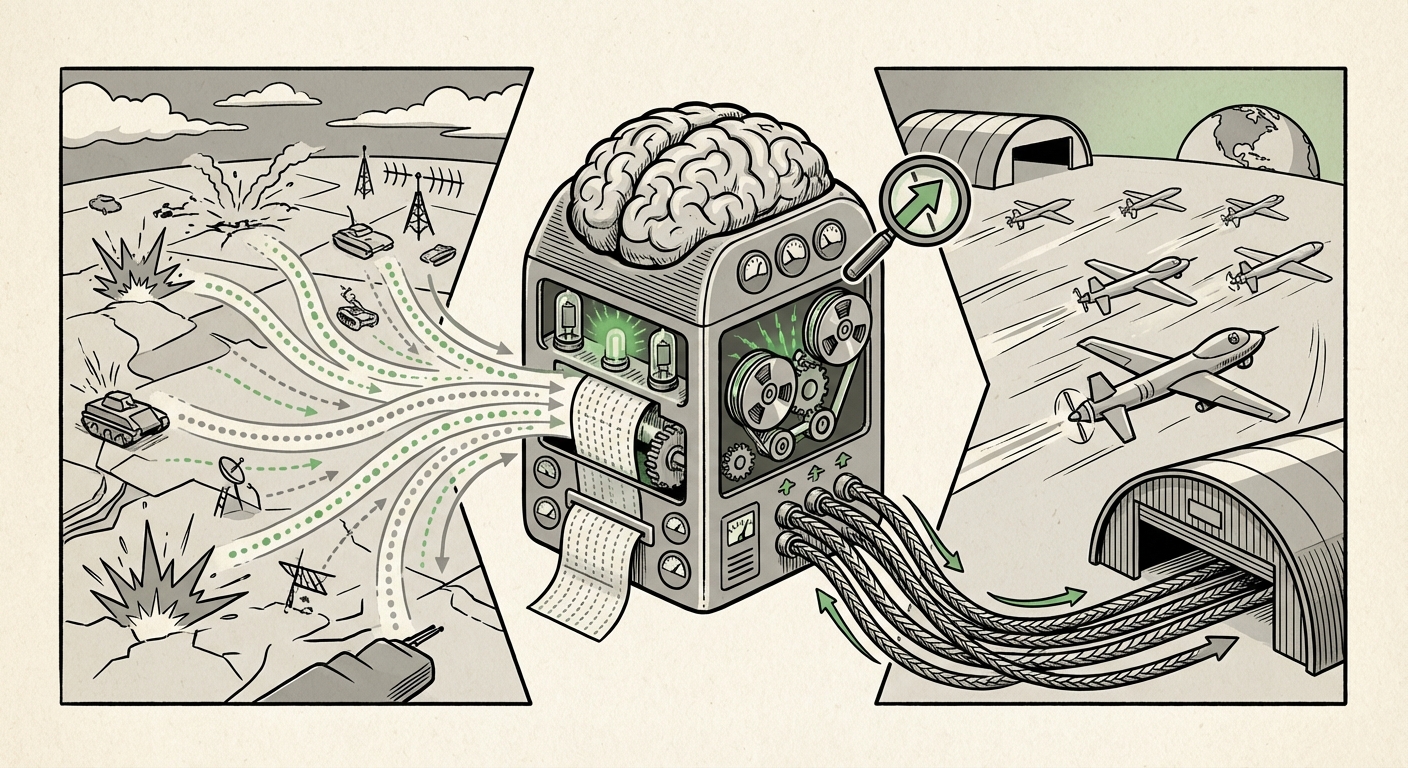
New research titled "Pathways of Visual Information Flow in Vision-Language Models" takes direct aim at that mystery. The work traces how visual signals travel through a model's internal layers, where they enter, where they get reshaped, and where they finally get turned into language. It is the kind of quiet, unglamorous research that ends up deciding which AI products work reliably, which ones fail in the field, and which ones you can safely trust with a decision that costs real money.
First, What Is a Vision-Language Model?
A vision-language model is an AI system that handles both images and text at the same time. You show it a picture and ask a question in plain English. It answers in plain English. This is the technology behind visual search, document scanning apps, image captioning, warehouse quality checks, medical image triage, and the "look at this screenshot" features now showing up in everyday software.
Under the hood, these systems are built from two halves. One half is trained to turn images into numbers, a mathematical summary of what is in the picture. The other half is trained on text and handles the conversation. The tricky part is the handoff. Somehow, the image summary has to be woven into the word-processing machinery so that the model's final sentence actually reflects what it saw.
That handoff is where the new research focuses. And it matters more than it sounds, because most failures of these models happen at that seam, not in the image part and not in the text part.
The Core Question: Where Does the Picture Actually Go?
The research is built around a simple, almost childlike question: when a model looks at an image, where does that information travel next?
There are a few possibilities, and they lead to very different kinds of machines.
- Early mixing. The image is fully translated into something like text right at the start, and then processed like any other prompt.
- Late mixing. The model mostly works out its answer from the words, glancing at the image only near the end to confirm.
- Continuous mixing. Visual information keeps flowing back and forth between layers, getting re-read and re-weighted many times as the answer takes shape.
The work is essentially a map-making effort. It asks researchers to stop treating the model as one big black box and instead follow the flow, layer by layer, attention head by attention head, to see which internal routes carry the visual signal and which routes carry language. The result is a kind of wiring diagram for machine perception.
Why "Pathways" Is the Right Word
Modern models do not process information in a straight line. They use attention, a mechanism that lets each part of the model decide which other parts it should pay attention to. Think of a busy control room where every operator can lean over and read another operator's screen for a second.
Because of that, information does not simply march forward. It loops, branches, and gets echoed. Some of those loops carry the image. Others carry the question. The interesting and hard part is that the two overlap, and when they overlap badly, the model answers the question it expected rather than the question you asked, or confidently describes something that is not in the picture at all.
This is precisely the failure mode people complain about most. A model reads a chart and misstates a number. It scans a form and invents a field. It looks at two nearly identical products and picks the wrong one. Those are not random bugs. They are routing problems, and routing problems can be mapped.
Three Big Implications for the Future of AI
1. Better Models, Built on Purpose
When you know which pathways carry visual information, you can design the next generation of models around them instead of hoping the right behavior emerges by accident. Teams can spend their compute where the signal actually travels, and stop paying for parts of the network that contribute little to what the model sees. That points toward models that are smaller, faster, and cheaper to run, a shift that matters enormously as these systems move from demos into everyday products.
2. Explainable AI Stops Being a Slogan
"Explainable AI" has been a promise for years. In practice, most explanations are post-hoc stories: the model gives an answer, and a separate tool guesses why. Pathway-level analysis is different. It offers evidence from inside the machine about what information was actually used.
For anyone in a regulated industry, that is a meaningful change. If a system denies a claim based on a photo, or flags a defect on an assembly line, the question "what did it look at?" needs a real answer. Traceable information flow is the beginning of that answer.
3. A New Tool for Safety and Robustness
Mapping the visual pathway also reveals its soft spots. If a model relies heavily on a narrow internal route to interpret an image, then anything that disrupts that route, an odd crop, a strange glare, an unusual font, a carefully crafted pattern of pixels, becomes an attack surface. Knowing the route means knowing where to build guardrails. It also means security teams can test for weaknesses systematically instead of guessing.
What This Means for Businesses Right Now
Most companies will never read this kind of paper. But they will feel its effects in the products they buy over the next several years. Here is how the shift shows up in practical terms.
Smarter Procurement Questions
Buyers of AI tools should start asking vendors a harder question: how do you know your model is looking at the right part of the image? Right now, many answers boil down to "it scores well on our tests." As pathway analysis matures, expect more sophisticated answers, and expect vendors who can give them to have a real edge in sales cycles.
Cheaper and Faster at the Edge
If a model only needs part of its visual machinery for a narrow job like checking labels on boxes, pathway insight can help trim the rest. Trimmed models run on smaller, cheaper hardware, often right on the factory floor or in a phone, rather than in a distant data center. That lowers cost and cuts the delay between seeing and acting, critical for robotics and safety systems.
Realistic Trust Budgets
Trust in AI should not be all-or-nothing. Pathway research helps teams decide where a model can be trusted to act alone and where a human needs to check the work. A system that reads handwriting with traceable, confident visual attention might be allowed to auto-fill a form. A system with a scattershot visual pathway probably needs a review step.
Practical Risks and Open Questions
Mapping is not magic. A few cautions are worth keeping in mind.
- Maps are not guarantees. Knowing where information flows does not prove the model will behave correctly on a new input. It just makes failure easier to diagnose.
- Interpretations can mislead. A pathway that looks important to a human analyst may not be the one that actually drove the answer. Careful validation is essential, or teams will chase the wrong signals.
- Results may not transfer. Findings from one model architecture do not automatically apply to another. Each family of models likely needs its own mapping work.
- Adversarial arms race. The moment you publish a map, someone can try to exploit it. Openness and security will need to be balanced carefully.
Actionable Insights: What to Do Now
- Demand evidence, not vibes. When evaluating any image-capable AI, ask for failure analysis on inputs that look different from training data, odd lighting, unusual angles, low quality scans.
- Build a test set from your own reality. Collect a few hundred real images from your own operation. This teaches you more about model reliability than any vendor benchmark.
- Design human checkpoints around the seams. Put review steps where images and text meet: form extraction, chart reading, multi-image comparisons.
- Track compute cost per decision. As trimmed, pathway-aware models arrive, revisit your cost assumptions, running a model in-house or on-device may become viable sooner than expected.
- Keep a model inventory. Know which systems in your company see images, who owns them, and what happens when they are wrong. Very few organizations can answer that today.
The Bigger Picture: Machines That Can Describe Their Senses
Human vision feels effortless, but it is deeply wired. We know, roughly, which parts of the brain handle edges, colors, faces, and motion. That map took a century of work, and it underpins everything from eyewear design to driver safety rules.
AI vision is now at the stage where that map is being drawn. The research on visual information flow is an early page in it. It treats model perception not as an unknowable fog but as a system with structure, routes that can be followed, measured, and improved.
The long-term consequence is fairly profound. Right now, we judge AI vision by its outputs. Soon, we will be able to judge it by its internal habits: Does it look at the whole image or fixate on one corner? Does it re-check the picture before committing to an answer, or lock in early and coast on language? Those habits predict real-world reliability far better than a single accuracy number.
For builders, that means a roadmap toward leaner, more predictable systems. For businesses, it means clearer contracts and sharper vendor questions. For society, it means the possibility of AI that can, in a limited but genuine sense, show its work.
Conclusion
Vision-language models have moved from novelty to infrastructure in a remarkably short time. The next phase of progress will not be defined only by bigger models or flashier demos. It will be defined by understanding, by knowing what happens between the pixels and the paragraph, and by using that knowledge to build systems people can actually rely on.
Mapping the pathways of visual information flow is a step in that direction. It is technical, it is incremental, and it will probably never trend on social media. But it is exactly the kind of groundwork that decides whether AI vision becomes dependable plumbing for the economy or stays a clever trick with unpredictable edges.