Windows for Hybrid Intelligence: Why the Next Big AI Shift Happens on Your Desk, Not in a Data Center
For the past few years, the story of artificial intelligence has been a story about distance. You type a question, it travels across the internet to a massive data center, giant computers think about it, and an answer comes back. It works, but it is expensive, it depends on your connection, and it means your most personal data takes a round trip through someone else's building.
That model is starting to change. The next phase of AI is being built around a simple idea: put intelligence where the work happens. On your laptop. On your phone. In the operating system itself. The push to build Windows for hybrid intelligence is the clearest sign yet that the industry's biggest platform is being redesigned around this shift, not as a feature bolted on top, but as a foundation underneath everything.
This matters far beyond one product update. It changes how software gets built, how companies budget for AI, how privacy rules get satisfied, and who gets to use powerful AI at all. Here is what is actually happening, and what it means for the future of AI and how it will be used.
What "Hybrid Intelligence" Actually Means
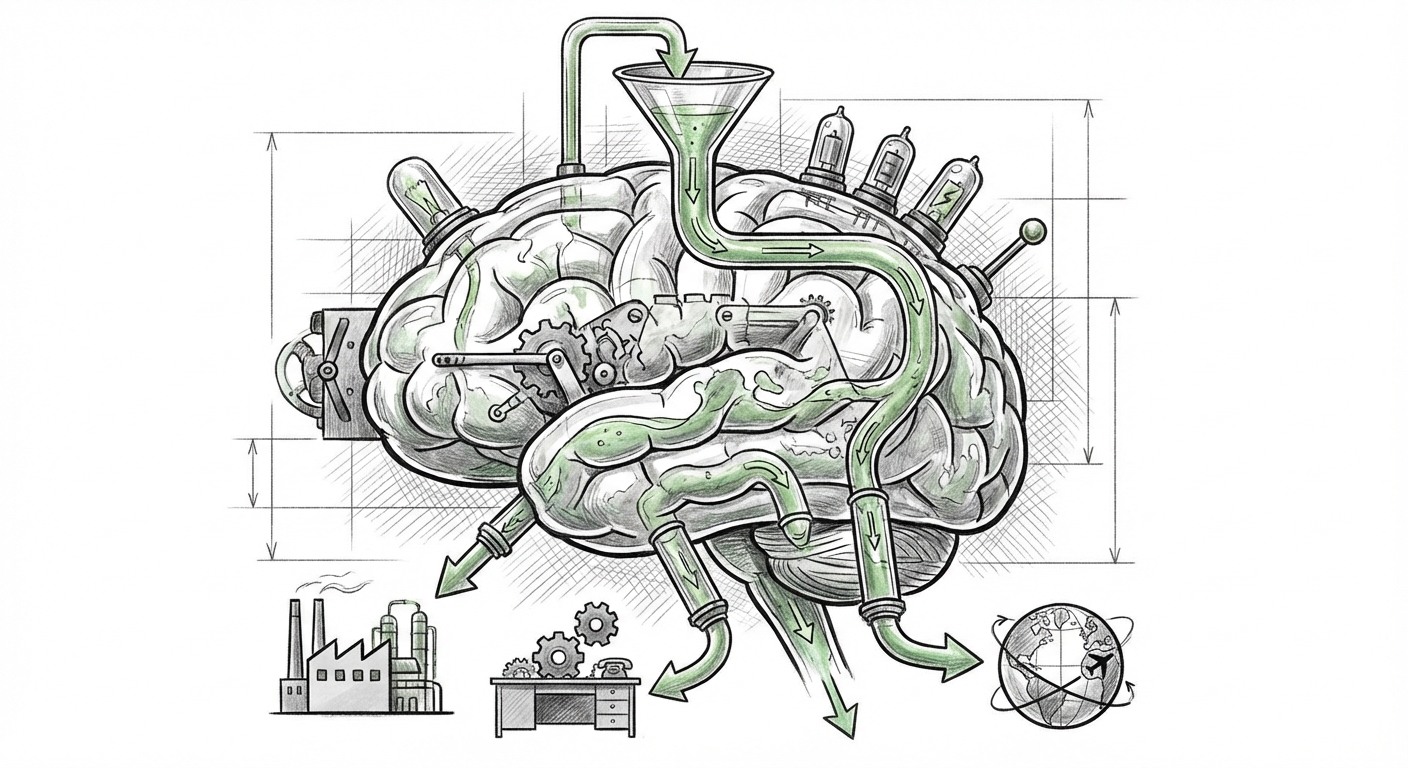
Hybrid intelligence is a fancy phrase for a practical arrangement: some AI runs on your device, and some AI runs in the cloud, and the system decides which is which based on the task at hand.
The logic is straightforward once you see it:
- Small, fast, personal tasks belong on the device. Autocorrect, summarizing a document you are reading, transcribing a meeting in real time, searching your own files, adjusting settings by voice. These need to be instant, work offline, and keep sensitive data local.
- Big, complex, one-off tasks belong in the cloud. Analyzing a thousand-page contract, generating a long report, training a custom model, or handling a question that needs enormous general knowledge. These need horsepower no laptop can carry.
A hybrid system routes each request to the right place. The user never thinks about it. That invisibility is the whole point. The best infrastructure is the kind you never notice.
The Hardware Finally Caught Up
This idea is not new. What is new is that the silicon inside ordinary computers can now do meaningful AI work. Modern processors increasingly include a dedicated neural processing unit, a chip designed specifically for the math that AI models rely on. Running AI on that chip uses far less battery than running it on the main processor, and it keeps working when the Wi-Fi drops.
Combine better chips with a generation of smaller, more efficient AI models, and you reach a tipping point. The operating system can now assume that a capable AI engine is sitting inside the machine, waiting to be used. That assumption changes everything about how software is designed.
Why an Operating System Is the Right Place to Build This
You could argue that AI should just live inside individual apps. Some of it does. But there is a strong case for putting the orchestration into the operating system itself.
First, the operating system already manages shared resources. It decides which program gets the processor, how much memory is available, and when to save power. In a hybrid world, it also needs to decide which AI tasks run locally, which go to the cloud, and how to keep latency low while protecting battery life. That is a scheduling problem, and scheduling is what operating systems have always done.
Second, the operating system sees context no single app can. It knows your calendar, your files, your screen, your notifications, and your device state. An assistant that can only see one app is a narrow tool. An assistant woven into the platform can connect dots across your whole day, but only if the privacy and permission model is built at the platform level too.
Third, developers need a common layer. Without it, every app reinvents the same plumbing: model loading, hardware detection, fallback to cloud, cost tracking. A platform-level set of interfaces lets a small team ship an AI feature without hiring a machine learning infrastructure group.
Fourth, trust has to live somewhere. If AI can read your files and act on your behalf, users need clear, consistent controls over what is allowed, what stays on the device, and what leaves it. Scattered, per-app permissions are a recipe for confusion. A platform can set a baseline.
The Big Trends This Signals
1. AI Becomes Ambient, Not a Destination
Today, using AI often means opening a specific chat window. That is a transitional phase. As intelligence moves into the platform, it stops being a place you go and becomes a capability that is simply there, in the search box, in the settings menu, in the photo gallery, in the file explorer. The companies that win will be the ones that make AI feel like part of the furniture rather than a separate appliance.
2. The Cost Model of AI Changes Shape
Cloud AI is priced per use. That is fine for experiments and painful at scale. When a meaningful share of inference runs on hardware the customer already owns, the economics shift from a recurring cloud bill to a capital purchase. For organizations rolling AI out to thousands of employees, that difference can be enormous, and it makes budgets predictable in a way usage-based pricing never is.
3. Privacy Becomes an Architecture, Not a Policy
Saying "we take your privacy seriously" is a promise. Keeping data on the device is a design. As regulators in many regions tighten rules around personal data and cross-border transfers, being able to say that sensitive information never left the machine is a genuinely powerful position. Hybrid intelligence turns compliance from a legal argument into an engineering fact.
4. Offline and Low-Bandwidth Use Cases Open Up
Field technicians, healthcare workers, factory floors, ships, rural clinics, and airplanes all share one trait: unreliable or absent connectivity. On-device AI makes those environments first-class citizens instead of second-class ones. This is one of the most underrated consequences of the whole shift.
5. The PC Becomes a Strategic Asset Again
For years, the personal computer was treated as a mature, boring category. Hybrid intelligence gives it a reason to be upgraded. An AI-capable machine is not just faster; it does things older machines physically cannot. Expect procurement cycles to be re-examined with AI capability as a first-class requirement, right alongside memory and storage.
Practical Implications for Businesses
Rethink Your AI Budget Structure
Most organizations today treat AI as a cloud subscription. Hybrid changes the math. Start modeling a mixed model: a device refresh that adds local AI capability, plus a smaller cloud allowance for the heavy lifting. For high-volume, low-complexity tasks, summarization, drafting, classification, transcription, local execution can be dramatically cheaper over a three-year horizon.
Classify Your Workloads Before You Deploy
Not all AI tasks are equal. Build a simple three-tier map:
- Stay local: anything involving personal data, confidential documents, or real-time interaction.
- Go to the cloud: heavy analysis, large-context reasoning, and anything requiring the newest and biggest models.
- Flexible: tasks where either path works, decided by cost and network conditions at runtime.
This single exercise will clarify more about your AI strategy than any vendor pitch.
Update Your Device Standards
If your fleet standard does not specify local AI capability, you are already behind. Add it to procurement criteria now, before the next refresh cycle locks you into hardware that cannot participate in the hybrid model. Pay attention to battery impact too, AI that drains a laptop by lunchtime will be switched off by users within a week.
Prepare IT for a New Kind of Management
Local AI introduces new questions: Which models are approved? How are they updated? How do you audit what an on-device assistant did? How do you wipe local model context when an employee leaves? These are manageable problems, but only if they are planned for rather than discovered.
Train People on Judgment, Not Buttons
When AI is everywhere in the interface, the skill that matters is knowing when to trust it. Invest in training that focuses on verification, source-checking, and knowing the limits of a small local model versus a large cloud one. The tool will keep changing. The judgment will not.
What Could Go Wrong
Honesty requires naming the risks. Fragmentation is the biggest. If local AI capability varies wildly across devices, developers face a mess of compatibility problems and users get inconsistent experiences. Security is the second: a model running locally can be inspected, tampered with, or tricked in ways cloud models are shielded from. The digital divide is the third, if the best AI requires new hardware, the gap between those who can afford it and those who cannot widens.
None of these are reasons to stop. They are reasons to build carefully, publish clear capability tiers, and make sure the fallback to cloud is graceful rather than jarring.
What Comes Next
The endpoint of this trajectory is an operating system that behaves less like a set of tools and more like a capable colleague. You describe an outcome; the system assembles the steps, using local intelligence for the fast and private parts and cloud intelligence for the heavy lifting. The interface stops being a menu of programs and starts being a conversation about intent.
That future is not here yet, and the transition will be uneven. But the direction is now set. The most important AI in your life over the next few years probably will not be a website you visit. It will be the layer sitting quietly between you and your machine, fast, private, and always available, with a data center on standby for the moments you need more.
For businesses, the practical message is simple: start planning for a hybrid AI estate today. Map your workloads, upgrade your standards, and treat local intelligence as infrastructure rather than a novelty. The organizations that do this early will find themselves with cheaper, faster, and more defensible AI than those still sending every keystroke to the cloud.