baseVultra: How Compact Nonlinear Recurrence and Reallocated Capacity Could Reshape AI Efficiency
For years, the AI world has chased one simple idea: bigger is better. Massive models with hundreds of billions of parameters have grabbed headlines and delivered impressive results. But a quiet countermovement is gaining strength. It focuses on making AI models smaller, smarter, and more efficient, not just larger. A new architecture called baseVultra sits right at the center of this shift. Its technical description, compact nonlinear recurrence with reallocated capacity, sounds like a mouthful, but it points to a future where AI can run faster, cheaper, and closer to where you actually need it.
In this article, we’ll break down what baseVultra’s description means, why it matters for the future of AI, and how businesses and society can prepare for the coming wave of efficient AI architectures.
The Bigger-Isn’t-Always-Better Trend
The dominant AI architecture today is the Transformer. It powers chatbots, image generators, and recommendation systems. Transformers rely on a mechanism called attention, which lets the model look at all parts of an input at once. That’s powerful, but it comes with a cost: the compute and memory needed grow rapidly as the input gets longer. Doubling the context length can quadruple the work. That makes large Transformer models expensive to train and run, especially on devices like phones or laptops.
This is why researchers are exploring alternatives. One family of alternatives is recurrence. Recurrent models process data step by step, keeping a memory of what they’ve seen. Classic recurrent neural networks (RNNs) were popular before Transformers, but they struggled with long-range dependencies and were hard to train at scale. Newer ideas, like state space models, have revived recurrence by making it more stable and parallelizable.
baseVultra enters this space with a twist: it is described as a compact nonlinear recurrence. “Compact” means the model is designed to be small in size, fewer parameters, lower memory footprint. “Nonlinear recurrence” means the step-by-step update rule is not a simple linear function but a more complex, nonlinear one. That nonlinearity is key: it allows the model to capture intricate patterns and dynamics that linear models might miss, without needing the massive scale of a Transformer.
What “Reallocated Capacity” Really Means
The second part of baseVultra’s description, reallocated capacity, is perhaps the most intriguing. In most neural networks, capacity (the number of parameters or neurons) is spread somewhat evenly across layers. But not all parts of a model contribute equally to solving a task. Some layers might be doing heavy lifting while others are mostly idle.
Reallocating capacity means shifting resources to where they matter most. Instead of giving every layer the same width, the architecture might dynamically assign more parameters to the layers that need them, and fewer to the rest. This could be done during training or even at inference time, depending on the input. The result is a model that uses its limited size more effectively, like a small team where everyone has the right skills for the job, rather than a large team with redundant roles.
Together, compact nonlinear recurrence and reallocated capacity suggest a design philosophy: do more with less. Rather than brute-forcing intelligence with scale, baseVultra appears to aim for architectural cleverness.
Why Nonlinear Recurrence Matters for the Future of AI
Recurrence has a natural advantage for sequential data: time series, audio, video, and text are all sequences. Processing them step by step can be far more efficient than attending to every element at once. But traditional recurrence had a weakness: it struggled to learn long-term dependencies. Nonlinear recurrence addresses this by making the memory update more expressive. It can learn to forget irrelevant details and hold onto important ones in a more nuanced way.
For AI applications, this could mean:
- Lower latency: Step-by-step processing can start producing outputs before the entire input is seen, which is great for real-time translation or live captioning.
- Constant memory use: Unlike attention, which grows with input length, recurrence can maintain a fixed-size memory. That makes it suitable for streaming data or very long documents.
- Edge deployment: Compact models can run on smartphones, sensors, and embedded devices without sending data to the cloud. This reduces cost, improves privacy, and enables offline functionality.
baseVultra’s nonlinear twist could make these benefits achievable without sacrificing too much accuracy. That’s a big deal. It means AI could move from centralized data centers to the devices we carry and the machines that surround us.
The Promise of Reallocated Capacity
Reallocated capacity is a response to a simple observation: most neural networks are over-parameterized. They have far more parameters than needed for the task. By reallocating capacity, a model can be both smaller and more capable. Imagine a compact car that dynamically shifts power to the wheels that need traction. That’s the idea.
In practice, reallocated capacity could take several forms:
- Conditional computation: The model skips unnecessary layers or neurons for easy inputs, saving compute.
- Dynamic parameter allocation: Different parts of the model get more or fewer parameters based on the task or even the specific input.
- Modular architectures: A small core model with specialized modules that can be swapped in as needed.
For businesses, this translates to lower inference costs and the ability to deploy AI on cheaper hardware. For society, it means AI services can be more accessible and energy-efficient.
What This Means for the Future of AI
The rise of architectures like baseVultra signals a broader shift in AI research. The era of “just add more GPUs” is hitting practical and environmental limits. Training a single large model can consume as much electricity as a small town. Inference, running the model, is even more costly over time. Companies are waking up to the fact that efficiency is not just nice to have; it’s essential for profitability and sustainability.
We are likely to see three major trends:
- Smaller, specialized models: Instead of one giant general-purpose model, we’ll have many compact models fine-tuned for specific tasks. They’ll be cheaper to run and easier to update.
- On-device AI: Compact architectures will enable AI on phones, laptops, cars, and industrial equipment. This will unlock new applications in health monitoring, predictive maintenance, and personalized assistants.
- Hybrid systems: Large cloud models will still exist for complex reasoning, but they’ll work alongside small local models for everyday tasks. baseVultra could be a building block for such hybrids.
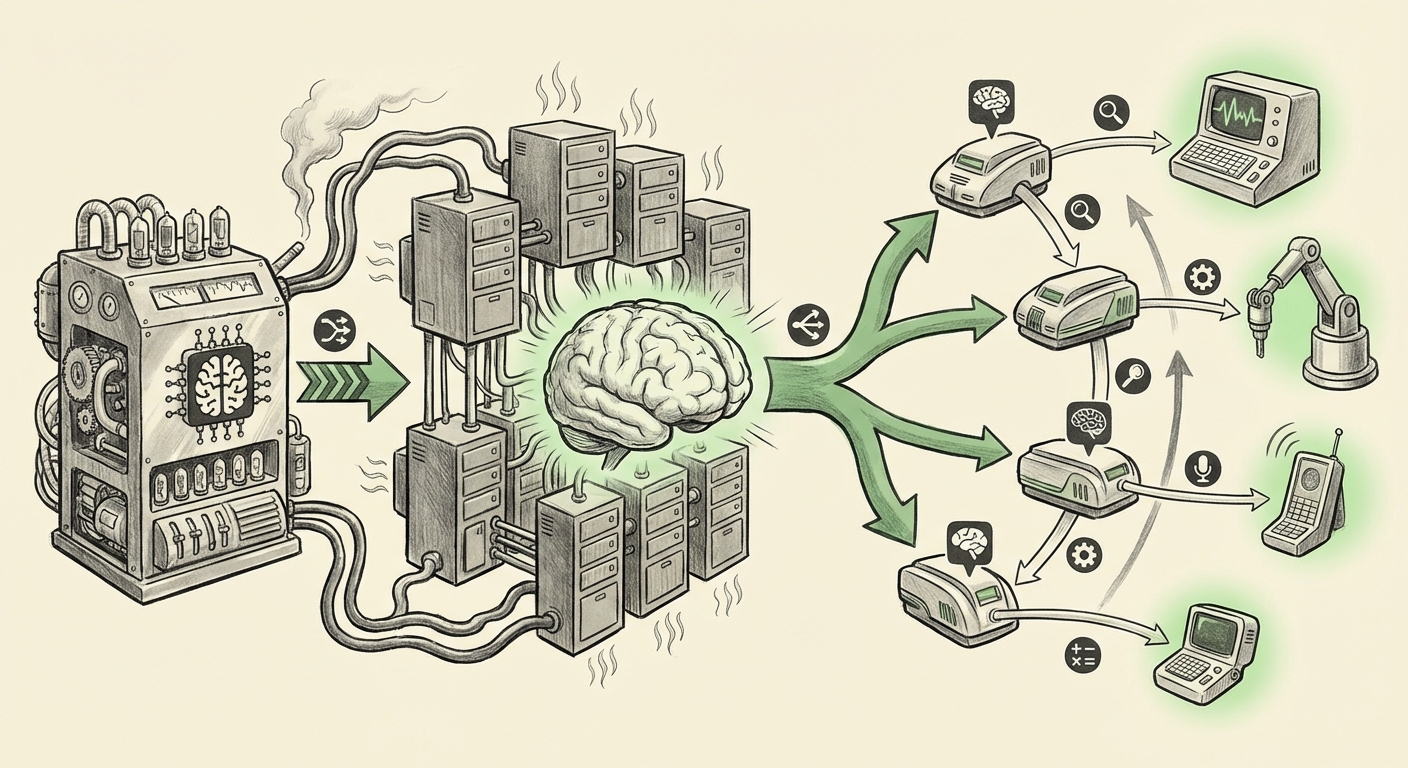
The future of AI won’t be a single massive brain in the cloud. It will be a network of efficient, specialized models working together. baseVultra, with its compact nonlinear recurrence and reallocated capacity, is a step in that direction.
Practical Implications for Businesses
If you run a business, you don’t need to become an AI researcher to benefit from this shift. Here’s what you should watch and do:
1. Re-evaluate your AI stack
Many companies default to large cloud-based models because they’re easy to access. But for tasks like document classification, sentiment analysis, or anomaly detection, a compact model might be just as accurate and far cheaper. Look for opportunities to replace or augment large-model calls with smaller, efficient alternatives.
2. Prepare for edge deployment
If your products or operations involve sensors, cameras, or mobile devices, compact AI can run directly on them. This reduces bandwidth costs, improves response times, and keeps sensitive data local. Start piloting edge AI for use cases like quality inspection, voice commands, or predictive maintenance.
3. Demand efficiency from vendors
When evaluating AI vendors, ask about model size, inference cost, and energy use. Vendors that adopt architectures like baseVultra will be able to offer lower prices and better performance on low-power hardware. Make efficiency a selection criterion.
4. Upskill your team
Your data scientists and engineers should understand the trade-offs between different architectures. Encourage them to experiment with compact models and recurrence-based approaches. The tools and frameworks are maturing quickly.
5. Think about new products
Efficient AI enables products that weren’t feasible before: real-time language translation earbuds, always-on health monitors, smart agriculture sensors. baseVultra and similar architectures could make these mainstream.
Societal Shifts and Risks
The move toward compact, efficient AI has big societal benefits. It lowers the barrier to entry, allowing smaller companies and developing regions to use advanced AI without massive infrastructure. It reduces the carbon footprint of AI, which is a growing concern. It also enhances privacy by keeping data on-device.
But there are risks. Compact models might be less transparent and harder to audit. If they run on billions of devices, ensuring they behave safely becomes a distributed challenge. There’s also a risk of a “efficiency gap”, organizations that master these architectures could outcompete those that don’t, widening inequality. Policymakers and industry leaders should pay attention to these dynamics.
Actionable Insights
Here’s a quick checklist for leaders:
- Audit your AI workloads: Identify tasks where a smaller model could replace a large one without loss of quality.
- Pilot edge AI: Choose one use case (e.g., visual inspection on a factory floor) and test a compact model.
- Track architecture trends: Follow developments in nonlinear recurrence, state space models, and reallocated capacity. baseVultra is one name to watch.
- Measure total cost of ownership: Include inference, energy, and data transfer costs when comparing models.
- Invest in efficiency research: Even small teams can contribute by sharing benchmarks and best practices.
Conclusion: Smarter, Not Just Bigger
baseVultra’s description, compact nonlinear recurrence with reallocated capacity, may sound like technical jargon, but it represents a profound shift. It suggests that the next wave of AI progress will come not from scaling up, but from designing smarter. By making models smaller, more expressive, and more resourceful, we can bring AI to more places, reduce its costs, and lessen its environmental impact.
For businesses, the message is clear: start exploring efficient AI architectures today. For society, the opportunity is to make AI more accessible and sustainable. The future of AI is not just about bigger models; it’s about better ones. baseVultra is a signpost on that road, and it’s worth watching closely.