The AI Shift of 2026: How AI Moves From Chatting to Doing, and What It Means for Business
For the past few years, most people have met artificial intelligence through a chat box. You type a question, it types back an answer. It feels impressive, sometimes magical, and often a little useless, because at the end of the conversation, you still have to do the actual work yourself.
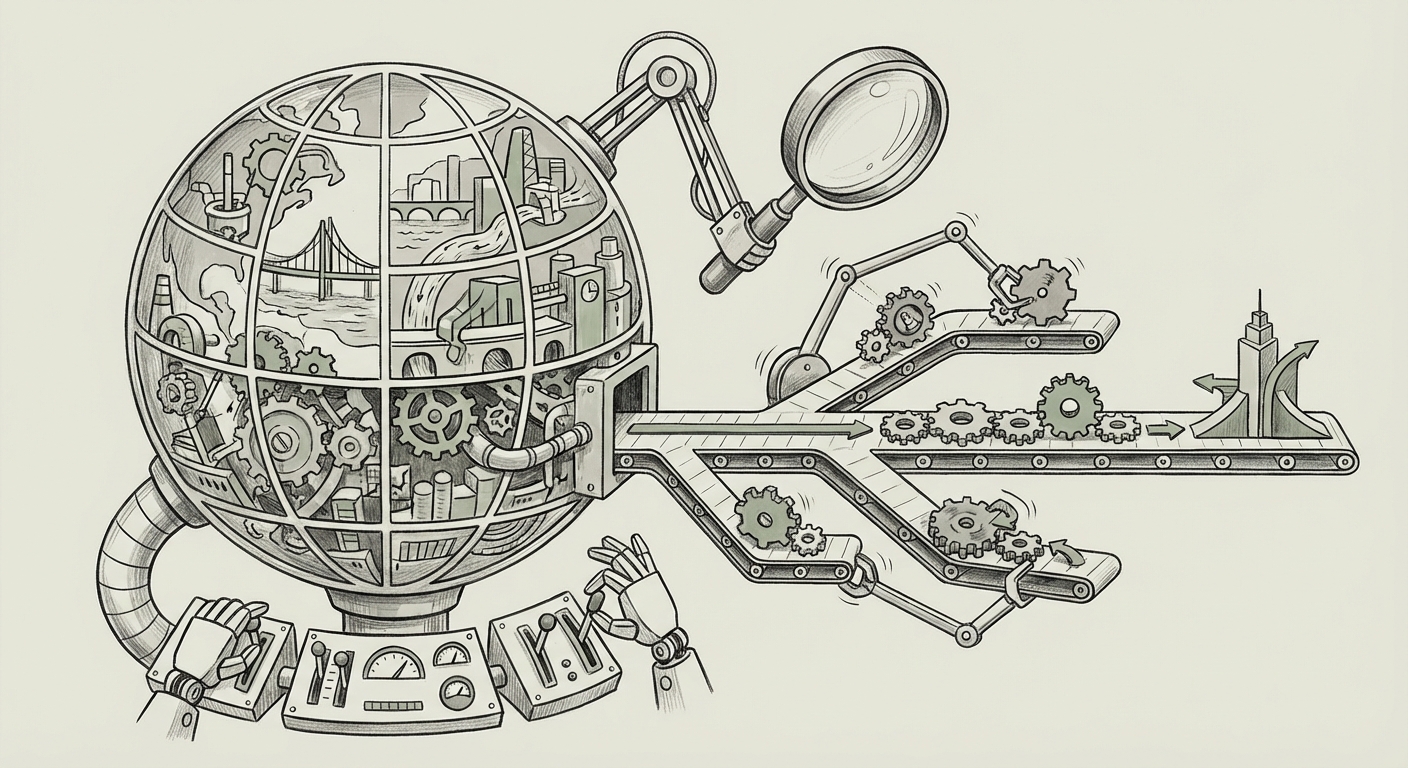
That era is ending. The defining story in AI right now is not a bigger model or a smarter chatbot. It is the move from answering to acting. AI systems are increasingly being built to take a goal, break it into steps, use tools, check their own work, and finish the task with minimal hand-holding. This shift, toward what the industry calls agentic AI, is reshaping how the technology is priced, how it is deployed, and how businesses need to think about it.
This article breaks down the trends driving that change, what they mean for the near future of AI, and what organizations can do about them now.
The Big Shift: AI That Acts Instead of Answers
A chatbot is a conversation. An agent is a worker. The difference sounds small but it changes everything.
When an AI system can take actions, calling software tools, reading documents, searching databases, filling in forms, sending messages, checking the results of its own work, it stops being a novelty and starts being part of the workflow. The value no longer comes from the cleverness of a single reply. It comes from the number of tasks the system can complete correctly, end to end, without a human babysitting every step.
This has a direct consequence for how companies evaluate AI. In the chat era, the question was, "Does this answer look good?" In the agent era, the questions become harder and more useful:
- Did it finish the job?
- Did it do it the way we require?
- What happens when it gets confused?
- Can we see what it did afterward and prove it?
Those are the questions of an operations team, not a demo audience. That tells you where the technology is heading.
Why Agents Change the Economics of AI
Chatbots are cheap to run because they are used in short bursts. Agents are different. A single agentic task can involve dozens or hundreds of steps, each one consuming computing power and time. That means the cost of AI is no longer measured per question. It is measured per completed task.
This creates a new kind of pressure. If an agent burns through a large amount of compute and still produces a wrong or half-finished result, the economics collapse quickly. So the industry is pushing hard on three things at once:
- Efficiency. Smaller, faster, more specialized models that can be run cheaply for routine steps.
- Routing. Sending easy tasks to cheap models and hard tasks to expensive ones, automatically.
- Reliability. Better planning, better self-checking, and better tools so agents fail less often.
The lesson for buyers is straightforward: price per token is the wrong metric. The metric that matters is cost per successfully completed task, plus the cost of human review when the system gets it wrong. That is the number that decides whether an AI deployment saves money or quietly drains it.
Multimodal Becomes Normal
Text-only AI already feels dated. Modern systems increasingly handle images, audio, video, screenshots, and documents together. For business, this is where AI finally meets the messy reality of actual work.
A great deal of enterprise knowledge is not stored in neat text files. It lives in scanned invoices, photographs of equipment, recorded calls, PDFs with broken formatting, and slide decks. Multimodal capability is what lets AI operate on that material instead of only on clean, well-organized text.
The practical implication is that whole categories of work, document-heavy back offices, inspection workflows, customer support with attachments, compliance review, become newly automatable. Not fully automated, but meaningfully assisted in ways that text-only tools could not manage.
Open Models and the Pressure on Price
The market is no longer a single-vendor story. Open-weight models have become genuinely capable, and businesses increasingly run some AI workloads on their own infrastructure or through specialized providers. This does several things at once.
First, it pressures pricing. When a capable alternative exists, buyers gain leverage and prices for standard capability trend downward over time.
Second, it changes the conversation about data. Organizations with sensitive information, health records, legal files, financial data, source code, often want AI that stays inside their own environment. Open models make that practical in a way that hosted-only services did not.
Third, it shifts the competitive moat. If the underlying model is increasingly a commodity, then advantage comes from something else: proprietary data, deep workflow integration, evaluation quality, and trust. That is where smart companies are now investing.
Trust, Evaluation, and the New Quality Bar
The biggest bottleneck to AI adoption is not capability. It is confidence.
Pilots are easy. Production is hard. The gap between the two is almost always the same: nobody built a reliable way to measure whether the system is doing a good job. Without measurement, every deployment becomes a leap of faith, and cautious organizations stall out.
This is why evaluation has quietly become one of the most important parts of any serious AI program. Good evaluation means having a real test set drawn from actual work, clear definitions of what "correct" means, tracking for regressions when models or prompts change, and human review of a sample on an ongoing basis.
It is unglamorous. It is also the difference between an AI project that survives its first year and one that gets quietly shelved.
The Infrastructure and Energy Question
AI runs on physical things: chips, data centers, electricity, and water for cooling. As usage scales and agents multiply the number of model calls per task, the physical footprint of AI becomes a boardroom issue rather than a technical footnote.
This produces two countervailing trends. On one side, demand for compute keeps climbing. On the other, efficiency work, better chips, better model architectures, smarter routing, caching, and distillation, keeps pulling costs down per unit of work. Both are happening at once, and the balance between them will shape which AI use cases are affordable at scale.
For businesses, this points to a simple practical step: treat AI compute as a managed budget line, not an unlimited utility. Teams that track spend per workflow tend to make better decisions about where AI actually pays off.
Governance Is Becoming a Competitive Advantage
Regulation of AI is arriving in different forms across different regions, with varying emphasis on transparency, risk assessment, and accountability. But even where rules are light, expectations are rising, from customers, from partners, and from internal legal and security teams.
The organizations handling this well are not treating governance as paperwork. They are using it as a design constraint that produces better systems: clear ownership of each AI workflow, logs of what the system did and why, defined limits on what it is allowed to touch, and a documented escalation path when something goes wrong.
That is also exactly what makes agents safe to deploy. Guardrails and audit trails are not the opposite of autonomy, they are the price of it.
What This Means for Businesses: Actionable Steps
The trends above point to a clear playbook. None of it requires waiting for the next model release.
1. Pick workflows, not tools
Stop shopping for an AI product and start listing tasks. The best starting points are high-volume, well-documented, low-drama processes where the inputs are consistent and the success criteria are obvious. Process customer emails. Reconcile invoices. Summarize support tickets. Draft first-pass reports. These are the places where gains show up fast.
2. Measure cost per completed task
Build a simple scorecard before you scale: how often is the output correct, how long does it take, how much human review is needed, and what does that cost compared with the current process? If you cannot answer those questions, you are not ready to scale, you are ready to pilot more.
3. Design for human oversight from day one
The most successful deployments put a person at the right checkpoint rather than at every step. That means designing approvals for high-stakes actions, payments, external communications, deletions, legal filings, while letting low-risk steps run automatically.
4. Invest in your data and your tools
Agents are only as useful as the systems they can reach. Clean interfaces, well-documented APIs, and organized internal knowledge do more for AI performance than most prompt engineering ever will. This is the boring work that pays the biggest dividends.
5. Build a small, cross-functional AI team
The teams shipping real value tend to mix subject-matter experts, engineers, and someone responsible for risk. Subject-matter experts catch failures that engineers miss. Risk people prevent the incidents that kill programs.
6. Train people, not just models
Adoption lives or dies on whether staff trust and understand the tools. Practical training on when to use AI, when not to, and how to check its output matters more than another feature.
What It Means for Society and Work
The honest answer is that this shift is neither the utopia nor the catastrophe that headlines promise. What it does is move the boundary of what can be automated, from routine tasks toward multi-step knowledge work that previously needed a person's judgment to coordinate.
That will reshape roles more than it eliminates them. The pattern appearing across industries is a shift toward supervision, exception handling, and quality control. Someone has to define the goal, check the result, and take responsibility when the system gets it wrong. Those skills become more valuable, not less.
The real risk is uneven adoption. Organizations that build measurement, governance, and data foundations will capture outsized gains. Those that treat AI as a procurement checkbox will spend money, generate frustration, and conclude, wrongly, that the technology does not work.
The Road Ahead
The most important thing to understand about the current moment is that the story has changed. The question is no longer how impressive an AI model can be in a demo. It is how much real work can be handed over safely, at what cost, with what oversight.
That is a harder question, and a more useful one. It rewards organizations that are disciplined about measurement, honest about limitations, and willing to redesign workflows rather than bolt AI onto old ones.
The chatbot era taught us what AI could say. The agent era will be about what AI can be trusted to do, and the companies that figure out that trust equation first will set the pace for everyone else.