Keep the Tokens Flowing: What 16 Open-Source RL Libraries Reveal About the Future of AI
Ask most people what changed in AI over the last few years, and they will point to bigger models. But the models that answer questions, write code, and solve math problems the way they do today got there through a second ingredient: reinforcement learning. RL is the step where a model tries thousands of answers, gets scored, and slowly learns which answers were worth giving.
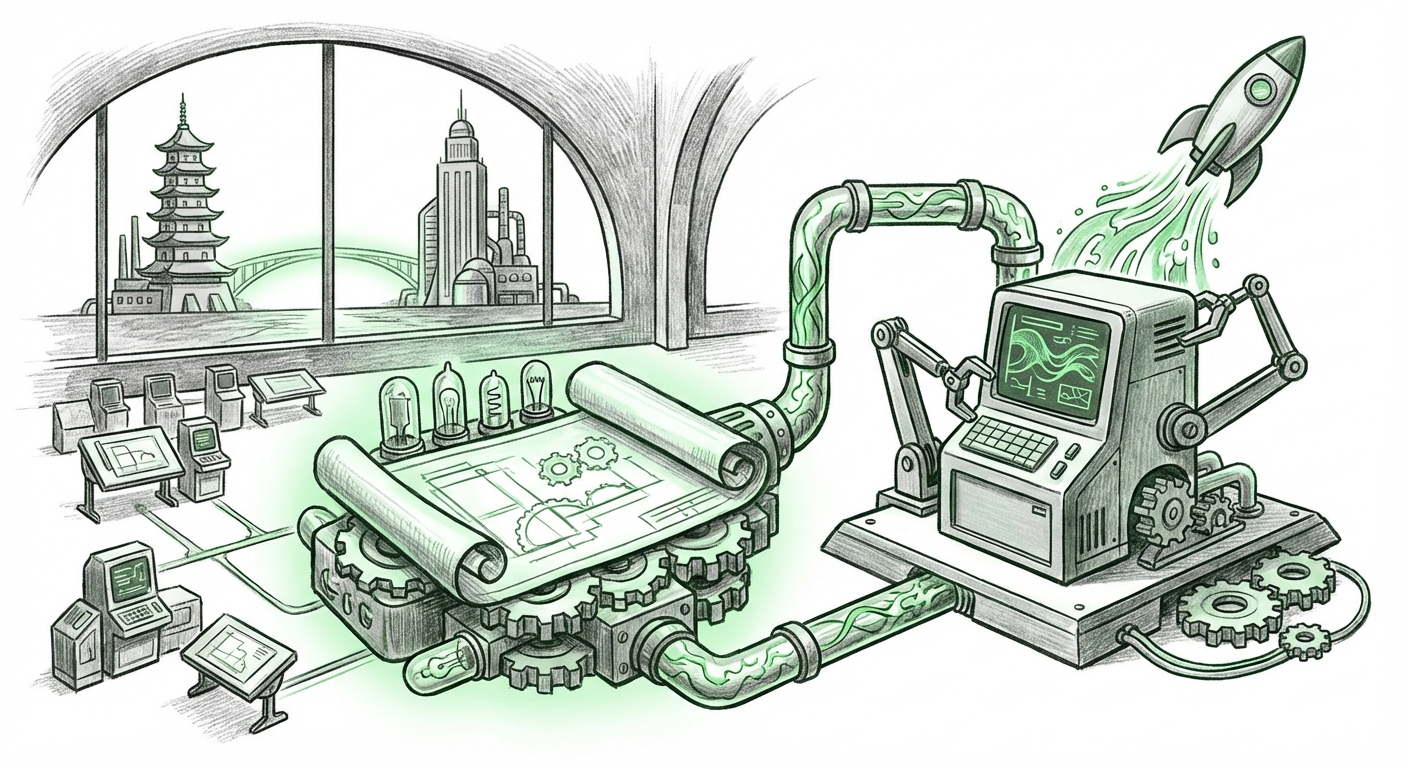
That step used to be a research curiosity. Now it is the main event. And a close look at 16 open-source reinforcement learning libraries, compared side by side, tells a story that has almost nothing to do with clever math and almost everything to do with plumbing. The libraries that work are the ones that keep the tokens flowing, from the model that generates answers to the model that learns from them, without stalling in between.
The big takeaway sits right there:
In modern AI training, the bottleneck has moved from the algorithm to the assembly line.Why RL Libraries Suddenly Matter
Pretraining a large model is a brute-force job. You feed it enormous amounts of text and let it learn to predict what comes next. It is expensive, but it is simple. One process, one goal, one direction of flow.
Reinforcement learning is the opposite. It is a loop with two very different halves. First, the model generates answers, this is called a rollout, and it looks a lot like serving a user. Then the system scores those answers, either with a reward model or a rule that checks correctness. Finally, the model trains on what it learned. Then the loop starts again, thousands of times.
Generation uses one piece of software. Training uses another. They have different memory needs, different speeds, and different failure modes. Getting them to cooperate is an engineering problem, not a theory problem, and it is exactly where the 16 libraries diverge.
Lesson One: The GPU Is Idle More Than You Think
The most consistent finding across these libraries is that generation eats the clock. Producing text token by token is slow and uneven. Some prompts finish in a blink. Others ramble on for thousands of tokens. Meanwhile the training hardware sits waiting.
The libraries that perform best treat this as a scheduling puzzle. They overlap generation with training, so that while one batch of answers is being written, the previous batch is already being learned from. They pack work tightly, reuse memory aggressively, and avoid any moment where expensive chips are simply waiting for a slow answer to finish.
For anyone building AI systems, the lesson is blunt: throughput is a design decision, not an afterthought. Two libraries running the same algorithm can differ enormously in how much useful learning they produce per hour, purely because of how they pipeline the work.
Lesson Two: The Algorithms Have Converged. The Pipelines Have Not.
Nearly every library reviewed implements roughly the same family of policy-gradient methods. The math is well understood and widely shared. What differs, dramatically, is everything around the math.
- How answers are filtered before training. Keep everything, and you train on noise. Keep too little, and you learn nothing.
- How batches are assembled, especially when sequence lengths vary wildly.
- How rewards are normalized, which quietly decides whether learning is stable or chaotic.
- How much of the training run is logged, which decides whether you can debug it at all.
A useful mental model: the algorithm is the recipe, and the pipeline is the kitchen. Same recipe, very different dinners. When teams report that RL "didn't work" for them, the cause is usually in the kitchen.
Lesson Three: Long Tails Break Everything
Language is lumpy. Most answers are short. A few are enormously long. In a normal batch, one 20,000-token answer can hold the entire batch hostage, because the system must wait for it before moving on. This is the straggler problem, and it shows up in library after library.
The mature answer is to stop thinking in terms of sequences and start thinking in terms of tokens. Token-level batching, partial rollouts that get paused and resumed, capacity limits on how long an answer may run, these are the design choices that separate a system that hums from one that stutters. The broader principle: plan for the outliers, not the average. In RL, the outliers carry most of the learning signal, so you cannot simply throw them away.
Lesson Four: Two Engines, One Brain
Every RL setup for language models runs two engines: an inference engine for generating text and a training engine for updating the model. After each update, the new weights have to reach the inference side. That handoff is expensive and easy to get wrong.
The strongest libraries treat weight syncing as a first-class problem rather than a detail. Some keep both engines on the same hardware and swap memory. Others split them across machines and stream updates. Each choice trades speed against freshness. If the inference engine is running on stale weights, the model is learning from answers produced by a slightly different model than the one being trained, a subtle mismatch that can quietly degrade results.
This is the kind of issue that never appears in a paper and always appears in production.
Lesson Five: Asynchronous Training Is a Trade, Not a Free Lunch
Going asynchronous, letting generation run ahead while training catches up, is the headline technique for keeping tokens flowing. It is also where teams get burned. Stale data means you are training on answers from an older policy, and the math that keeps learning stable assumes some amount of freshness.
The libraries that handle this well do three things. They measure staleness instead of ignoring it. They bound it, so a run cannot drift too far. And they correct for it with weighting and clipping. The lesson for the wider field is that speed and correctness are negotiable, but only if you measure the gap.
Lesson Six: The Reward Is the Product
In RL, the reward function is the actual specification of what you want. If it is a learned reward model, it can be gamed. If it is a code checker or a math verifier, it gives crisp answers but only for domains you can verify. Either way, the libraries make one thing clear: a flawed reward produces a confident, well-optimized wrong answer.
The most useful pattern emerging across these projects is separating the reward from the training loop. Treat scoring as its own service with its own tests. Version it. Watch it for drift. This matters far beyond research: every company that wants a model to behave a certain way is, whether it knows it or not, writing a reward function.
Lesson Seven: If You Cannot See It, You Cannot Fix It
RL runs fail in strange ways. A run can look healthy for hours and then collapse. Response lengths can creep upward until the model rambles. Reward can climb while quality drops, because the model found a loophole.
Across the 16 libraries, the ones that teams actually stick with are the ones that log generously: reward distributions, answer lengths, clipping rates, how often the model's new policy departs from its old one, and how stale the training data is. Observability is not a nice-to-have here. It is the difference between a debugging session that takes an afternoon and one that takes a month.
Lesson Eight: Modularity Beats Monoliths
Sixteen libraries means sixteen opinions about structure. The pattern that survives contact with real users is modularity. Let teams swap the training backend, the inference engine, or the reward source without rewriting everything. Lock-in is painful in normal software; in RL, where the best approach changes every few months, it is fatal.
Several projects also lean on shared conventions, common data formats and standard interfaces, so that a pipeline built for one model can be reused for another. That is a quiet but powerful shift, because it turns RL from an artisanal craft into something closer to a standard production line.
What This Means for the Future of AI
Three big implications follow.
First, post-training gets cheaper and more accessible. When the hard part is engineering rather than secret math, good open-source pipelines lower the barrier. Smaller organizations will be able to specialize general models with their own rewards and their own data, without building an RL team from scratch.
Second, the moat moves. If the algorithms are shared and the pipelines are open, the advantage shifts to what you feed the loop: proprietary data, well-designed tasks, and reliable verifiers. The companies that win will be the ones that can define "good" precisely for their domain and check it automatically.
Third, agents become trainable. The same loop that teaches a model to solve math problems can teach it to use tools, follow multi-step procedures, and recover from errors, as long as the environment can score the result. Much of the energy in these libraries is going toward making environments cheap to run at scale, because environments are the new training data.
There is also a caution. As RL tooling gets easier, the temptation to optimize a reward without understanding it grows. Models are exceptionally good at finding the shortest path to a high score. The future of AI quality will depend as much on careful specification as on faster chips.
What This Means for Businesses and Society
For business leaders, the practical shift is this: the ability to shape model behavior is moving in-house. Off-the-shelf models will keep getting better, but the difference between an average assistant and one that handles your workflows correctly will come from reinforcement learning on your own tasks. Budget for evaluation and reward design the way you budget for data labeling today.
For society, the upside is better-behaved systems, models that follow instructions more reliably and make fewer careless errors, because someone actually specified what correct looks like and checked it. The risk is that "correct" gets defined narrowly and optimized hard. Transparent reward design, and open tools that let outsiders inspect it, become a public interest issue, not just an engineering detail.
An Actionable Playbook
- Measure throughput before you tune anything. If your chips are idle waiting on generation, no algorithmic tweak will save you.
- Instrument staleness and answer length from day one. These two numbers predict most RL failures.
- Treat your reward as a product. Version it, test it, and watch for gaming.
- Start with verifiable tasks. Math, code, structured output, and rule-based checks give clean signal while you learn the tooling.
- Prefer modular stacks. Assume you will swap at least one component within a year.
- Plan for the long tail. Assume one runaway answer will try to stall your whole batch, and design so it cannot.
The Bottom Line
The most important lesson from studying 16 open-source RL libraries is also the least glamorous. The future of AI is not being decided by who has the cleverest update rule. It is being decided by who can keep data moving, generate, score, learn, repeat, without expensive hardware sitting idle. That is unglamorous, deeply practical work. And it is exactly the kind of work that turns a research demo into a product millions of people rely on.