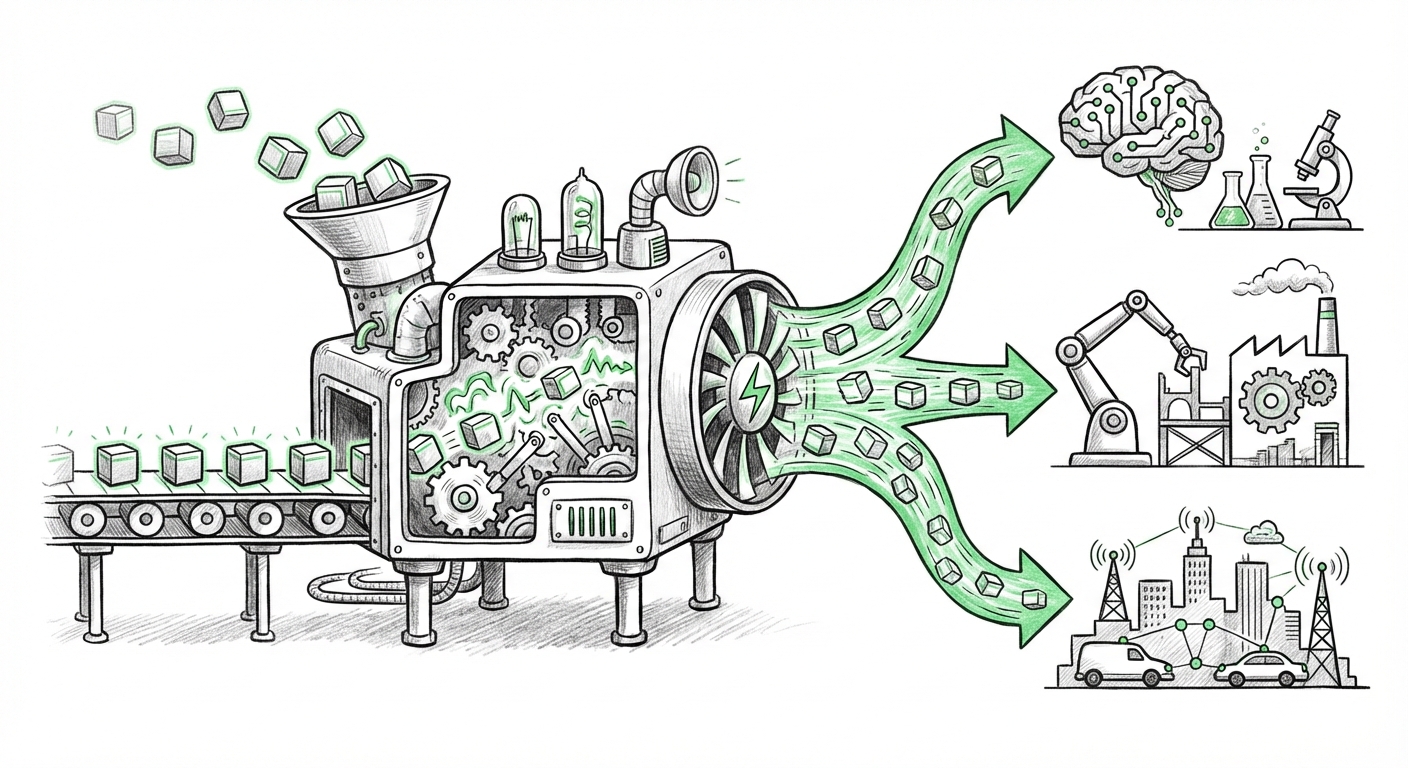
LLMs in 2025: How Far We've Come and What's Next for AI
As 2025 comes to a close, the world of large language models (LLMs) looks very different from just a year ago. We've seen remarkable leaps in capability, a flood of new applications, and a growing awareness of the technology's limits. This year-end review breaks down the biggest progress, the stubborn problems, and the predictions that will shape how we use AI in the years ahead. Whether you're a developer, a business leader, or just curious about where this is all going, here's what you need to know.
Progress: Smarter, Faster, and More Accessible
The most obvious trend in 2025 is that LLMs got genuinely better at reasoning. Models can now work through multi-step problems, follow complex instructions, and even explain their thinking in ways that feel more reliable. This isn't just about answering trivia, it's about handling real work like analyzing data, drafting plans, and debugging code. The gap between "demo" and "deployable" has narrowed significantly.
Another big step: multimodal understanding became standard. Leading models can now seamlessly process text, images, audio, and sometimes video. That means you can show a model a chart and ask for insights, or upload a screenshot of a bug and get a fix. This opens up use cases in fields like healthcare, manufacturing, and education, where information rarely comes in plain text.
Cost and speed also improved dramatically. Inference is cheaper and faster than ever, thanks to better hardware, smarter architectures, and techniques like quantization and distillation. Smaller, specialized models now rival the giant models of yesterday on many tasks. This has made LLMs accessible to startups and individual developers, not just tech giants. Open-weight models have matured too, giving organizations more control over privacy and customization.
Perhaps most importantly, LLMs became more useful as agents. Instead of just answering questions, they can now take actions: browse the web, call APIs, write and run code, and coordinate with other tools. This agentic capability is still early, but it's already changing how we think about automation. Tasks that once required a human in the loop, like booking travel, filling out forms, or triaging support tickets, are increasingly handled by AI with minimal oversight.
Problems: The Same Old Ghosts, Plus New Ones
For all the progress, 2025 also reminded us that LLMs are not magic. Hallucinations remain a major headache. Models still confidently make things up, especially when asked about niche topics or recent events. While retrieval-augmented generation (RAG) and better training have reduced errors, no one has solved the problem completely. In high-stakes domains like law, medicine, and finance, this is a dealbreaker. Businesses are learning to treat LLM outputs as drafts, not final answers.
Evaluation is still a mess. We have more benchmarks than ever, but they often don't reflect real-world performance. Models can ace a test and still fail in production. The industry lacks standard ways to measure safety, robustness, and fairness. This makes it hard for buyers to compare models and for regulators to set rules. Expect more focus on practical, domain-specific evaluations in the coming year.
Safety and alignment concerns haven't gone away, they've just gotten more nuanced. While catastrophic risks (like models going rogue) remain theoretical, more immediate harms are real: bias, misinformation, copyright infringement, and privacy leaks. Regulators in several regions have started to act, but the rules are still patchy. Companies are scrambling to build guardrails, but it's a cat-and-mouse game.
Finally, the energy and environmental cost of training and running LLMs is under scrutiny. Even with efficiency gains, the compute demands are enormous. Data centers are straining power grids, and water usage for cooling is a growing concern. The industry is responding with more efficient hardware and renewable energy pledges, but the tension between capability and sustainability isn't going away.
Predictions: Where LLMs Are Headed Next
Based on the trends of 2025, here are the developments I expect to dominate the conversation in the near future.
1. The rise of specialized, small models
We'll see fewer monolithic models and more compact, task-specific ones. Think a model that's an expert at contract review, another that's a whiz at medical coding. These small models will be cheaper, faster, and easier to fine-tune. They'll run on edge devices and inside private clouds, reducing latency and privacy risks.
2. Agentic workflows become mainstream
2025 was the year agents got real. Next, they'll get reliable. We'll see agent frameworks that handle long-running tasks, recover from errors, and collaborate with humans seamlessly. This will transform knowledge work, imagine an AI that monitors your inbox, drafts responses, schedules meetings, and flags urgent items, all while learning your preferences. The key challenge will be trust: people need to feel confident that agents won't go off the rails.
3. Regulation finds its footing
Governments are moving from principles to enforcement. Expect clearer rules on transparency, data provenance, and liability. Companies will need to document how their models are trained and tested. This will raise costs but also build trust. The smart players will treat compliance as a competitive advantage, not a burden.
4. LLMs become invisible infrastructure
The most profound change will be that we stop talking about LLMs as a separate thing. They'll be embedded in everything, your word processor, your CRM, your car, your doctor's assistant. The interface will fade into the background. You won't "use an LLM"; you'll just use software that happens to be smart. This is already happening, but by the end of next year it will be the norm.
5. The talent gap widens, and narrows
Demand for people who can build, fine-tune, and deploy LLMs will remain high. But tools are getting easier to use, so non-experts can accomplish more. The winners will be organizations that combine technical chops with deep domain knowledge. Liberal arts majors, take note: prompt engineering and AI product management are real careers now.
What This Means for Businesses and Society
For businesses, the message is clear: experiment now, but plan for integration. LLMs are not a silver bullet, but they are a powerful lever. Start with low-risk, high-volume tasks like customer support, content drafting, and code assistance. Measure results carefully. Invest in data quality and human oversight. And don't ignore the cultural shift, your employees need training and reassurance, not just tools.
For society, the stakes are high. LLMs can democratize access to expertise, helping a small business owner draft a legal contract or a student learn a new subject. But they can also amplify misinformation, displace workers, and concentrate power in the hands of a few tech companies. The decisions we make now about openness, regulation, and education will shape the next decade. The genie isn't going back in the bottle, so we'd better learn to steer it.
One thing is certain: the pace of change isn't slowing. The LLMs of 2026 will make today's look quaint. The organizations and individuals who thrive will be those who stay curious, stay critical, and stay human.