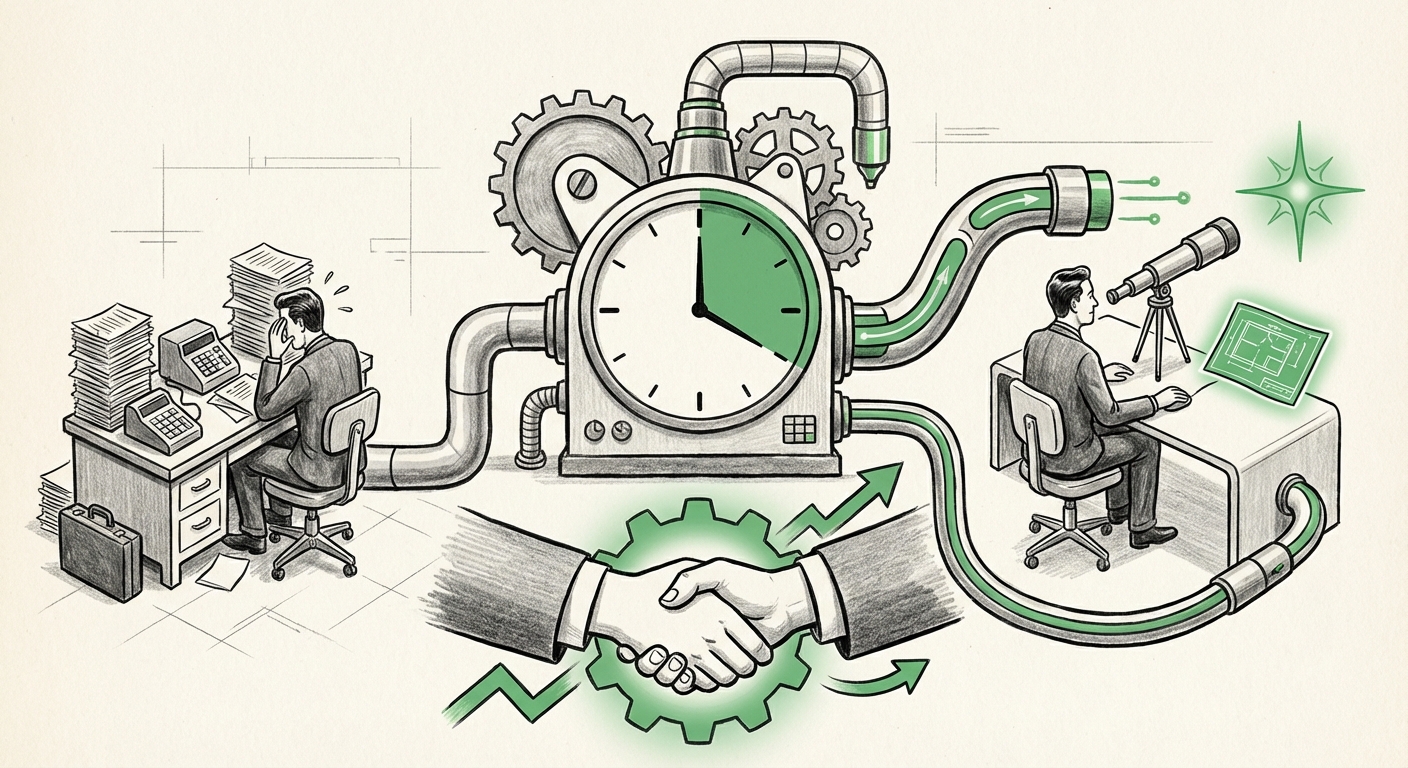
One Man, One Switch, Two Wars: Why Starlink's Secret Power Is the Warning Label for the AI Era
Imagine owning a road. Not a piece of software, not a patent, an actual road that whole armies and whole cities depend on. Now imagine a government calling you every few months to ask you to close a lane here, open a lane there, or block a truck from driving through. That is roughly the position Elon Musk and SpaceX have been in for years with Starlink, the satellite internet network that beams broadband down from low Earth orbit.
New reporting confirms something that was long suspected but never fully laid out: US officials have repeatedly asked Musk to change how Starlink service works in Ukraine and in the Middle East. The requests were not one-off. They came over years, they crossed different administrations and different conflicts, and they touched the most sensitive question in modern technology: when a private company controls a critical network, who actually decides how it behaves?
That question sounds like a policy story. It is really an AI story. Because the mechanism that lets a company open or close a satellite link is the same mechanism that will soon run our power grids, our logistics networks, our hospitals and our defense systems, software making real-time decisions at machine speed, with no human in the loop. Understanding Starlink's strange position is the best way to understand what is coming, and what we should do about it.
What Actually Happened
Starlink is a constellation of thousands of small satellites built and operated by SpaceX. It provides internet access from the sky, which means it works even where there are no cables, no towers, and no friendly neighbors. That makes it invaluable in a war zone, where ground infrastructure is the first thing to be destroyed.
The reporting shows that US officials asked Musk, again and again, to adjust Starlink's behavior, to extend coverage in some places, to restrict it in others, and to keep the service running in contested regions. Ukraine and the Middle East were both on that list. The requests were about coverage, access, and control. In plain terms: the US wanted a private company to shape how a privately owned network served the public interest, and, in some cases, the national interest.
What makes this remarkable is not that governments ask. Governments ask companies for things all the time. What makes it remarkable is that Musk alone can say yes or no. A single CEO became an unaccountable switchboard for the communications of entire regions. There is no treaty that covers this. There is no regulator. There is no appeal process.
The New Chokepoint: Private Infrastructure as Foreign Policy
For most of the twentieth century, the great chokepoints were physical. Straits, canals, undersea cables. Whoever controlled them had leverage. Today, a new class of chokepoint has appeared: the private platform that everyone relies on, owned by a handful of people, running on software no outsider can audit.
Starlink is the clearest example, but the pattern is everywhere. Cloud providers host the infrastructure of governments. Payment networks can cut off entire sectors of the economy. App stores decide which businesses exist. The result is a quiet transfer of state power to boardrooms, and the people in those boardrooms are not elected, not confirmed, and not bound by any published rulebook.
That is uncomfortable, but here is the part that matters for the future: the harder these networks become to run manually, the more they will be run by AI. Nobody at SpaceX flips a switch for a single user. Automated systems manage coverage, beam allocation, traffic routing, and usage rules across a fleet of thousands of satellites and millions of terminals. Those systems are getting smarter every year. Which means the real question is no longer "will the CEO decide?" It is "what rules did we teach the machine?"
Where AI Fits: The Machine That Decides Before Anyone Asks
Satellite networks are a perfect candidate for automation. The physics is complicated, the fleet changes constantly, and conditions shift by the second. A modern constellation needs software that can allocate bandwidth, steer beams, avoid interference, plan handoffs, and spot anomalies, all without a human watching.
Now layer geopolitics on top. If a government asks a provider to limit service in a certain region, someone has to turn that policy into a technical rule. In practice, that means a geofence, a permissions rule, or a service policy written into the network's control plane. Once written, it can be enforced automatically at scale.
This is the frontier that most people have not noticed yet. Policy is becoming code, and code is becoming policy. A diplomatic request becomes a configuration change. A configuration change becomes a machine-enforced reality for millions of users. The gap between political intent and lived experience shrinks to near zero, and the audit trail shrinks with it.
Three shifts follow from this:
- Decisions move from days to milliseconds. Human review cannot keep up with a network that reconfigures itself constantly. AI absorbs the discretion by default, not by design.
- Rules become invisible. A user cannot tell whether a slowdown is a bad signal day, a hardware fault, or a policy choice enforced by software. That opacity is the core governance problem of the next decade.
- The operator's values get baked in. Engineers who write optimization targets are making decisions about who gets prioritized. Those choices are rarely debated and almost never disclosed.
The Accountability Gap Nobody Owns
Here is the uncomfortable truth: the systems described above have no clean owner. The company owns the network. The government pressures the company. The AI enforces the outcome. When something goes wrong, each party can point at the next one.
We already see this pattern in other AI systems. A model makes a decision, the operator deploys it, the regulator arrives late, and the affected person never finds out why. Satellite networks make the problem bigger because the stakes are physical. A restricted connection in a conflict zone is not a bad product experience, it can be a matter of life and death, for civilians and soldiers alike.
The fix is not to ban automation. That ship has sailed. The fix is to demand explainable and auditable decisions at the network layer, the same way we demand log files from financial systems. If a service was altered, the record should show what changed, when, on whose instruction, and under what rule. That is a technical requirement and a legal one at the same time.
What This Means for Businesses
Most companies will never operate a satellite fleet. But almost every company is building a version of the same risk.
1. Your critical dependency is probably a vendor
Ask a simple question: which single vendor could take you offline tomorrow, and what would it take for them to do it? For a retailer, it might be a cloud or payment provider. For a manufacturer, a logistics platform. For a startup, an app store. The Starlink story shows that dependency is not just a cost issue, it is a strategic one, shaped by forces you do not control.
2. Contracts are not enough
A service-level agreement covers uptime. It rarely covers political risk. Teams should add clauses about notice periods for service changes, data on why changes happen, and the right to an independent audit trail. If your provider's AI can change your service overnight, you want the right to know it happened.
3. Build for degraded mode
Assume a critical link goes away. What still works? Design your operations so a core set of functions survives losing any single dependency. Test it for real, not on paper.
4. Put a human on the policy layer of your AI
If your AI enforces business rules at scale, someone must own those rules by name. Automated enforcement without a named accountable owner is how good companies end up in bad headlines.
What This Means for Society
There is a bigger argument buried in this story, and it is worth stating plainly. The world has quietly allowed a handful of private platforms to become the plumbing of public life. Those platforms are now run increasingly by AI. That combination, private ownership, public dependence, automated decisions, is a new kind of power that our laws were not built to handle.
Two paths are open. One is drift: governments negotiate case by case with individual founders, outcomes depend on personal relationships, and trust erodes every time a switch is flipped. The other is structure: clear rules for how critical networks must respond to government requests, published transparency reports, independent technical audits, and standards for AI systems that make decisions with public consequences.
The second path is harder, but it is cheaper than the first. Every country that depends on a privately controlled network for connectivity, commerce, or defense now faces the same basic question: do we have a plan for when the operator says no?
Actionable Insights
- Map your single points of control. Identify every third party whose AI or policy layer can change your service without your consent.
- Push for decision logs. Require providers to record and share why automated changes occurred. Silence is not a compliance strategy.
- Treat "policy as code" as a governance function. The people who translate rules into software need review, oversight, and documentation, just like finance teams.
- Invest in redundancy where it counts. Multi-vendor and offline fallbacks for the handful of systems that would hurt most.
- Brief your board on geopolitical dependency. Risk committees should discuss who controls your infrastructure, not just how much it costs.
- Follow the standards work. Auditable, explainable AI for critical infrastructure is being written now. Early adopters will shape it.
The Road Ahead
The Starlink story will be remembered as a strange chapter in which one entrepreneur became a geopolitical actor by accident. But its real legacy will be the lesson it taught. Control of infrastructure is control of outcomes. And increasingly, the thing doing the controlling is not a person at all, it is a model, optimized for uptime, cost, and policy, executing decisions faster than any human can review.
AI will make these networks better. It will also make them more opaque, more autonomous, and more consequential. The companies and governments that thrive in that world will be the ones that decide, on purpose, what their machines are allowed to do, and who has to answer when they do it.