BDH-CQ Explained: The AI That Thinks Without Talking Could Rewrite How We Use Models
Every time you talk to an AI model today, you are watching it think out loud. It writes a word, then another word, then another, and somewhere in that stream of text the actual reasoning is supposed to be hiding. If it makes a mistake, we tell it to "show its work." If it gets stuck, we ask it to "think step by step." The whole industry has quietly agreed that thinking and writing are the same activity.
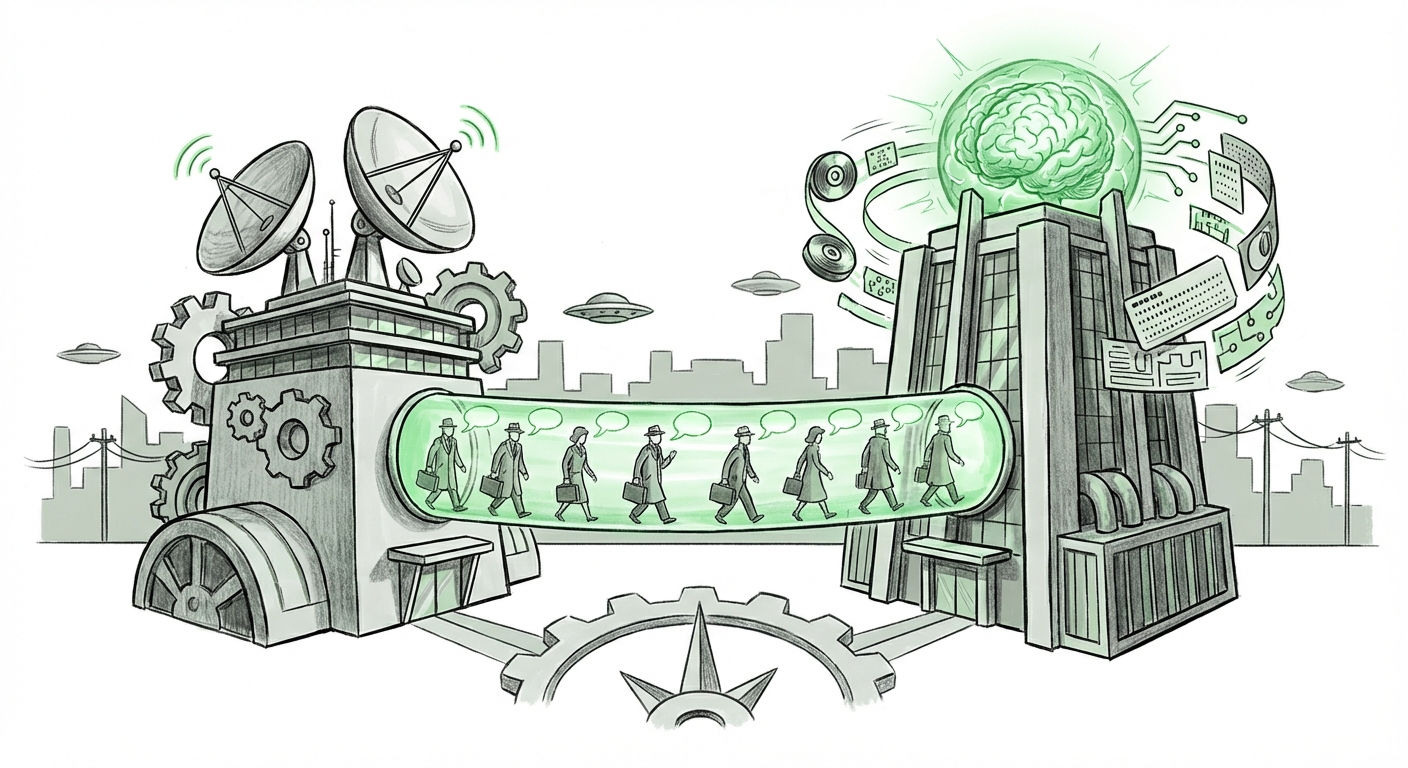
BDH-CQ breaks that agreement. The design, which pairs in-context learning with reasoning that happens outside the token stream, points at something different: a model that can work through a problem internally, in a space that is not made of words, before it ever produces a sentence you can read. It is a small-sounding technical distinction with very large consequences.
Here is why this matters, what it changes, and what businesses should start doing about it now.
Two Ideas, Fused Together
To understand BDH-CQ, you need to separate the two halves of its name.
Half one: in-context learning
In-context learning is the ability of a model to pick up a new task from examples placed right in front of it, no retraining, no fine-tuning, no new weights. You show it five examples of a formatting style, or a customer's tone of voice, or a set of rules for how your company classifies invoices, and it adapts on the spot. This is the feature that turned large language models from research demos into general-purpose tools. It is fast, cheap, and flexible.
But in-context learning has always had an awkward limitation. The model learns from what is written in the prompt. Anything it works out along the way has to be written down too, in tokens, before the model can build on it. The scratchpad becomes the memory. The thinking and the record of the thinking are the same artifact.
Half two: reasoning outside the token stream
This is the newer and stranger idea. Instead of forcing every intermediate step into words, the model performs its internal computation in a continuous, non-textual space. There is no sentence in the middle that says "first I will check the date, then I will compare the two figures." There is just a state that evolves, and then a final answer that emerges.
Put simply: today's models think by writing. BDH-CQ is built around the idea that a model can think, then write.
Why Anyone Would Want This
The moment you describe reasoning outside the token stream, three practical benefits jump out, and all three are things enterprises currently pay real money and real latency for.
1. It is dramatically cheaper and faster
Tokens are the billing unit of modern AI. Every reasoning step a model writes out is a token you pay for and a fraction of a second you wait. Long chains of visible reasoning are powerful but expensive, and they scale badly: a hard problem can generate thousands of words of internal monologue before reaching a two-sentence answer. When reasoning happens in a hidden, continuous space, the model does not have to spend the cost of narrating itself. For high-volume workloads, support triage, document review, code checks, that difference compounds into serious savings.
2. It handles some things language handles badly
Not every problem is naturally verbal. Spatial relationships, multi-step arithmetic, structured comparisons across long tables, and constraint satisfaction often fit poorly into prose. A model forced to narrate a geometry problem or a scheduling conflict is doing extra translation work that introduces errors. A continuous reasoning space can represent those relationships more directly.
3. It changes the privacy and security picture
There is a quiet side effect here that few teams have thought through. Today, when a model reasons in tokens, its intermediate thoughts are visible in logs, in streaming responses, and sometimes to end users. Sensitive details can leak through the scratchpad even when the final answer is clean. Reasoning that stays off the token stream reduces that exposure surface, fewer places for confidential context to appear in plain text.
The Cost Nobody Gets for Free: You Cannot Read the Mind
Here is the honest counterweight, and it is a big one. The single greatest safety and quality tool in modern AI is that we can read what the model was thinking. When a system gives a wrong answer, engineers read the reasoning trace and find the bad step. When an auditor asks why a loan application was flagged, the trace is the evidence. When a regulator wants accountability, visible reasoning is the paper trail.
Reasoning outside the token stream takes that away by design. You get the answer without the argument.
That does not make BDH-CQ unsafe. It makes it unverifiable by the methods we currently rely on. Which means the organizations that adopt this class of system will need replacements for the thing they are giving up:
- External verification instead of internal narration. If you cannot inspect the reasoning, you have to test the output. That means stronger evaluation harnesses, golden datasets, and automated checks that judge answers against ground truth rather than trusting the process.
- Confidence signals and structured citations. A model that cannot show its steps can still be required to point at the sources or data rows it used, so a human can audit the trail from the outside in.
- Human review at the decision boundary. The higher the stakes, the less acceptable a black-box intermediate step becomes. Hiring, credit, medical triage, and legal judgment are not places to remove visibility without a substitute.
What This Means for the Future of AI
The deeper story here is not one model design. It is a shift in what the industry thinks a model is.
For the past several years, the dominant pattern has been "the model as a writer that happens to reason." We optimized for output tokens, graded models on how well they explain themselves, and built entire product categories, agents that narrate their plans, chatbots that show their steps, debugging tools that parse reasoning traces, on the assumption that thought is text.
BDH-CQ belongs to a competing pattern: the model as a thinker that happens to write. In that world, output is a thin interface layer over a much larger, invisible computation. Several things follow from that.
The economics of intelligence change shape
If reasoning gets cheaper per problem, more problems become worth solving. Workflows that were uneconomical to automate, reviewing every contract clause, checking every transaction, reading every support thread, start to pencil out. Cheap thinking is a bigger deal than fast writing, because it moves AI from "assist on demand" to "run continuously in the background."
Agents get quieter and more capable
Today's autonomous agents are chatty. They plan in prose, loop in prose, and fail in prose. A model that plans internally can run longer, more complex tasks without burning context on self-narration, and without filling your logs with thousands of words nobody reads.
Interpretability becomes a product feature, not a research nicety
If the reasoning is hidden, then tools that reconstruct or approximate what happened inside become valuable. Expect the observability layer of the AI stack, evaluation, monitoring, provenance, audit trails, to grow in importance as the model layer becomes more opaque. The companies that win in regulated industries will be the ones that pair opaque reasoning with transparent evidence.
Practical Implications for Businesses
The temptation is to treat this as a research headline and move on. That would be a mistake. The practical lessons are available today, even before systems like BDH-CQ are widely deployed.
- Stop depending on reasoning traces as your quality control. If your review process is "a human reads the model's chain of thought," you are already fragile, traces are long, unread in practice, and disappear with this class of architecture. Move to output-based evaluation: test sets, spot audits, and outcome metrics.
- Separate "needs proof" from "needs answer." Triage your AI use cases. Low-stakes, high-volume tasks, drafting, summarizing, classifying, routing, benefit enormously from cheaper hidden reasoning. High-stakes decisions need visible evidence and should stay on architectures that provide it.
- Design for evidence at the edges. Require structured outputs, source references, and confidence scores regardless of what happens inside the model. Those contracts survive an architecture change; reasoning traces do not.
- Model the cost curve, not just the capability curve. Per-task inference cost is the variable that decides which automations scale. A design that cuts the cost of hard reasoning reshapes your business case more than a small accuracy bump ever will.
Actionable Next Steps
For technical leaders, three concrete moves are worth making this quarter.
First, build an evaluation harness you trust more than a transcript. Collect a few hundred real tasks with known-good answers. Score models on outcomes, not explanations. This is the single highest-leverage investment, because it is the only thing that keeps working when reasoning goes dark.
Second, audit where you currently rely on visible thinking. Find every product surface, compliance process, and internal review that depends on reading the model's steps. Then ask what the substitute would be. You do not need to change anything today, you need to know the exposure.
Third, keep a fast lane for experiments. Architectures that move reasoning off the token stream are a genuine departure, not a tuning tweak. Teams with a standing way to test new model designs against their own tasks will capture the benefit early; teams locked into one vendor's API contract will read about it later.
The Bottom Line
BDH-CQ is interesting less because of what it does on a benchmark and more because of the assumption it challenges. For years, the field has treated reasoning as something that must be spoken aloud to be real. That assumption shaped our products, our pricing, our safety practices, and our idea of what an AI even is.
If thinking can happen outside the token stream, then the next generation of AI will be quieter, cheaper, and harder to inspect, and the winners will be the organizations that learn to trust evidence instead of narration. The models are about to stop showing their work. It is time to build systems that do not need them to.