Becoming AI Native: Why Individuals, Businesses, and Nations Must Redesign Themselves
Most organizations today are not AI native. They are AI curious. They have a chatbot on the intranet, a pilot program in one department, and a slide deck that says the word "transformation" a lot. What they do not have is a company that would break if the AI were removed.
That gap is the heart of a body of thinking put forward by Julia Lampert, whose argument is both simple and uncomfortable: becoming AI native is not a software purchase. It is a redesign. And that redesign has to happen at three levels at once, the individual, the business, and the nation, because the three reinforce each other in ways that are easy to miss and expensive to ignore.
This article breaks down what that means in practice, why "bolting on" AI keeps failing, and what leaders, workers, and policymakers can actually do about it.
What "AI Native" Actually Means
The phrase borrows from an older idea: the "digital native." But there is a crucial difference. Being digital native was about growing up with a technology, so it felt natural. Being AI native is about architecture, not comfort.
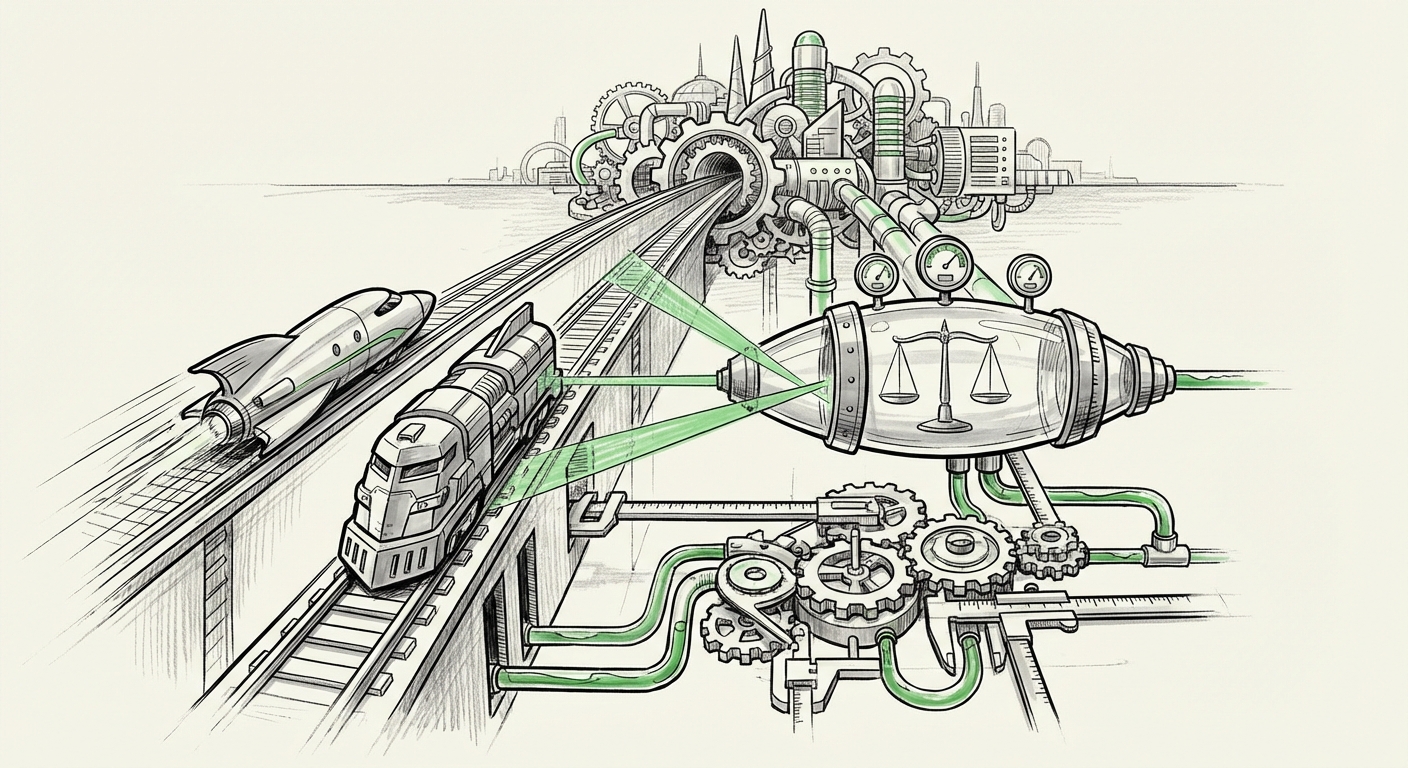
A truly AI native organization treats machine intelligence the way a modern city treats electricity. Nobody writes a strategy document about whether to have electricity. It is simply assumed, wired into the walls, and metered. AI native means the same thing for models, data, and automated decisions: they are the default, not the exception.
That leads to a useful test. Ask a simple question: if the AI systems were switched off tomorrow, would the business stop working, or would it just feel slower? For most companies, the honest answer is "slower, and honestly fine." That is the distance to travel.
The Individual: Redesigning How Work Gets Done
At the personal level, the transformation is less about prompt tricks and more about identity. The people who gain the most are not the ones who learn the fastest, they are the ones who stop defending the old division of labor between thinking and doing.
In a traditional workflow, a person does research, drafts, edits, formats, and checks. In an AI native workflow, the person sets the intent, defines the quality bar, and judges the output. The middle layer of production gets compressed. That is a big shift, and it is genuinely uncomfortable for people who take pride in craft.
Three habits separate the people who thrive from the people who stall:
- They externalize their judgment. Instead of keeping their standards in their head, they write them down, what a good answer looks like, what makes an output unacceptable. That written standard becomes the instruction set for the machine and the training manual for the team.
- They build small, reusable systems. Not one-off prompts, but repeatable routines for the five or six tasks they do every week.
- They stay in the verification seat. The single most valuable skill in an AI native workplace is the ability to tell a confident wrong answer from a correct one. That requires real domain knowledge, which is why deep expertise becomes more valuable, not less.
This is an important point that often gets lost. The fear is that AI makes expertise obsolete. In practice, AI raises the price of expertise, because the machine produces plausible output at volume and only an expert can sort the good from the bad. The bottleneck moves from production to judgment.
The Business: Three Layers of Redesign
Companies tend to attack AI adoption in the wrong order. They start with tools, then wonder why nothing changes. The more effective sequence works through three layers.
1. Process redesign
Most business processes were designed around human constraints: how long a person can read, how many files they can check, how fast they can respond. When those constraints loosen, the process should not just get faster, it should be restructured. A support workflow built around triage and escalation looks very different when a system can resolve a large share of issues instantly and hand the rest to a human with full context. Copy-pasting AI onto a human-shaped process captures a fraction of the value.
2. Organizational redesign
AI native companies flatten the distance between intent and execution. Small teams can now do work that used to require whole departments. That shifts the org chart: fewer coordination layers, more cross-functional "owners," and a new kind of role, someone accountable for the quality and safety of automated decisions, not just the humans making them.
It also changes hiring. The question stops being "does this person know the tools?" and becomes "can this person define good work and spot bad work?" That is a different interview.
3. Product redesign
The deepest layer. If your product is basically unchanged but now has a chat box, you have added a feature, not become AI native. The real question is what your product becomes when intelligence is assumed. What could a customer do without ever opening a menu? What work could disappear entirely? Companies that answer this honestly often find their roadmap reshuffles itself.
There is a governance layer under all three. AI native does not mean unsupervised. It means the guardrails are designed in from the start, clear ownership, audit trails, human checkpoints at the points that matter, and a fast way to roll something back. Organizations that skip this step tend to discover it the hard way, usually in public.
The Nation: Why This Is Infrastructure, Not Just Industry
The national dimension is where Lampert's framing becomes genuinely strategic. Countries do not become AI native because their companies do. They become AI native when the conditions exist for those companies to succeed.
That means several things at once:
- Compute and energy. AI is an industrial input. Nations that cannot supply power and data center capacity will find their businesses importing capability at a premium.
- Data and language. Models trained mostly on one language and one culture perform poorly elsewhere. Nations with their own languages and legal traditions need representation in the systems their institutions depend on.
- Skills, not just engineers. The bigger gap is not AI specialists. It is the millions of ordinary workers, nurses, teachers, clerks, technicians, who need enough fluency to use these tools well and enough judgment to know when not to.
- Rule-making that keeps pace. Regulation that arrives years after deployment governs the past. The harder and more valuable work is building rules that are adaptable, that reward transparency, and that do not simply hand the field to the largest incumbent.
There is also a public-sector dimension that is easy to overlook. Governments are among the largest employers and the largest processors of paperwork on earth. When a nation redesigns its own administration around AI, benefits processing, permit review, health records, it does two things at once: it improves services, and it builds domestic proof that the technology can be trusted. That proof is a competitive asset.
The Redesign Gap: Why Bolt-On Always Underdelivers
There is a consistent pattern behind failed AI programs. The technology works. The organization does not adapt around it. A model gets deployed into a workflow nobody changed, measured against metrics designed for a human-only process, owned by no one in particular, and quietly abandoned after the pilot.
Becoming AI native requires treating the redesign as the project. That means:
- Name an owner for every AI system, a person, not a committee, accountable for its accuracy and its failures.
- Change the metrics before you change the tools. If success is still measured in hours saved, you will only ever get hours saved.
- Start where the volume is boring. High-frequency, low-drama tasks build fluency and trust faster than flagship moonshots.
- Invest in the middle. The managers and team leads who translate strategy into daily habits decide whether adoption sticks.
- Keep humans where judgment is the product. Speed matters, but so does the cost of a confident mistake.
What This Means for the Future of AI
The next phase of AI will be less about breakthroughs and more about absorption. The models will keep improving; that is now close to a given. What is not given is whether institutions can rewire themselves fast enough to use them well.
That reframes the competitive landscape. The winners will not simply be the companies with the best models or the countries with the most compute. They will be the ones that redesigned their processes, their org charts, and their rules so that intelligence could flow through the system without breaking it. The technology is becoming a commodity. The redesign is the moat.
And the redesign starts uncomfortably close to home, with individuals deciding, honestly, whether they are still doing work the old way with new tools, or whether they have changed how they think about the work itself.