Inside VAKRA: Why AI Agents Fail, and What That Means for the Future of AI
For the last few years, the big story in AI was the chatbot. You typed something, it typed something back, and you decided what to do with it. That era is ending. The new story is the agent, a system that does not just answer, but acts. It searches, clicks, writes code, calls APIs, fills in forms, and moves money from one place to another.
That shift changes everything about how we judge AI. A chatbot that gives a slightly wrong answer wastes your time. An agent that takes a slightly wrong action can cost you real money, break a system, or leak private data.
This is the exact problem the VAKRA analysis tackles. VAKRA breaks agent behavior into three parts that matter: reasoning, tool use, and failure modes. It is less a victory lap and more an X-ray. And it lands at the right moment, because the industry is moving fast from "look what it can do" to "how do we trust it to do it."
The Anatomy of an Agent Loop
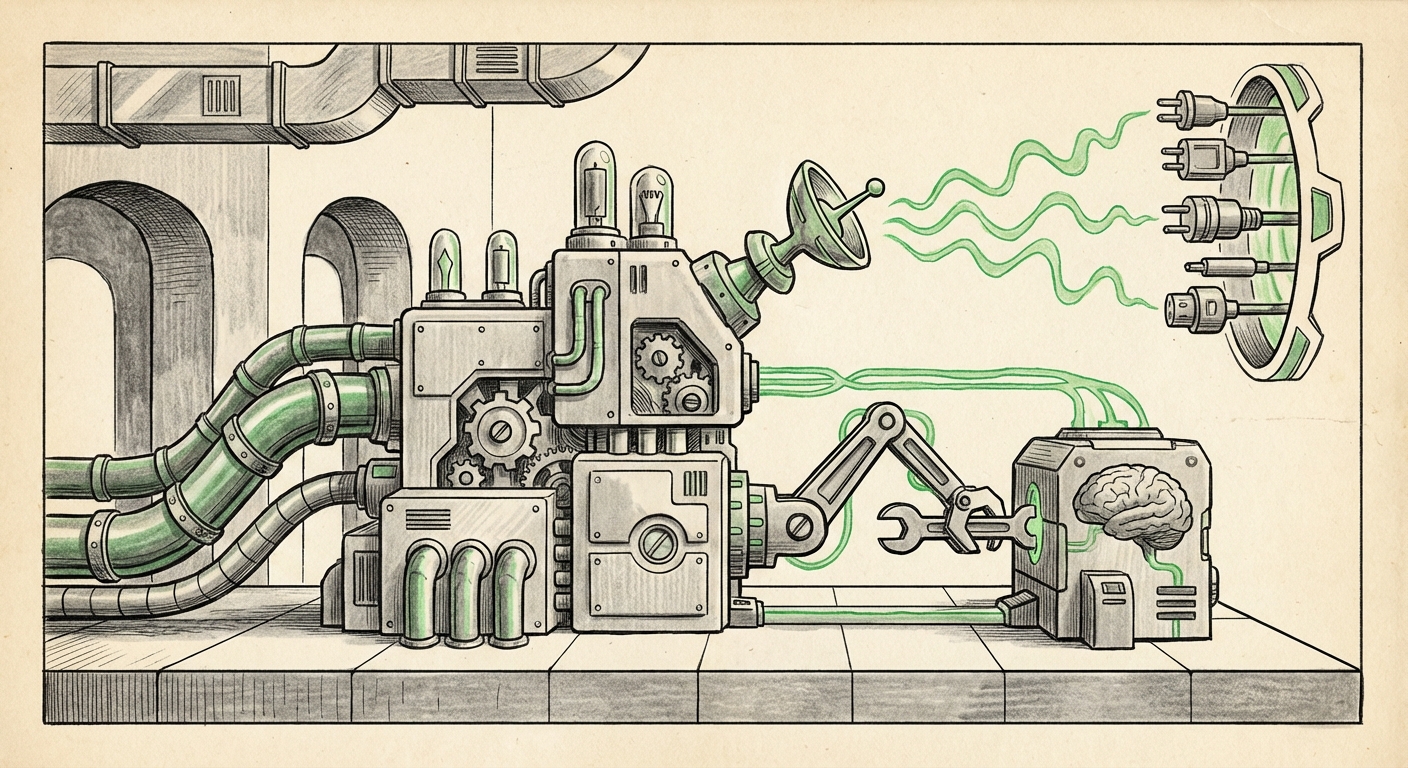
To understand why VAKRA matters, you need to see how an agent actually runs. It works in a loop, and the loop repeats until the job is done or something breaks.
First the model reasons: it looks at the goal and the history so far, and decides what to do next. Then it acts: it picks a tool and sends it a request. Then it observes: it reads whatever the tool sends back. Then it reasons again. Over and over.
Every step in that loop is a place where things can go wrong. VAKRA's three lenses map neatly onto the three steps. Reasoning covers the thinking. Tool use covers the acting and observing. Failure modes cover what happens when either one slips, and then compounds.
Reasoning: The Engine You Cannot See
Agent reasoning is where modern AI looks most impressive and is least trustworthy. The model can write out a plan that sounds calm, logical, and correct. That narrative is useful. It is not proof.
A model can produce a confident explanation of a step that is wrong. This is the core trap. When you read the reasoning, you tend to nod along. The words flow. The logic seems tight. But the underlying decision can still be off by one detail, the wrong customer ID, the wrong date range, the wrong file.
The bigger risk is drift. Over a long task, an agent has to hold a goal in place across many steps. Each step is a small chance to lose the thread. Ten steps is fine. Fifty steps starts to wobble. A few hundred steps, and the agent may be working hard on the wrong problem and never notice.
This is why reasoning quality is not the same as reasoning soundness. Developers often test whether the model sounds smart. The harder test is whether it catches itself, whether it notices the plan stopped matching the goal.
Tool Use: Where AI Touches the Real World
Tools are how an agent gets out of the chat box. Search engines, code runners, databases, browsers, payment systems, internal company APIs, each one is a doorway. And doorways are where security and reliability problems live.
Tool interfaces are messy in ways that models handle badly. A form expects a date in one format and the agent sends another. A database rejects a query because a column name changed. An API returns an error buried inside what looks like a normal response. The agent has to read all of this and adapt. Sometimes it does. Sometimes it does not.
There is also a security issue that many teams still underrate: tool output is untrusted input. A web page, an email, a PDF, or a support ticket can contain instructions. If an agent reads that text and treats it as a command, it can be steered by a stranger. This is not a rare edge case in agent design, it is a structural one. Anything an agent reads could be trying to talk to it.
The lesson from VAKRA's focus on tools is simple but easy to miss: agent reliability is often not a model problem at all. It is an interface problem. Clean schemas, clear error messages, and tight permissions do more for reliability than a slightly smarter model.
The Failure Modes Catalog Nobody Wanted, and Everyone Needs
The most useful part of looking closely at agents is naming how they break. VAKRA's attention to failure modes points at a pattern the industry keeps rediscovering: agents do not fail randomly. They fail in repeatable, recognizable ways.
Some of the common shapes:
- Looping. The agent repeats the same action, gets the same result, and tries again. It burns time and money without progress.
- Hallucinated tool calls. The agent invents a function, a parameter, or a field that does not exist, then builds a plan on top of it.
- Silent wrong parameters. The call succeeds. The action was executed. The customer was wrong. No error ever fired.
- Over-trusting output. The agent treats a tool's answer as truth, even when the tool returned something stale, partial, or poisoned.
- False completion. The agent declares the task done when it is only partly done, because it checked its own work with its own reasoning.
- Cascading errors. One small mistake becomes the input for the next step, which produces a bigger mistake, and so on.
- Scope creep. The agent decides to be helpful and does something extra that nobody asked for, sometimes something irreversible.
The important insight is that these compound. A misread result feeds a bad plan, which feeds a bad action, which feeds a confident summary that tells you everything is fine. That last part is the dangerous one. Agents are very good at sounding finished.
Why Failure Modes Beat Benchmarks
The AI world loves benchmarks. A high score is easy to market. But benchmarks mostly measure what happens in the middle of the curve, the average case. Businesses do not get hurt in the average case. They get hurt in the tail.
A support agent that handles ninety-nine out of a hundred tickets well and quietly issues a refund to the wrong account on the hundredth is not a ninety-nine-percent success. It is a liability with a nice dashboard.
This is the shift VAKRA's framing pushes toward: failure budgets instead of pass rates. Ask not "how often does it work?" but "what happens when it doesn't?" How bad is the worst case? Can it be undone? Would anyone notice? How long until someone notices?
When a system can take actions, the design question moves from accuracy to containment.
What This Means for the Future of AI
Agents will be judged like employees, not like software
We do not judge a new hire only on whether they can do the task. We judge them on whether they know when to ask, whether they flag problems, and whether they stop before doing something dumb. Agents are heading straight for that standard. The winners will not be the ones with the flashiest demos. They will be the ones that fail safely and tell you when they are unsure.
Agent operations becomes a real discipline
Expect the rise of agent ops: teams that watch live agents, set permissions, run evaluation suites, and review logs the way site reliability teams watch servers. Tools for tracing an agent's reasoning step by step will become as normal as application logs are today.
Model choice matters less than system design
Swapping in a stronger model helps. But sandboxing, narrow tool permissions, human checkpoints on irreversible actions, and clear error surfaces help more. The companies that get agents right will be the ones that treat the model as one part of a system, not the whole thing.
Trust becomes the product
As agents do more, buyers will ask harder questions. What can it touch? What can it not touch? What is the audit trail? Who is accountable when it gets something wrong? Those answers will separate serious vendors from demos.
A Practical Playbook
For teams putting agents into production now, a few moves go a long way.
- Start narrow. One task, one tool, one clear success condition. Expand only after you can measure the failure rate.
- Make actions reversible where you can. Drafts before sends. Staged changes before commits. Preview before payment.
- Put a human on irreversible steps. Anything that spends money, deletes data, or contacts a customer deserves a checkpoint.
- Treat tools as the security perimeter. Least privilege, scoped credentials, and no broad access "just in case."
- Separate reading from doing. Content the agent reads should never be able to grant it new powers.
- Log everything, especially the reasoning. When something goes wrong, you need the trail, not just the outcome.
- Test for the bad day. Build a set of known failure cases, loop bait, poisoned documents, broken APIs, and run them every time you change anything.
- Watch cost like a metric. A looping agent is a billing event. Put a ceiling on steps and spend.
The Bottom Line
The move from chatbots to agents is the most important shift in AI right now, and it is happening faster than most organizations are ready for. The hard part is not making an agent that can act. It is making one that stops at the right moment, admits when it is lost, and never quietly does the wrong thing.
VAKRA's focus on reasoning, tool use, and failure modes is a useful corrective to a market obsessed with capability. The next wave of AI winners will not be the systems that never fail. They will be the ones whose failures are small, visible, and cheap.