Track, Guard, and Remediate: The New Blueprint for Controlling AI Inside Your Company
Every company now has AI running somewhere in its walls. A chatbot answering customers. A coding assistant finishing pull requests overnight. An agent quietly pulling data from a dozen systems to draft a report. The problem is that most organizations can answer a simple but frightening question with a shrug: what exactly is our AI doing, and is any of it dangerous?
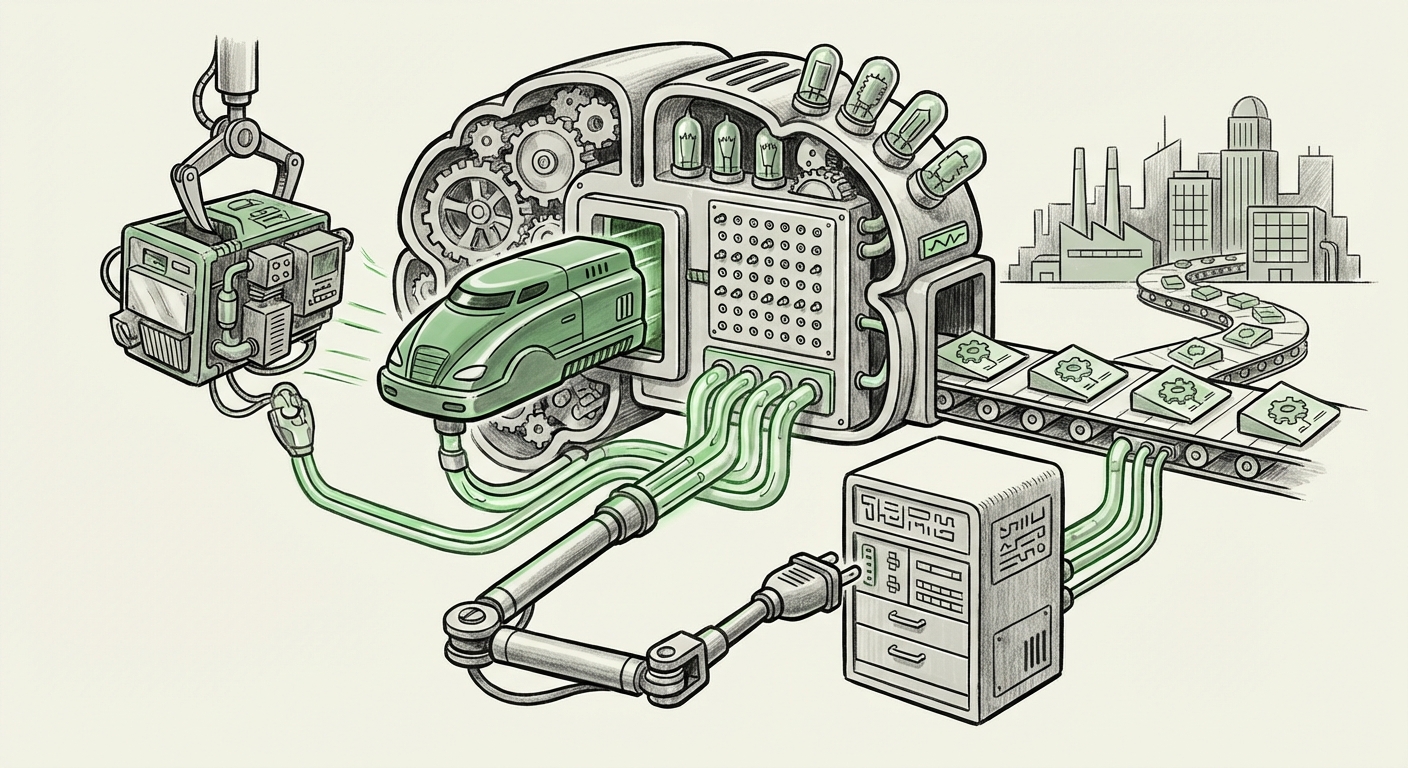
That gap is closing. The arrival of a joint capability between W&B Weave, the AI observability and evaluation platform from Weights & Biases, and CrowdStrike Falcon AIDR marks a real turning point. The pitch is short and direct: track, guard, and remediate AI usage. Three verbs that describe the full lifecycle of AI risk, from seeing what happened to stopping what shouldn't and fixing what broke.
This is more than a product integration. It is a signal that the two worlds that have been circling each other, AI observability and cybersecurity operations, are finally joining forces. And that changes how enterprises will build, buy, and govern AI from here on.
Why AI Needs Three Verbs, Not One
Traditional software has decades of tooling behind it: logs, monitoring, security scanning, incident response. AI applications break most of those assumptions. Their behavior is probabilistic. The same prompt can produce two different answers. Their "code" includes prompts, model versions, retrieved documents, and tool calls that change constantly. And critically, the output isn't just a screen, it can trigger actions in the real world.
That is why single-purpose tools fall short. A monitoring dashboard tells you a model answered slowly. It doesn't tell you the model leaked a customer's address. A firewall blocks a bad domain. It doesn't know that an AI agent was the one trying to reach it, or why.
The three-verb framing maps cleanly onto three distinct jobs:
- Track: Capture every AI interaction, prompts, responses, tool calls, model versions, token costs, and outcomes, so teams can trace behavior end to end instead of guessing.
- Guard: Apply security policy and detection to AI activity in real time, spotting misuse, prompt injection attempts, data exfiltration, and risky agent behavior as it happens.
- Remediate: When something goes wrong, respond, contain the activity, fix the flaw, and prove the fix worked.
Put those together and you get something organizations have been missing: a closed loop. Observability without security is a diary of your own mistakes. Security without observability is a smoke alarm with no idea which room is burning. The combination is what makes AI actually governable.
What the Weave and Falcon AIDR Combination Represents
W&B Weave is built around tracing and evaluating AI applications. It gives builders a window into what their models and agents are doing in production, and lets them score quality, catch regressions, and debug complex multi-step workflows. Its natural audience is the engineering and ML team, the people shipping the AI.
CrowdStrike Falcon AIDR belongs to a different tradition: AI detection and response, delivered through a security platform already trusted to watch endpoints, identities, and cloud workloads. Its audience is the security operations center, the people defending the company.
Bringing these together matters because the people who build AI and the people who defend the company usually do not share a screen. Builders see traces. Defenders see alerts. When a model starts behaving oddly or an agent reaches somewhere it shouldn't, the two sides often discover it at different times, in different vocabularies, and with no shared record of what happened.
An integrated track-guard-remediate workflow collapses that distance. The security team gains visibility into AI behavior that previously lived only in developer tooling. The AI team gains a security backstop that watches for threats their evaluation suite was never designed to catch. And the organization gains a single story it can tell auditors, regulators, and customers.
The Rise of AI Detection and Response
AI detection and response is quickly becoming its own security category, and for good reason. The threat surface has changed shape. Attacks against AI systems are not just "hack the server." They include:
- Prompt injection, where hidden instructions in a document or web page hijack an assistant's behavior.
- Data leakage, where sensitive information flows out through a model's response or into a third-party system.
- Agent misuse, where an autonomous agent with tool access performs actions no human approved.
- Shadow AI, where employees quietly connect unsanctioned models and tools to company data.
None of these look like classic malware. They look like normal traffic, normal prompts, normal API calls. Catching them requires something that understands AI context, which is exactly what an observability layer provides and what a security platform needs to act.
The strategic logic runs both ways. Observability platforms get a distribution channel into security budgets, which are large and resilient. Security platforms get the deep AI context they cannot easily build themselves. Customers get fewer integrations to stitch together and fewer blind spots to explain away.
Practical Implications for Businesses
1. Governance stops being a paperwork exercise
For the past few years, AI governance has largely meant policies, committees, and risk registers. Useful, but disconnected from runtime reality. When you can track actual AI interactions and tie them to security detections, governance shifts from "we have a policy" to "we can show you the evidence." That is a far stronger position when a regulator, board, or enterprise customer asks how AI is controlled.
2. The security team gets a seat at the AI table
Security leaders have spent years worried about AI they cannot see. An integration like this gives them a defensible answer: here is the inventory, here is the traffic, here are the policy violations, here is the response. It also lets them stop saying "no" to every AI project and start saying "yes, with these guardrails."
3. Incident response finally covers AI
Ask most companies what their playbook says when an AI agent misbehaves, and you will get a blank look. Track-guard-remediate gives that playbook a structure: detect the anomaly, trace the interaction, contain the access, patch the prompt or policy, verify the fix. Repeatable, auditable, and teachable.
4. Cost and quality become security-adjacent
Observability data is not only about risk. It reveals runaway agents, looping prompts, and expensive model calls, the operational failures that quietly burn budget. When that data sits next to security telemetry, a single dashboard can answer both "is this safe?" and "is this sane?"
An Actionable Playbook for the Next Two Quarters
The organizations that benefit most from this shift will not wait for a perfect platform. They will build the habits now. A practical sequence:
- Inventory your AI usage honestly. Include sanctioned apps, embedded vendor AI, and the tools employees signed up for on their own. You cannot guard what you have not found.
- Instrument the highest-risk workflows first. Customer-facing assistants, anything touching regulated data, and any agent with write access to systems. Trace these end to end before expanding.
- Define what "bad" looks like in concrete terms. Not "the AI should be safe" but "the assistant must never reveal account numbers" or "the agent must never call the payments API without human approval."
- Wire detection to response. Every guardrail needs an owner, a threshold, and an action, alert, throttle, block, or roll back.
- Rehearse the incident. Run a tabletop exercise where an agent leaks data or a prompt injection succeeds. Find the gaps before a real event does.
- Keep builders and defenders in the same room. Shared dashboards, shared review meetings, shared language. Tooling alone will not fix an organizational divide.
What This Means for the Future of AI
Three bigger trends sit behind this integration.
First, AI observability is becoming infrastructure, not a nice-to-have. As AI moves from demos to core operations, the ability to see inside a model's behavior will be treated like logging or tracing, a baseline expectation, not a premium feature.
Second, the security stack is being rebuilt around AI as a first-class workload. Just as cloud workloads once forced a new generation of security tools, AI agents are doing the same now. Expect AI detection and response to become a standard line item, evaluated alongside endpoint and cloud security rather than as a science project.
Third, the era of unaccountable AI is ending. When every interaction can be traced and every anomaly can be tied to a response, the excuse "we didn't know what the model was doing" stops working. That raises the bar for everyone, vendors, enterprises, and the teams deploying agents into production.
There is a cultural dimension too. The most mature organizations will stop treating AI risk as a blocker and start treating it as an operating discipline. The teams that can ship fast and prove control will win the trust that slower, more cautious competitors never earn.
Open Questions Worth Watching
No integration solves everything. Observability and security teams still speak different dialects, and merging their data raises real questions about privacy, data retention, and who owns the record of AI interactions. Tracing every prompt can capture sensitive content, so controls around the observability layer itself become critical.
There is also the question of coverage. The fastest-growing AI usage is not in carefully instrumented applications, it is in browser tabs, chat windows, and half-forgotten API keys. Closing that shadow AI gap will require more than developer tooling; it will require visibility at the point where people actually use AI.
And finally, the economics. Guardrails that slow teams down get bypassed. The winners in this category will be the ones that make tracking, guarding, and remediating feel like a natural part of building, not a tax on it.
The Bottom Line
The track-guard-remediate model is deceptively simple, and that is its strength. It gives organizations a shared mental model for something that has felt unmanageably abstract. Seeing AI behavior, protecting against it, and fixing what fails is not a feature list, it is the minimum standard for putting AI into production responsibly.
The companies that adopt that standard early will not just be safer. They will be faster, because they will be able to say yes to ambitious AI projects with confidence instead of fear. In a market where everyone is racing to deploy AI, the decisive edge may belong to the organizations that can prove they are in control.