The Eternal Complement: Why AI's Future Is Working With People, Not Replacing Them
Every few months, a new wave of headlines promises that machines are about to take over a whole profession. And every few months, the reality on the ground looks different. The tools arrive, the workflows change, and the humans stay, doing different work, with different leverage. That pattern has a name worth taking seriously: the eternal complement.
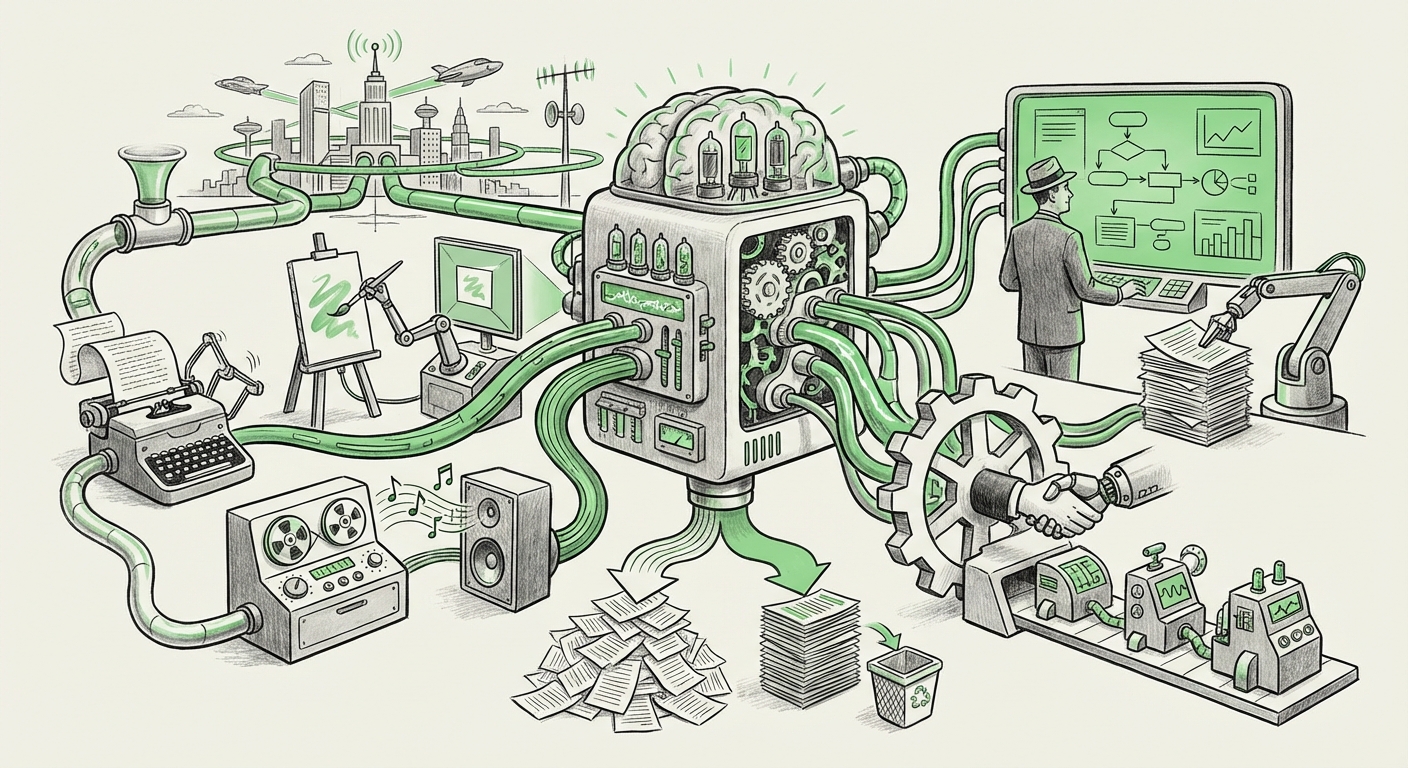
The idea is simple. Artificial intelligence is not a drop-in replacement for human beings. It is a permanent counterpart, a system that is most valuable when it is paired with human judgment, context, and accountability. This is not a comforting fallback story for people nervous about automation. It is a design principle, an economic reality, and increasingly the way the most serious AI builders think about what they are making.
Understanding why that is true, and what it means for the next phase of AI, is the most useful thing anyone building, buying, or regulating these systems can do right now.
What "The Eternal Complement" Actually Means
The phrase captures a durable relationship rather than a temporary stage. A complement is not something that fills in until the "real" solution arrives. It is something that makes the other part better, and is made better by it in return. Human reasoning and machine reasoning have very different strengths, and those strengths do not overlap much.
Machines are extraordinary at scale, speed, recall, and consistency. They can read a thousand documents before a person finishes one. They do not get tired, do not forget a step in a checklist, and do not bring a bad mood into a Monday morning meeting. They can generate twenty variations of an idea in the time it takes to describe the problem.
People are extraordinary at meaning, context, relationship, and responsibility. They know which of those twenty variations will land with this client, in this room, at this moment. They know when a rule should be broken and when it absolutely must not be. They can be held accountable, legally, ethically, and socially, in a way no model can.
Put those two sets of strengths together and you get something neither can produce alone. That is the complement. It is not a compromise. It is the actual product.
Why the Replacement Story Keeps Missing the Mark
The replacement narrative usually works by counting tasks and calling them jobs. If a system can do seven of the ten things a role involves, the headline says the role is 70% automated. But real work is not a bag of independent tasks. It is a web of decisions, handoffs, and judgments where the value often lives in the seams.
Three things keep pulling the story back toward complementarity:
- Context lives outside the model. The most important information in most organizations, why a decision was made three years ago, which stakeholder will object, what the unwritten rule is, is rarely written down in a form a system can learn from. A person carries that context and supplies it.
- Errors have owners. When something goes wrong, someone has to answer for it. Accountability is a human-shaped thing. Systems can be audited, but they cannot be responsible. Any high-stakes workflow therefore keeps a person in the loop by necessity, not by sentiment.
- Trust is built, not installed. Adoption follows experience. Teams that start with a system making suggestions and a person approving them end up trusting the tool more than teams handed an autopilot they never learned to read.
None of this means jobs do not change. They change a lot. But the direction of change is toward supervision, orchestration, and judgment, not toward absence.
The Three Layers Where Complementarity Shows Up
1. The cognitive layer: thinking partners
At the level of individual work, AI shows up as a thinking partner. It drafts, summarizes, critiques, and explores. The person supplies the goal and the taste. The most effective users are not the ones who delegate everything, they are the ones who argue with the output, push back, and refine. The value comes from the loop, not from the first draft.
2. The organizational layer: coordination machines
At the level of a company, AI increasingly acts as connective tissue. It routes information, drafts routine communication, flags anomalies, and keeps projects moving. This is where the biggest real gains sit, because most organizational friction is not intellectual, it is coordination overhead. Here too, humans set priorities and resolve conflicts the system surfaces but cannot settle.
3. The judgment layer: the final call
At the highest level, the complement shows up as decision support. Systems widen the option space and sharpen the trade-offs; people choose. This is the layer that resists automation longest, because choosing involves values, not just predictions. And it is the layer where AI's real contribution is largest, not by deciding, but by making the decision better informed.
What This Means for the Future of AI Itself
If complementarity is the durable shape of the technology, it changes what good AI looks like. Several design shifts follow directly.
Interfaces become as important as models. A system that is 5% smarter but harder to steer is a worse product. The winning pattern is tools that show their work, invite correction, and make it cheap for a person to say "no, try this instead."
Agents need to be legible, not autonomous. The push toward systems that take multi-step actions on their own is real, but the ones that get deployed are the ones that narrate what they are doing, pause at checkpoints, and can be interrupted. Autonomy is a dial, not a destination.
Evaluation must measure the pair, not the model. Benchmark scores tell you how a model performs alone. What matters in practice is how much better a person performs with it. That is a different measurement, and it is the one that predicts whether a deployment succeeds.
Trust and calibration become features. A system that says "I am not sure" at the right moment is worth more than one that is confidently wrong. Teaching models to express uncertainty well is a complementarity problem, not a raw capability problem.
Practical Implications for Businesses
The organizations that get the most out of this shift tend to do a few things differently from the ones that stall.
They start with workflows, not tools. Instead of asking "where can we add AI?", they ask "where does work get stuck, and what would unsticking it look like?" That question almost always points to a handoff, a review cycle, or a search problem, places where a system can compress delay while a person keeps the decision.
They redesign roles instead of eliminating them. A role that was 80% production and 20% judgment becomes 30% production, 50% review and direction, 20% relationship. That is a real change in daily experience, and it needs to be managed as one, with training, new expectations, and honest communication.
They protect the apprenticeship pipeline. This is the most underrated risk in the whole conversation. Many professional skills are learned by doing the junior version of the work. If the junior version is fully automated, where do the senior people of the next decade come from? Smart teams deliberately keep enough hands-on work in the loop to grow judgment.
And they keep a human accountable at every high-stakes gate. Not as theater, but because accountability is what makes the system usable in regulated, reputational, or safety-critical contexts. A named person who owns the outcome is a design requirement, not a leftover.
Actionable Insights
- Audit at the task level, not the job level. Map where a system can draft, check, summarize, or route, and where a person must decide. Then rebuild the workflow around that split.
- Measure the pair. Track how much faster and better people perform with the tool. That number, not a benchmark score, justifies the investment.
- Buy for steerability. Favor systems that show reasoning, accept correction, and log what they did. Reject black boxes in any workflow with consequences.
- Fund the human side. Budget for training, role redesign, and review time. The tool is usually the smaller line item.
- Keep the ladder intact. Make sure junior people still get reps on real problems, or you are borrowing senior talent from your future self.
- Write down your context. Every process you document becomes something a system can actually help with. Institutional knowledge is now infrastructure.
Where the Complement Story Could Break
Honesty requires naming the risks. Complementarity holds when humans remain meaningfully in the loop and when the gains are shared. It frays if three things happen.
First, if systems become capable enough across entire workflows that the human review step becomes a rubber stamp, present on paper, absent in practice. That is worse than either full automation or full human control, because it combines the failure modes of both.
Second, if the productivity gains concentrate entirely in the hands of whoever owns the systems, leaving workers with the disruption and none of the upside. The complement only stays stable if the value is shared.
Third, if the skills pipeline collapses because entry-level work disappears faster than new entry-level work appears. Complementarity assumes a person worth complementing. That assumption has to be actively maintained.
The Bottom Line
The most useful frame for the coming years is not "what will AI replace?" but "what will AI complete?" The technology is at its best when it removes friction, widens options, and handles scale, while people supply meaning, context, and accountability. That division of labor is not a temporary arrangement while we wait for better models. It is the shape the relationship keeps returning to, wave after wave.
For leaders, the practical instruction is clear: design for the pair. For workers, it is equally clear: the durable skills are judgment, taste, context, and the ability to direct a system rather than compete with it. The eternal complement is not a promise that nothing changes. It is a promise that the change is a partnership, and partnerships are something you have to build on purpose.