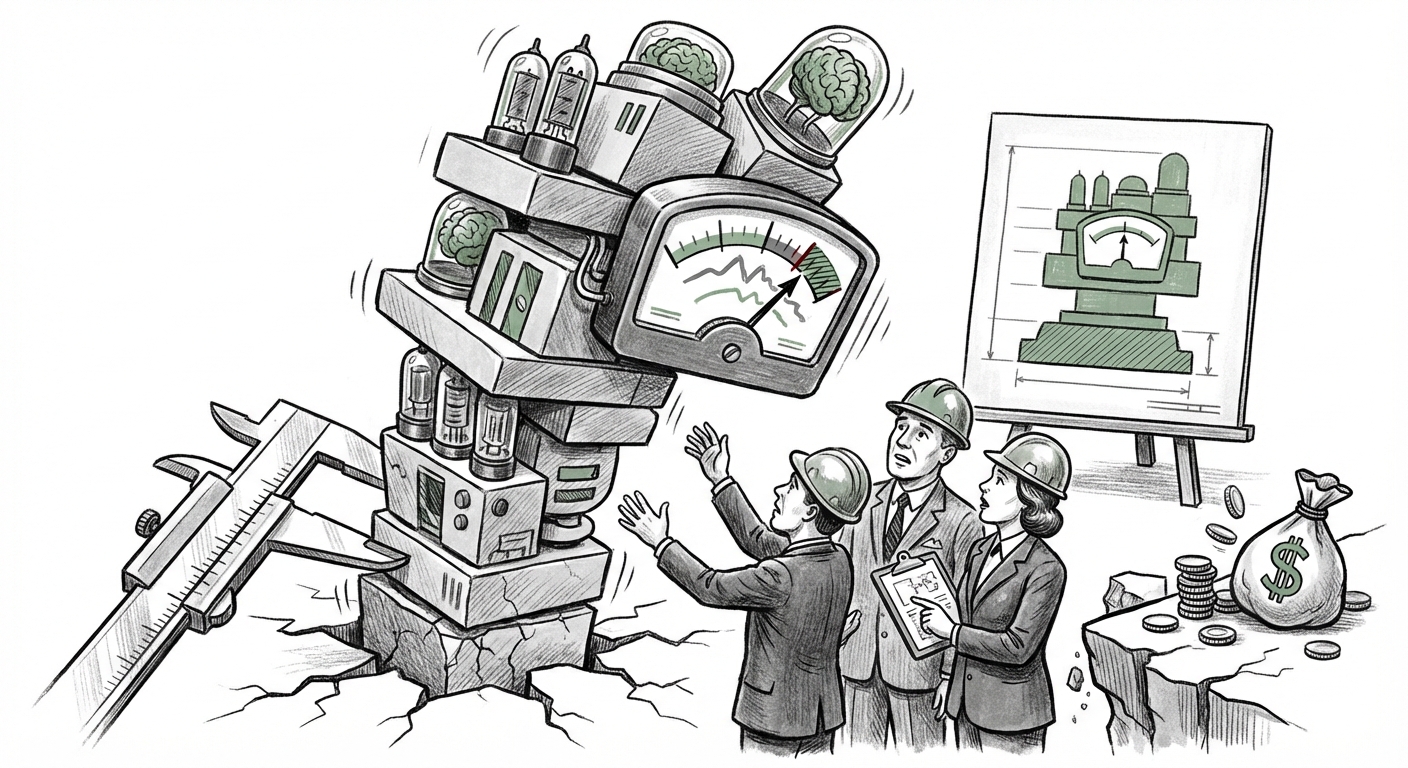
Google Reshapes AI Leadership: Demis Hassabis Moves to AGI Strategy, What It Means for the Future of AI
Something important just shifted inside one of the world's most powerful AI companies. Google is reshaping its artificial intelligence leadership, and Demis Hassabis, the researcher most closely tied to its deep research ambitions, is moving into a role focused on AGI strategy.
On the surface, that sounds like an internal org-chart shuffle. A title changes. A desk moves. Maybe a new layer of management appears on a slide somewhere.
But look closer, and this is a signal worth paying attention to. When the person who has spent years chasing artificial general intelligence steps back from day-to-day building and into the role of deciding what AGI should be, when it should arrive, and how it should be governed, that tells you something about where the whole industry is heading.
AGI, artificial general intelligence, is the term for a system that can handle almost any mental task a human can, not just one narrow job like translating text or writing code. Nobody has built one yet. But the companies racing toward it are now spending real money and real executive time arguing about how to get there responsibly.
That's the story here. Not a staffing change. A shift in priorities.
What Actually Changed
The announcement confirms a structural change at the top of Google's AI efforts. Hassabis, long the public face and scientific driving force behind the company's most ambitious research, is now focused on AGI strategy rather than running the full research and product machine on his own.
This is a meaningful split. For years, the same person was expected to chase breakthroughs in the lab and make sure those breakthroughs showed up in products people actually use, search, cloud, phones, developer tools, and everything else Google sells.
Those are two very different jobs.
One job is about discovery. It rewards curiosity, tolerance for failure, and long time horizons. The other is about delivery. It rewards reliability, speed, cost control, and meeting customer demand. Forcing one leader to own both is like asking a research scientist to also run a factory floor.
Splitting them is a sign of maturity. It suggests Google believes the lab work is now strong enough to survive on its own, and the strategic questions are now big enough to need full-time attention at the top.
Why "AGI Strategy" Is Suddenly a Real Job Title
A decade ago, "AGI strategy" would have sounded like science fiction inside a corporate job posting. Today it's a serious executive function. There are three reasons for that.
1. The timeline debate has gone mainstream
Nobody agrees on when AGI arrives. Some researchers think we're a handful of years away. Others think it's decades off, or that the whole framing is wrong. But the debate itself has moved from academic seminars into boardrooms, because the answer changes everything, how much you invest, what you build, what you regulate, and what you tell your customers.
A dedicated AGI strategy role is a way of saying: we're going to think hard about this, and we're going to make decisions on purpose rather than by accident.
2. Capability and safety are now the same conversation
The more capable a system becomes, the more important it is to know what it will and won't do. Safety used to be treated as a brake on progress, something you added at the end. Increasingly it's being treated as part of the design. Assigning a senior scientific leader to this space sends a message that the company wants responsible development led by people who understand the technology deeply, not just by lawyers and communications teams.
3. Strategy is how you avoid building the wrong thing
At this scale, the expensive mistakes aren't technical. They're directional. Building a massive system that solves a problem nobody has, or that creates risks you can't manage, is a multi-billion-dollar error. A strategy function exists to make sure the research engine is pointed at something that matters.
The Research-to-Product Gap Is the Real Battleground
Here's the practical thing most people miss. The hardest part of AI isn't having a great idea in a lab. It's turning that idea into something that works reliably, cheaply, and safely for millions of users, and then keeping it working.
Companies across the industry are discovering this the hard way. A demo can be stunning and still be useless in production because it's too slow, too expensive, too unpredictable, or too hard to explain to a regulator.
By separating the AGI strategy function from the product function, Google is essentially admitting the two need different leaders and different scorecards. That's not a weakness. That's how big organizations handle genuinely hard problems.
For anyone watching the industry, this is the pattern to track: which companies have clearly separated the "invent it" work from the "ship it" work, and which ones are still asking one team to do both? The ones that separate well will move faster with fewer public disasters.
What This Means for Businesses
If you run a company that uses AI, which is most companies now, this leadership shift carries a few practical lessons.
Your AI strategy needs an owner, not a committee
Too many organizations treat AI as a side project. A few people experiment, something interesting happens, nobody scales it, and the effort quietly dies. What Google's move illustrates is the value of putting a senior person in charge of the direction of AI, separate from the people responsible for daily delivery.
You don't need a chief AGI officer. But you do need someone who can answer: what are we trying to do with AI, what are we deliberately not doing, and how would we know if we were wrong?
Expect the underlying technology to keep changing
Leadership changes at major AI labs are a reminder that this field is still in motion. The model you built on last year may not be the best choice next year. That means your systems should be built so the underlying model can be swapped out without rebuilding everything around it. Lock-in is the quiet killer of AI budgets.
Plan for governance before you need it
If the biggest labs are now treating AGI strategy as a dedicated executive function, regulators and customers will expect something similar from everyone else. That means documented policies, clear accountability, and a way to audit what your AI systems actually do. Companies that build this early will spend far less time firefighting later.
Safety, Trust, and the Reputation Trap
There's a harder truth buried in this story. The companies leading the AI race are caught between two pressures that pull in opposite directions.
Move too slowly, and a competitor ships first. Move too fast, and you ship something that causes harm, and the public remembers.
Putting a respected scientific leader on AGI strategy is one way to manage that tension. It creates an internal voice whose job is to ask uncomfortable questions early, while there's still time to change course. That voice matters most in the months before a major launch, when everyone is excited and nobody wants to hear bad news.
For businesses and the public, the useful question is this: who inside these companies is empowered to say no? If the answer is "nobody senior," be cautious about what gets released.
Talent and the Competition for Judgment
Leadership moves like this also shape the talent market. Top AI researchers want to work somewhere their work matters and where decisions make sense. A clear structure, with a defined strategy function and a defined product function, is easier to navigate than a blurry one where nobody knows who decides.
It also signals something to the next generation of researchers: the path upward isn't only about publishing papers. It's about shaping direction. As the field matures, judgment becomes as valuable as raw technical skill.
Actionable Insights
- Separate invention from delivery. Give research and product different leaders, different metrics, and different timelines. Mixing them slows both down.
- Appoint a single AI strategy owner. Someone senior should own the question of what AI is for inside your organization, and what it isn't for.
- Build for model portability. Assume the leading AI systems will change. Design your stack so swapping providers is a project, not a rebuild.
- Write your AI governance rules now. Not after an incident. Plain-language policies, named accountability, and a review step before launch.
- Watch the org charts, not just the product launches. Leadership structure reveals priorities months before the public sees them in a release.
- Train your people to ask "should we?" The teams that catch bad use cases early save the most money and reputation.
What to Watch Next
The immediate question is how Google's research and product organizations settle into their new shape, and whether the split produces faster shipping, clearer safety decisions, or both. Watch for whether the AGI strategy role becomes a model other labs copy. If it does, that's a strong signal the industry as a whole is moving from "can we build it?" to "how should we build it?"
The bigger question is cultural. For years, the AI race has been framed as a sprint for raw capability. Leadership changes like this suggest the next phase is a race for judgment, the ability to decide which capabilities to build, how to release them, and who gets to say when.
The Bottom Line
Demis Hassabis moving into an AGI strategy role at Google is not a story about one person changing desks. It's a story about an industry growing up.
The easy years of AI were about proving the technology could work at all. The hard years are about deciding what it should do, who it should serve, and how to keep it from doing harm. That work doesn't fit neatly into a research lab or a product roadmap. It needs its own seat at the table.
Google just built that seat. Expect others to follow, and expect the companies that do it well to be the ones we're still talking about in five years.