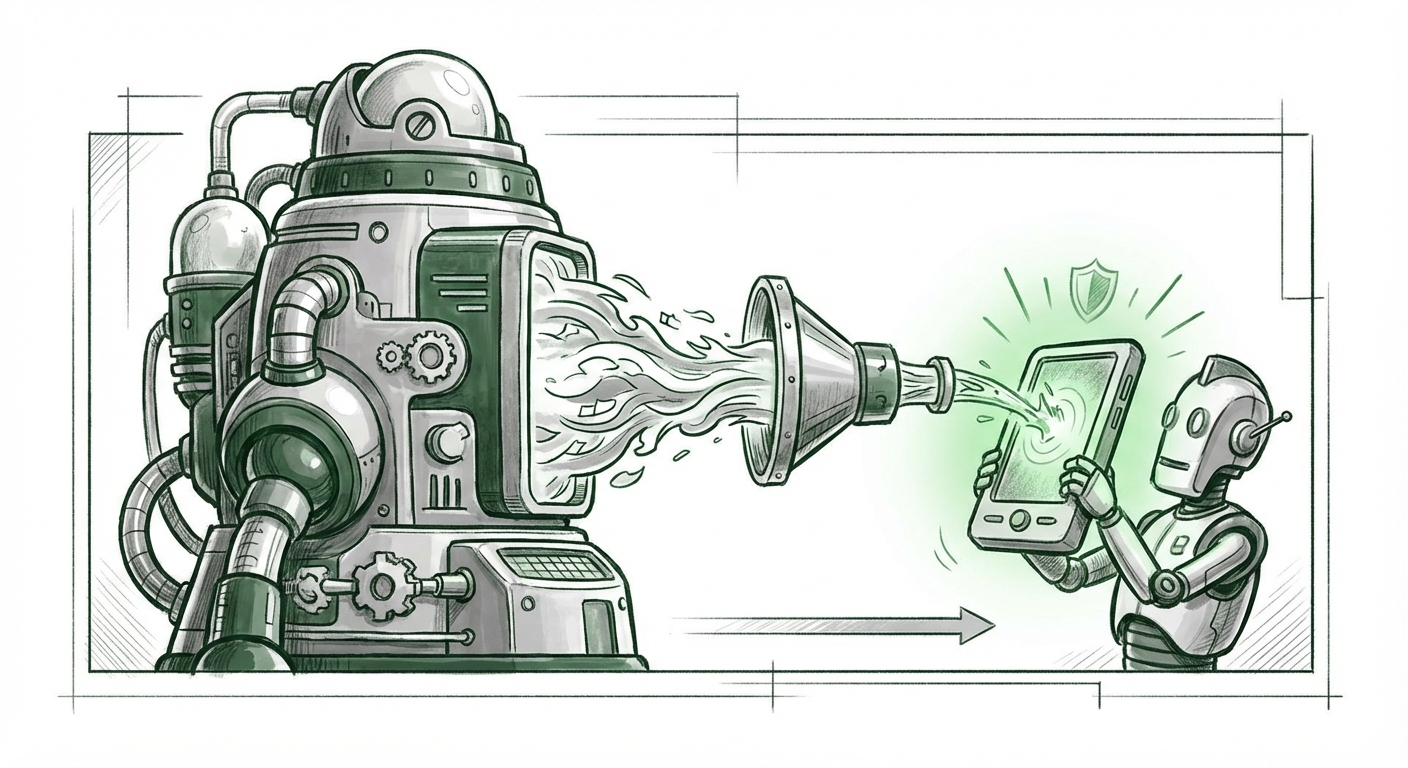
Injecting Domain Expertise Into AI Systems: How to Turn General AI Into a Business Expert
Artificial intelligence has made huge leaps in recent years. Large language models can write essays, answer questions, and even code. But if you ask a general AI to handle a task in your specific industry, like interpreting a legal contract, diagnosing a machine failure, or processing an insurance claim, it often stumbles. Why? Because general AI knows a little about everything but not enough about your world. That's where injecting domain expertise comes in. It's the process of giving AI systems the specialized knowledge, rules, and context they need to perform like an expert in a particular field. And it's quickly becoming the most important trend in enterprise AI.
The Problem With General-Purpose AI
General AI models are trained on vast amounts of public data from the internet. This makes them good at common tasks and general conversation. But they lack the deep, nuanced understanding that comes from years of experience in a specific domain. For example, a general AI might not know that in your company, a "finished good" means something very different from what it means in a textbook. It might miss industry-specific regulations, safety rules, or jargon. Worse, it can "hallucinate", make up facts that sound plausible but are wrong. In high-stakes fields like healthcare, finance, or manufacturing, those mistakes can be costly or even dangerous.
Businesses are realizing that a one-size-fits-all AI model isn't enough. To get real value, AI needs to understand your business the way your best employees do. That means injecting domain expertise.
What Does "Injecting Domain Expertise" Actually Mean?
At its core, injecting domain expertise means teaching an AI system the specific knowledge, rules, and patterns of a particular field. It's not just about feeding it more data, it's about feeding it the right data and the right guidance. Domain expertise can come from many sources: internal documents, expert interviews, historical records, industry standards, and even the tacit knowledge that experienced workers carry in their heads. The goal is to make the AI behave like a seasoned specialist, not a curious generalist.
This is different from simply building a bigger model. A bigger model trained on more internet text won't necessarily know your company's return policy or the specific way your factory floor is organized. Domain expertise is about depth, not breadth.
Key Methods for Injecting Domain Expertise
There are several practical ways to inject domain expertise into an AI system. Most successful projects combine more than one method.
1. Fine-Tuning
Fine-tuning takes a pre-trained model and trains it further on a smaller, domain-specific dataset. For example, you might fine-tune a language model on thousands of your company's customer support tickets so it learns how to respond to common issues in your brand's voice. Fine-tuning is powerful, but it requires high-quality labeled data and can be expensive.
2. Retrieval-Augmented Generation (RAG)
RAG connects an AI to an external knowledge base, like a database of documents, product manuals, or legal cases. When the AI needs to answer a question, it first retrieves relevant information from that knowledge base and then uses it to generate a response. This is often the easiest and most cost-effective way to inject expertise because you don't have to retrain the model. You just give it access to the right information at the right time.
3. Knowledge Graphs
A knowledge graph is a structured way to represent facts and relationships. For example, a medical knowledge graph might link symptoms to diseases to treatments. By integrating a knowledge graph, an AI can reason more logically and avoid contradictions. This is especially useful in fields where precision matters, like finance or engineering.
4. Rule-Based Guardrails
Sometimes the best way to inject expertise is to hard-code rules. For instance, you might tell the AI, "Never recommend a drug dosage above X" or "Always include a disclaimer when discussing legal matters." These guardrails prevent the AI from going off track and ensure compliance with industry regulations.
5. Prompt Engineering With Domain Context
Even without changing the model, you can inject expertise through carefully crafted prompts. By including detailed instructions, examples, and context in the prompt, you guide the AI to behave like an expert. This is a quick win, though it may not scale as well as other methods.
6. Human-in-the-Loop Feedback
Experts can review the AI's outputs and correct mistakes. Over time, this feedback can be used to improve the model or the knowledge base. Human-in-the-loop is essential for building trust and capturing the subtle judgments that experts make.
7. Domain-Specific Evaluation
You can't just test an AI on general benchmarks. You need to evaluate it on real-world tasks from your domain. Create a test set of challenging cases and measure how often the AI gets them right. This tells you whether the injected expertise is actually working.
Why This Matters: The Business Case
Injecting domain expertise isn't just a technical exercise, it delivers real business value. Here's how:
- Higher accuracy and trust: An AI that understands your domain makes fewer mistakes, which means employees and customers can rely on it.
- Compliance and safety: Domain-specific guardrails help ensure the AI follows laws and regulations, reducing risk.
- Competitive advantage: An AI that knows your business can automate complex tasks that general AI can't handle. That frees up experts to focus on higher-value work.
- Cost savings: Smaller, specialized models can be cheaper to run than massive general models, and they often perform better on narrow tasks.
- Better customer experience: AI that speaks your industry's language and knows your products feels more helpful and professional.
In short, domain expertise turns AI from a novelty into a trusted tool.
Challenges and How to Overcome Them
Injecting domain expertise isn't without hurdles. Here are the most common challenges and how to tackle them.
Data Quality and Availability
Domain data is often messy, scattered across systems, or locked in PDFs. Before you can inject expertise, you need to collect and clean your data. Start small: pick one high-value use case and gather the relevant documents, records, and examples.
Privacy and Security
Domain data often contains sensitive information. You need to ensure that data is handled securely and that the AI doesn't leak private details. Work with your security team from day one.
Capturing Tacit Knowledge
Some of the most valuable expertise lives in the heads of experienced employees. They may not have written it down. To capture it, conduct interviews, record walkthroughs, and observe how experts solve problems. Then turn that into rules, examples, or training data.
Maintenance and Updates
Domain knowledge changes. New regulations appear, products evolve, and best practices shift. You need a plan to keep your AI's expertise current. That might mean regular updates to your knowledge base or periodic fine-tuning.
Evaluation Is Hard
It's tricky to measure whether an AI truly "understands" a domain. Don't rely on generic benchmarks. Build your own test suite with real cases from your business. Have experts grade the AI's answers and track improvement over time.
Practical Steps to Get Started
Ready to inject domain expertise into your AI? Here's a simple roadmap.
- Pick a narrow, high-value use case. Don't try to boil the ocean. Choose one task where AI could save time or reduce errors, like answering customer questions about a specific product line or flagging compliance issues in contracts.
- Assemble a team of domain experts and AI engineers. You need both. Experts provide the knowledge; engineers build the system.
- Build a data pipeline. Collect the documents, records, and examples that contain the expertise. Clean and organize them.
- Choose your injection method. Start with RAG if you have a good knowledge base. Consider fine-tuning if you have lots of labeled data. Add guardrails for safety.
- Create a feedback loop. Have experts review outputs and correct mistakes. Use that feedback to improve.
- Measure and iterate. Track accuracy, time saved, and user satisfaction. Keep refining.
- Scale gradually. Once you have a win, expand to related use cases.
The Future of AI Is Specialized
Looking ahead, the trend is clear: the most valuable AI systems won't be the biggest general models, they'll be the ones with deep, injected expertise. We're already seeing a shift toward vertical AI solutions built for specific industries like healthcare, legal, and manufacturing. These systems combine general language understanding with specialized knowledge to deliver expert-level performance.
In the future, we can expect to see smaller, more efficient models that are trained from the ground up on domain data. These models could run on local devices, making AI faster and more private. We'll also see new roles emerge, like "AI domain curators" who are responsible for capturing and maintaining expertise. And as AI becomes more specialized, it will become safer and more trustworthy, because it will be constrained by domain rules and validated by experts.
Ultimately, injecting domain expertise democratizes AI. You don't need a massive research team to build an AI that knows your business. With the right methods and a focus on your unique knowledge, you can turn a general-purpose model into a powerful, specialized assistant.
Conclusion
The race for AI dominance isn't about who has the biggest model. It's about who can best inject their domain expertise. General AI is a starting point, but specialized AI is where the real value lies. By combining human knowledge with machine learning, businesses can create AI systems that are accurate, trustworthy, and genuinely useful. The future belongs to AI that understands your world, and that future starts with injecting domain expertise.