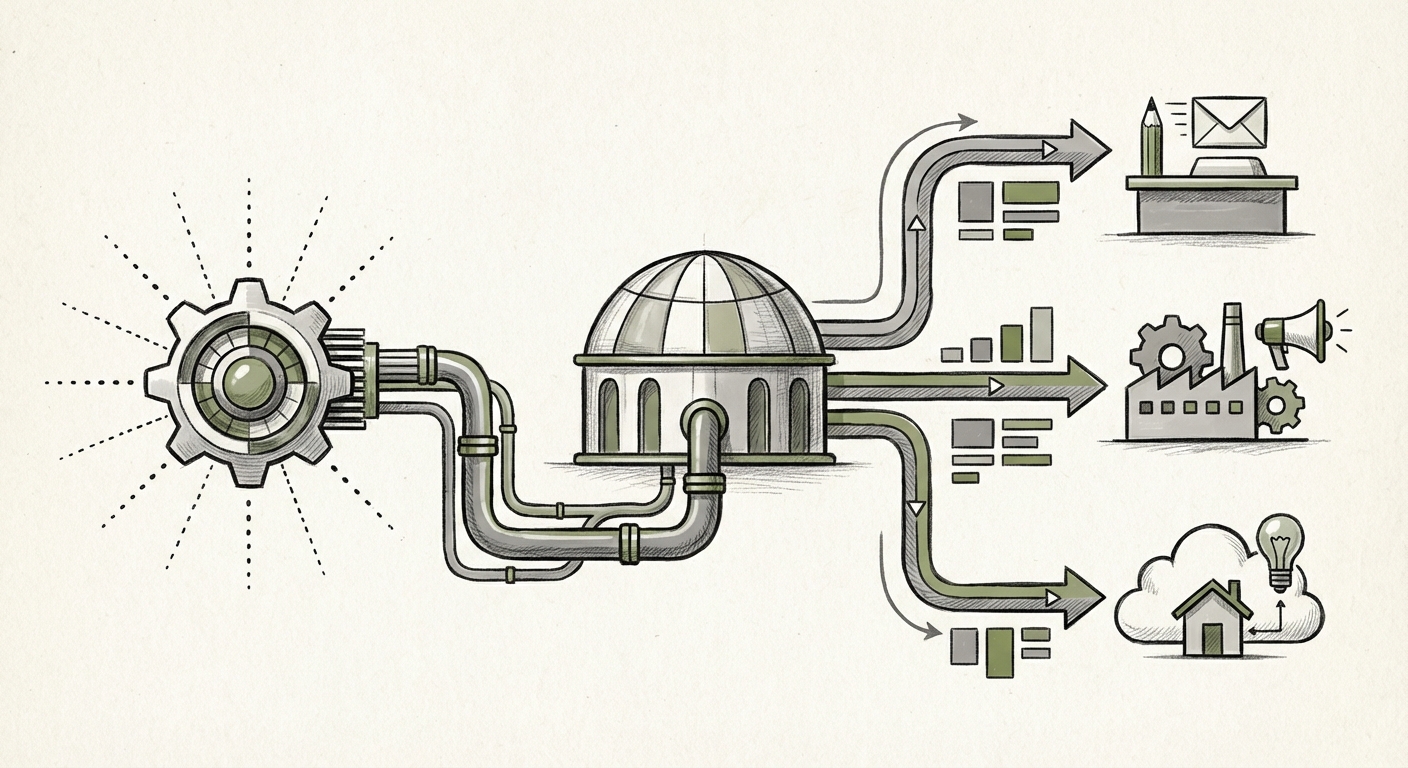
Quality-Controlled Data: The Hidden Engine Behind Small Language Models That Answer Your Calls
Most of the AI conversation still circles around giant models. Bigger context windows. More parameters. More benchmarks. But some of the most important work happening right now is happening in the opposite direction, in the small, focused, carefully trained models that pick up the phone when you call a business.
The arrival of quality-controlled reply and summary data designed specifically for post-training small language models in AI call-screening agents marks a real shift. It signals that the call-screening industry is moving past the demo phase and into the engineering phase. The question is no longer "can a model talk on the phone?" It is "can we trust it to say the right thing, write down the right notes, and do it at a price that makes sense?"
That is a data problem before it is a model problem. And that is exactly why this development matters.
Small Models Are Taking the Front Lines
Call screening is a strange and demanding job. An agent has to answer quickly, sound human, understand messy speech, handle interruptions, ask follow-up questions, respect privacy, and summarize what happened in a way a human can actually use. All of that has to happen in real time, often thousands of times a day.
Large language models can do many of these things well. But putting a giant model behind every inbound call is expensive, slow, and hard to control. Latency matters when someone is waiting on the line. Cost matters when call volume is high. And compliance matters when every conversation may contain personal information.
This is where small language models come in. These are models trained to be good at a narrow set of tasks rather than everything at once. They can run faster, cost less, and be deployed closer to where the call happens. For a business that screens thousands of calls, those differences add up fast.
But small models have a weakness. They have less room to "figure things out" on their own. A large model can sometimes recover from a vague instruction. A small model usually cannot. It needs examples. It needs clear patterns. It needs data that shows exactly what a good reply looks like and exactly what a good summary contains.
The Real Bottleneck: Data Quality, Not Model Size
This is the heart of the story. The limiting factor for small language models in call screening is not architecture or compute. It is the quality of the training data used after pre-training, the post-training stage where a general model becomes a specialist.
Post-training is where a model learns the habits of a job. It learns how to greet a caller, how to ask for a name, how to handle a request to speak to a manager, and how to end a call politely. It also learns how to compress a five-minute conversation into four sentences of useful notes.
If that training data is sloppy, the model learns sloppy habits. If it is inconsistent, the model becomes inconsistent. If it contains private information, the model may memorize and repeat it. Quality control is not a nice-to-have here. It is the whole game.
Replies and Summaries Are Two Different Products
One of the most useful ideas embedded in this kind of work is that reply data and summary data should be treated as separate products with separate quality rules.
A reply is a live action. It has to be fast, natural, and safe. It must not promise things the business cannot deliver. It must not give advice it is not allowed to give. It must handle a caller who is confused, upset, or in a hurry. The quality bar for a reply is about tone, timing, and boundaries.
A summary is a record. It has to be accurate, complete, and short enough to read in seconds. It must capture who called, why, what was agreed, and what should happen next. The quality bar for a summary is about facts, structure, and recall.
Mixing the two into one blob of training data is a common mistake. It teaches the model to blur the line between talking and recording. Separating them lets teams measure each one properly and fix problems where they actually occur.
What "Quality-Controlled" Actually Means
Quality control in this context is a set of checkpoints, not a single review. It usually includes:
- Clear annotation rules. Everyone labeling data follows the same definition of a good reply and a good summary.
- Multiple reviewers. More than one person checks each example, and disagreements are resolved on purpose rather than ignored.
- Consistency scoring. Teams measure how often reviewers agree, because low agreement means the rules are unclear.
- Redaction and privacy checks. Names, numbers, account details, and health information are removed or handled under strict rules before data is used.
- Edge-case coverage. The data deliberately includes angry callers, accents, background noise, silence, interruptions, and requests the agent must refuse.
- Versioning. Every change to the dataset is tracked so results can be traced back to a specific data version.
None of this is glamorous. All of it is what separates a model that works in a lab from a model that works on a Tuesday morning when a caller is frustrated and the phone will not stop ringing.
Why This Matters for the Future of AI
The biggest lesson here goes well beyond call screening. It points to where a large share of practical AI is heading: small, well-trained, task-specific models fed by carefully built data.
For years, the default answer to almost every AI problem was "use a bigger model." That is changing. Teams are learning that a smaller model with excellent data can beat a larger model with messy data on a narrow task. It can also be cheaper, faster, easier to audit, and easier to keep private.
This has three big implications.
1. Data work becomes a core business function
When model quality depends on data quality, the people who write guidelines, review examples, and resolve disagreements become central to the product. Data labeling stops being a back-office task and becomes part of engineering. Companies that treat it that way will ship better AI. Companies that do not will keep wondering why their demos do not survive contact with real users.
2. Privacy moves from policy to pipeline
Call data is some of the most sensitive data a business holds. Building quality-controlled training data forces teams to decide, in concrete terms, what gets stored, what gets removed, and who can see it. That is healthier than writing a privacy policy and hoping for the best. The pipeline itself becomes a control.
3. Evaluation gets specific
You cannot improve what you cannot measure. Once replies and summaries are treated as separate outputs with separate quality rules, teams can build separate tests. Did the agent stay in bounds? Did the summary capture the callback number correctly? Did it miss the reason for the call? Specific tests lead to specific fixes, and specific fixes lead to trust.
What This Means for Businesses
For companies deploying or buying AI call-screening agents, this shift changes the questions worth asking.
Ask how the model was trained, not just how big it is. A vendor who can explain their post-training data process, how examples were chosen, reviewed, and cleaned, is showing you something more useful than a parameter count.
Ask for separate accuracy on replies and summaries. These fail in different ways. A polite reply with a wrong summary is still a failure. A perfect summary with a rude reply is still a failure.
Ask about refusal behavior. What does the agent do when asked for medical advice, legal advice, or something outside its scope? Good training data includes those moments, and good models handle them gracefully.
Ask about update cycles. Real call patterns change. New products launch. New scams appear. A model trained once and left alone will drift out of date. Quality-controlled data pipelines make regular updates possible.
Start with a narrow scope. The strongest early deployments screen and route calls, capture structured information, and produce summaries for human follow-up. That is a well-defined job with clear success criteria. It is a much better starting point than trying to automate an entire customer relationship on day one.
Risks Worth Watching
None of this removes risk. Quality-controlled data reduces some problems and highlights others.
- False confidence. A clean dataset can make a model look better than it is if the test set is too similar to the training set.
- Bias in the examples. If the training calls mostly sound like one region, one accent, or one type of customer, the model will struggle with everyone else.
- Over-refusal. Models trained to be cautious can become unhelpful. Balance matters.
- Data drift. Callers change. Products change. A frozen dataset ages quickly.
- Human review fatigue. Quality control depends on people. People get tired. Processes need to account for that.
The answer is not to avoid these models. It is to treat data quality as an ongoing operation, not a one-time project.
Actionable Steps for Teams Starting Now
- Define "good" in writing. One page of clear rules beats ten pages of vague guidance.
- Split your data by task. Keep reply examples and summary examples in separate, separately evaluated sets.
- Build a small, hard test set. Include the awkward calls: silence, accents, interruptions, angry callers, out-of-scope requests.
- Measure reviewer agreement. If two reviewers disagree often, your rules are the problem, not the model.
- Redact before you train. Make privacy a step in the pipeline, not a promise in a document.
- Version everything. Track data versions alongside model versions so you can explain why a change happened.
- Keep a human in the loop for exceptions. The agent should know when to hand off, and the handoff should be smooth.
The Bigger Picture
The move toward quality-controlled reply and summary data for small language models in call screening is a sign of maturity. It says the industry has stopped asking whether AI can talk on the phone and started asking how to make it reliable, affordable, and safe at scale.
That is a harder problem. It is also the problem that decides which AI products actually get used. The companies that win will not necessarily be the ones with the largest models. They will be the ones with the clearest rules, the cleanest data, and the most honest measurement.
Small models are only as good as the examples they learn from. In call screening, those examples are the product. Everything else is packaging.