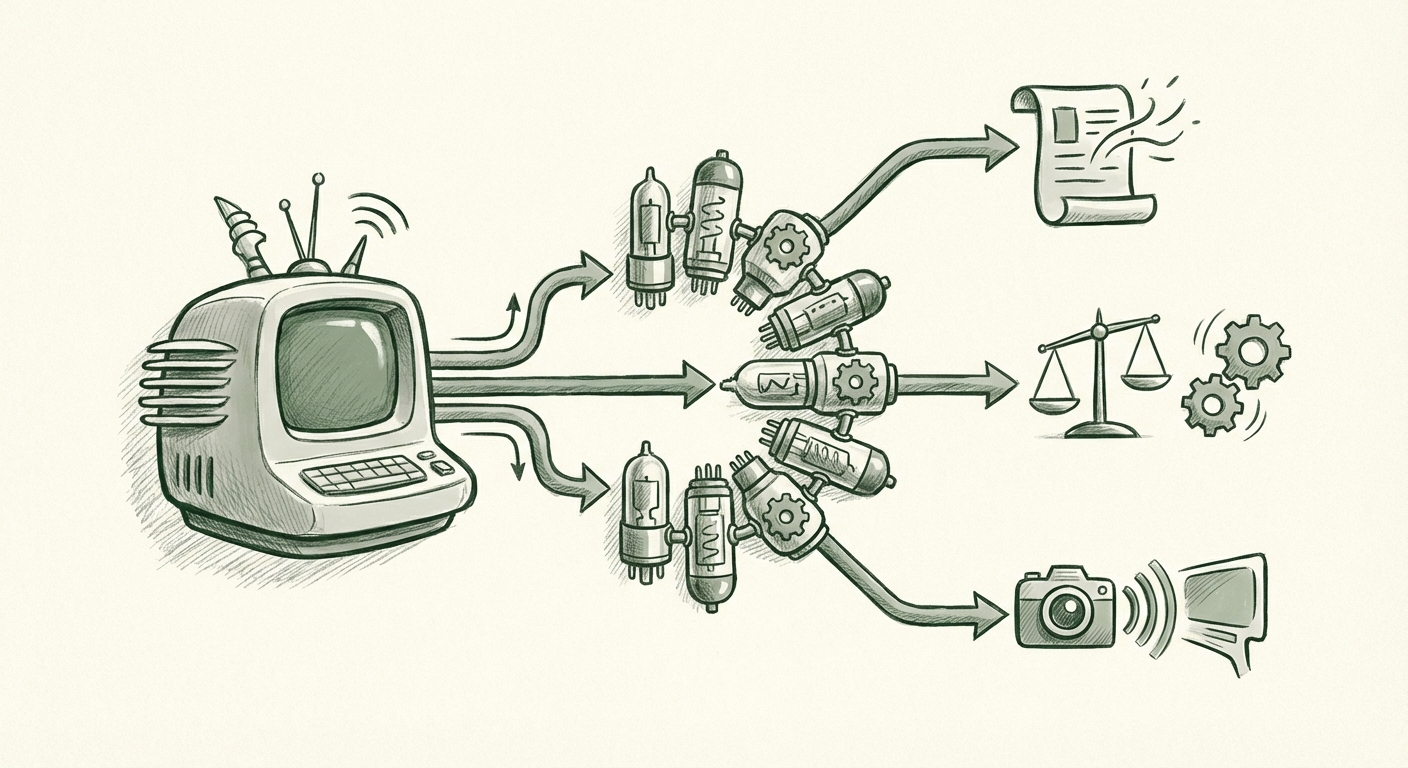
Meeting Transcription APIs Explained: Real-Time vs. Batch and Why Scribe v2 Changes the Playbook
Every meeting your company holds is now a data event. Whether it happens on a video call, in a conference room, or on a phone line, the conversation contains decisions, commitments, blockers, and context that used to evaporate the moment everyone hung up. In late 2026, that is no longer true, and the reason is not better note-taking apps. It is the quiet rise of the meeting transcription API as core infrastructure.
The arrival of Scribe v2, a transcription model built to serve both live streaming and batch (async) workloads, marks a meaningful shift. It signals that speech-to-text is graduating from a bolt-on feature inside a single app into a shared layer that many products and internal systems can build on. This article breaks down how the two modes work, why it matters, and what it means for the future of AI at work.
Two Modes, Two Very Different Jobs
The first thing to understand about a modern transcription API is that "real-time" and "batch" are not two settings on the same dial. They are two different products with different physics.
Real-time (streaming) transcription
In real-time mode, audio is pushed to the API as it happens, chunk by chunk, and text comes back while people are still talking. The engineering challenge here is latency. Every millisecond you spend waiting for a model to think is a millisecond the user notices. This mode is what powers live captions, in-call search, instant action-item detection, and voice agents that need to know what was just said before they respond.
Real-time transcription is also unforgiving. If the network hiccups or a chunk arrives out of order, the system has to recover gracefully rather than drop the rest of the sentence. This is why streaming transcription tends to be harder to ship than it looks on a demo.
Batch (async) transcription
Batch mode takes a finished recording and returns a full transcript later. The trade-off flips: latency matters less, so the system can afford to do more work, better punctuation, more careful handling of overlapping speakers, cleaner formatting, and richer structure around the output.
Batch is where post-meeting intelligence lives. A recording uploaded after the call becomes the canonical record: a searchable transcript, a summary, a list of decisions, and the raw material for everything downstream. It is also cheaper to run at scale and far easier to retry when something goes wrong.
The practical architecture most teams land on
In practice, mature teams do not choose one mode. They run both against the same meeting:
- Streaming during the call for live captions, keyword alerts, and "what did we just decide?" search.
- Batch after the call for the authoritative record, summaries, and indexing into a knowledge base.
The key insight is that both outputs need to speak the same language, same speaker labels, same timestamps, same structure, or you end up with two incompatible versions of the same meeting.
Why One Model Serving Both Modes Is the Real Story
Historically, teams stitched real-time and batch together from different vendors or different model versions. The result was predictable friction: speaker labels drifted between the live and final transcripts, timestamps did not line up, and engineering time disappeared into reconciliation code nobody wanted to own.
A single model family covering both modes removes a whole category of that work. When the live transcript and the final transcript come from the same underlying system, you get consistency for free. Your live captioning layer and your post-call summarization layer are looking at the same representation of the conversation.
That sounds like plumbing. In reality, it is the difference between transcription being a feature you integrate and transcription being infrastructure you standardize on. And standardizing is exactly what unlocks the next wave of AI products.
The Bigger Trend: Voice Becomes the Front Door for AI
For the past few years, most AI systems have been fed text. People typed questions, pasted documents, and uploaded PDFs. Voice was the messy cousin, transcribed badly, used reluctantly.
That is changing fast, and meeting transcription is the leading edge. Consider what a well-built transcription pipeline actually produces: a time-stamped, speaker-attributed, searchable record of what humans said to each other. That is some of the highest-signal data any organization owns. It contains intent, disagreement, ownership, deadlines, and the reasoning behind decisions, none of which show up in a project tracker.
Where this leads
- Conversational memory for AI agents. An agent that can query every meeting a team has held becomes dramatically more useful than one that only sees typed messages.
- Retrieval over spoken knowledge. Most institutional knowledge is spoken before it is written down, if it is written down at all. Transcription turns that oral culture into a queryable corpus.
- Voice-native interfaces. Once streaming transcription is reliable and cheap, talking to software stops feeling like a novelty and starts feeling like a shortcut.
- Closed-loop accountability. If a commitment was made out loud, it can be captured, assigned, and checked, automatically, without anyone taking minutes.
The strategic implication is uncomfortable but clear: companies that treat meetings as disposable will fall behind companies that treat them as a dataset.
What This Means for Businesses Right Now
For business leaders, the practical question is not "should we use a transcription API?" It is "what do we want to be true in twelve months?" Here is how the decision breaks down.
1. Separate the two use cases in your planning
Real-time transcription is a product decision. It affects user experience, latency budgets, and what your interface can promise. Batch transcription is a data decision. It affects storage, retention, search, and how your AI features get their context. Budget and staff them separately, even if you buy them from the same place.
2. Design for failure from day one
Live transcription will drop. Networks will fail. Audio will be muffled. Build idempotent pipelines: store the original audio, treat the batch transcript as the source of truth, and treat the streaming transcript as a helpful preview. If your system assumes the live feed is perfect, you will spend your first quarter on bug reports instead of features.
3. Own your data governance before you scale
Transcribed meetings are among the most sensitive assets an organization holds. Someone will say something in a performance review, a legal discussion, or a candid strategy debate that should not be searchable by everyone. Decide early on:
- Who can search transcripts, and by what scope.
- How long audio and text are retained, and how deletion works.
- How consent is captured and surfaced in the product.
- Which regions data can live in, and which vendors can touch it.
Retrofitting governance onto a live transcription feature is painful. Designing it in from the start is a checklist.
4. Treat transcription output as an API, not a document
The teams that get the most value do not stop at a text file. They expose transcripts as structured data with speakers, timestamps, and segments, so other systems, search, CRM, ticketing, coaching tools, can consume them. The transcript is the raw material. The value is in what you build on top.
The Risks Nobody Talks About Enough
Enthusiasm is warranted, but so is caution. Three risks deserve attention.
Accuracy is not the same as correctness. A transcript can be faithful to the audio and still misrepresent what happened, especially with jargon, accents, cross-talk, and poor microphones. Any downstream AI that summarizes or extracts actions inherits those errors and can amplify them.
Surveillance creep is real. The same system that produces helpful action items can produce employee monitoring. The line is drawn by policy and product design, not by the technology. Say out loud what you will not do with transcripts.
Cost compounds quietly. Streaming every meeting in every room is a very different bill from transcribing a few high-value calls. Start with a defined scope, measure, and expand.
An Actionable Playbook
- Pick one high-value workflow, sales calls, incident reviews, or customer onboarding, and instrument it end to end before going company-wide.
- Run both modes from day one so streaming and batch outputs stay consistent, even if you only ship one to users initially.
- Store the original audio and keep the batch transcript as the canonical record. Re-transcribe when models improve; you will want that option.
- Publish an internal policy covering consent, retention, access, and permitted uses before the first broad rollout.
- Measure the boring metrics, time-to-transcript, retry rate, search success, and how often users edit the output. They predict adoption better than accuracy benchmarks.
- Build for iteration. Transcription quality is improving quickly; the teams that win are the ones that can swap models without rewriting their product.
Conclusion: The Meeting Becomes a First-Class Data Source
The shift represented by a model like Scribe v2 is not really about transcription quality. It is about legitimacy. When real-time and batch transcription come from the same dependable API, voice stops being a risky integration and becomes a standard building block, the same way databases and payment APIs became defaults.
That changes what companies can build. Assistants that remember conversations. Search that reaches into spoken knowledge. Agents that follow up on commitments without being asked. None of it requires exotic breakthroughs; it requires clean, reliable, structured access to what people actually said.
The organizations that move first will not just take better notes. They will build a memory layer for their business, and the ones that wait will be reconstructing decisions from memory, one lost meeting at a time.