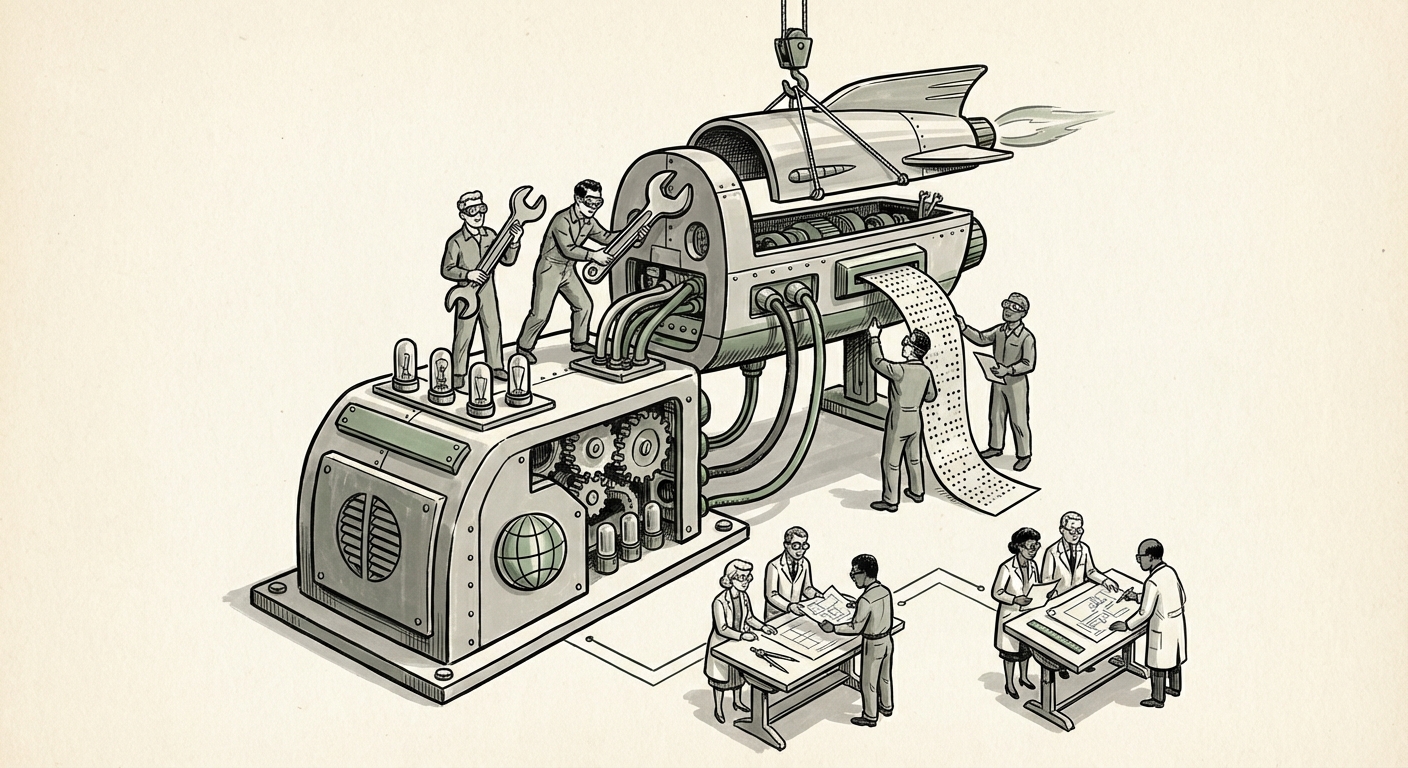
From Lab to Life: Why AI's Biggest Challenge Is Translation, Not Invention
Every few months, a new AI breakthrough makes headlines. Researchers publish papers showing models that can write code, diagnose diseases, or drive cars in simulation. The results look stunning on paper. But then something strange happens: the same AI that crushed benchmarks in the lab often stumbles when you try to use it in the real world. This gap between research and reality is the quiet crisis of the AI industry, and it's about to become the main event.
The next wave of AI value won't come from inventing bigger models. It will come from translating what we already have into tools that work reliably, safely, and affordably in everyday life. That translation is much harder than it sounds. And understanding why is key to predicting how AI will actually be used in the coming years.
The Lab vs. the Real World: A Different Game
In a research lab, AI lives in a controlled bubble. The data is clean and labeled. The environment is predictable. The goal is to beat a specific score on a test. Researchers can tweak the model until it wins. Failure is cheap, you just run another experiment.
The real world is the opposite. Data is messy, incomplete, and full of surprises. A model trained on perfect examples may never see the weird edge cases that happen daily, like a customer typing in all caps, a sensor glitching, or a sudden change in weather. The environment shifts constantly. And failure has real costs: lost money, broken trust, or even safety risks.
This is the translation gap. It's not about whether AI can do something impressive in a demo. It's about whether it can do it consistently, at scale, under pressure, and for people who don't care how the technology works, they just need it to work.
Why Translating AI Is So Hard
There are several barriers that block AI from moving from the lab to real life. Each one is a practical, unglamorous problem that doesn't get as much attention as the latest model release.
1. Data Is Messy and Hard to Get
Real-world data is often scattered across different systems, locked in silos, or full of errors. A hospital might have patient records in five different formats. A factory might have sensors that report different units. Before AI can help, someone has to clean, connect, and label all that data. That work is slow, expensive, and requires deep knowledge of the business, not just machine learning skills.
Worse, the data that exists may not reflect the real world. If a model is trained only on data from one city, it may fail in another. If it's trained on historical data, it may miss new trends. Keeping data fresh and representative is a constant chore.
2. Integration with Existing Systems
AI doesn't live in a vacuum. It has to plug into old software, databases, and workflows that were never designed for it. Think about a bank that wants to use AI to approve loans. The AI model needs to talk to the loan application system, the credit bureau, and the compliance database. It must respond in milliseconds. It must handle errors gracefully. Building those connections is often more work than building the model itself.
This is why many AI projects stall after a successful pilot. The pilot runs on a laptop with a clean dataset. Production requires a whole new architecture.
3. Reliability and Safety
In the lab, a model that's right 90% of the time is a success. In the real world, a 10% error rate can be disastrous. A self-driving car that misreads a stop sign one time in ten is not safe. A medical AI that misses a tumor one time in ten is not usable. Real-world AI needs guardrails: fallback systems, human oversight, and continuous monitoring. Those add complexity and cost.
There's also the problem of drift. Over time, the world changes, and the model's accuracy slowly degrades. A model that predicts shopping habits may become useless after a holiday season. Without ongoing maintenance, even a great model goes stale.
4. Cost at Scale
Training a large AI model can cost millions of dollars. But the bigger challenge is often inference, running the model every time a user needs an answer. If you're serving millions of requests per day, the computing bill adds up fast. Many organizations underestimate this. They build a great model, then discover that using it in production is too expensive to be profitable.
Translation requires optimizing for cost: smaller models, smarter caching, and efficient hardware. That's engineering work that doesn't win academic awards but determines whether a project succeeds.
5. People and Process
AI changes how people work. A new AI tool might make a job easier, but it also requires training, trust, and new processes. Employees may resist if they fear the technology will replace them. Managers may not know how to measure its value. The organization may lack the skills to maintain it.
These human factors are often the hardest to solve. A technically perfect AI can fail if the people using it don't understand it or don't trust it.
6. Regulation and Responsibility
As AI moves into high-stakes areas like healthcare, finance, and hiring, it faces a growing web of rules. These rules exist to protect people from bias, privacy violations, and unsafe decisions. But they also add complexity. Companies must document how their models work, test for fairness, and provide explanations. That's a lot of extra work, and it's non-negotiable.
What This Means for the Future of AI
The translation gap is reshaping the AI industry in several important ways.
From Model-Centric to Deployment-Centric
The spotlight is shifting from "who has the biggest model" to "who can deploy AI most effectively." That means more investment in data engineering, MLOps (the practice of managing machine learning models in production), and monitoring tools. The companies that win won't necessarily have the most advanced research, they'll have the best pipelines for turning research into reliable products.
The Rise of AI Translators
We'll see more demand for people who can bridge the gap between AI researchers and business teams. These "AI translators" understand both the technology and the problem domain. They can look at a messy business process and figure out where AI fits, and where it doesn't. They can explain trade-offs to executives and translate business needs into technical requirements. This role is already emerging, and it will become critical.
Smaller, Specialized Models Win
For many real-world tasks, a giant general-purpose model is overkill. It's slow, expensive, and hard to control. Instead, companies will increasingly use smaller, focused models trained on specific data. These models are cheaper to run, easier to explain, and more accurate for narrow tasks. The future of AI isn't one model to rule them all, it's a toolbox of specialized tools.
Evaluation Becomes Real-World
Benchmark scores will matter less. What matters is how AI performs in the actual environment where it's used. Companies will develop continuous evaluation systems that track performance on real data, catch drift, and flag problems. The question will shift from "How did it score on the test?" to "How is it doing today, for our users?"
AI Becomes Invisible Infrastructure
The most successful AI won't be flashy. It will be baked into everyday tools, like a spam filter, a route planner, or a recommendation engine, and people won't even notice it. The goal of translation is to make AI so reliable and seamless that it fades into the background. That's when it truly delivers value.
Practical Implications for Businesses
If you're leading a business or a team, the translation gap has direct consequences for how you approach AI.
- Start with a problem, not a technology. Don't ask "How can we use AI?" Ask "What problem are we trying to solve?" Then find the simplest tool that works, which may not be AI at all.
- Invest in data infrastructure first. Clean, accessible, well-governed data is the foundation of any successful AI project. Without it, even the best model will fail.
- Build cross-functional teams. Include engineers, domain experts, designers, and ethicists from day one. Siloed teams create AI that doesn't fit the real world.
- Pilot small, scale what works. Start with a narrow use case, measure results honestly, and only expand when you've proven reliability and value. Avoid the temptation to boil the ocean.
- Plan for maintenance. AI isn't a one-time build. Budget for monitoring, retraining, and updates. Treat it like a living product, not a finished project.
- Address trust and change management. Train your people, explain how the AI works, and give them a way to give feedback. Adoption is a human problem, not just a technical one.
- Design for safety and compliance from the start. Bake in transparency, fairness testing, and human oversight. Retrofitting these later is painful and expensive.
Actionable Insights for Leaders
Here's what you can do right now to close the translation gap in your organization:
- Audit your data readiness. Pick one high-value use case and trace the data needed to support it. Identify gaps and fix them before you build a model.
- Create a deployment checklist. List everything needed to move from pilot to production: integration points, latency targets, monitoring, fallback plans, and cost estimates.
- Hire or train translators. Look for people who can speak both business and technical language. They'll save you from expensive miscommunications.
- Measure outcomes, not accuracy. Define success in terms of business results, time saved, errors reduced, revenue gained, not just model scores.
- Start a dialogue about trust. Talk to the people who will use the AI. Ask what would make them comfortable. Address their concerns openly.
The Road Ahead
The AI revolution won't be won in the lab. It will be won in the messy, complicated, real world, where data is dirty, systems are old, and people are skeptical. The organizations that master translation will be the ones that turn AI's promise into everyday reality. The rest will be stuck with impressive demos that never leave the building.
This is actually good news. It means the future of AI isn't determined by a few giant research labs. It's determined by thousands of teams solving practical problems, one deployment at a time. The race is just beginning, and the prize goes to those who can bridge the gap.