Anthropic’s Safer AI Blueprint: Separating the LLM Brain From the Hands
Large language models are moving from the chat box into the real world. They can now plan, use tools, call software, and take actions that change things outside the conversation. That shift is exciting, but it also creates a new safety problem. A model that can only write text can still be wrong. A model that can act can be wrong and move money, send email, delete data, or change a system.
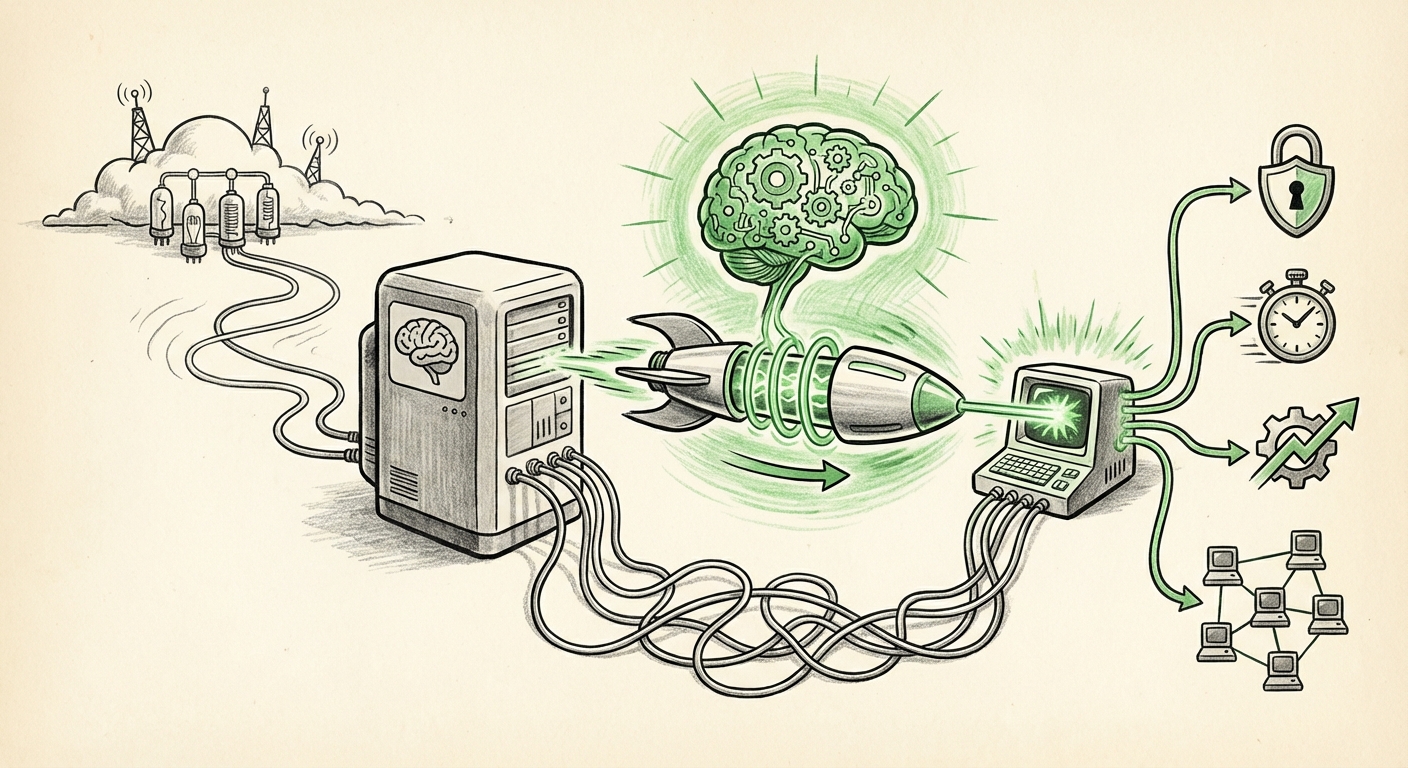
Anthropic’s recent work on shipping an LLM into the world safely puts a sharp name on the solution: separate the brain from the hands. The idea is simple and powerful. Let the model think. Let it plan. But do not let it touch the world without a controlled layer between its ideas and its actions.
What “Separating the Brain From the Hands” Actually Means
The “brain” is the language model. It reads context, reasons, forms plans, and decides what it wants to do next. The “hands” are everything that can act on the world: APIs, browser sessions, code runners, databases, payment systems, email tools, and business software.
In a less safe design, the brain and the hands are blended together. The model gets broad access and can call tools freely. That is fast to build, but it is hard to control. If the model is tricked, confused, or simply wrong, it can take harmful action before a person notices.
In a safer design, the brain proposes and the hands execute under rules. The model may say, “I should send this email” or “I should update this record.” But a separate safety layer checks that action. It asks questions like:
- Is this action allowed for this user, in this context, right now?
- Does the action need human approval before it happens?
- Is the tool sandboxed so a mistake cannot spread?
- What record will be left behind for review?
- Can the action be stopped, reversed, or limited?
That boundary is the key. The model’s intelligence is not the same as its permission. The model can be smart and still be denied the ability to do something risky. This is a basic safety idea borrowed from other fields: give people and systems only the access they need, and make important actions visible and reversible.
Why This Is the Right Safety Bet for Agentic AI
The AI industry is moving toward agents: systems that do more than answer questions. They carry out multi-step tasks. They use software. They work in the background. That is where much of the business value lies. It is also where the risk grows quickly.
Text errors are often easy to spot. Action errors are different. An agent that sends a wrong message can damage a relationship. An agent that changes a database can corrupt records. An agent that buys, books, or pays can create real financial loss. An agent that runs code can open a security hole. The more access an agent has, the larger its blast radius, the range of damage a single mistake can cause.
Separating the brain from the hands shrinks that blast radius. It does not depend on the model being perfect. It assumes the model can fail. That is a more mature way to think about safety. Instead of asking, “How do we make sure the model never makes a mistake?” the better question is, “How do we make sure a mistake cannot do too much harm?”
This matters for another reason: prompt injection. When an agent reads web pages, emails, documents, or messages, it can encounter text designed to trick it. A malicious page might tell the agent to ignore its instructions and take an action. If the brain and hands are fused, that trick can become a real-world event. If they are separated, the action still has to pass through permission checks, sandboxes, and approval gates.
The principle is not “trust the model less.” It is “design the system so trust is not the only control.”
The Bigger Trend: Safety Is Becoming System Design
For years, much AI safety work focused on the model itself: filtering outputs, refusing harmful requests, and tuning behavior. Those things still matter. But as AI systems gain hands, safety has to move into the architecture.
That means safety is becoming a product and engineering problem, not just a policy problem. It lives in identity systems, permission models, tool gateways, logging, rate limits, approval workflows, and rollback plans. It looks more like secure software design than like a content filter.
This is a healthy shift. A model can be aligned in its training and still be deployed in an unsafe system. A safe system adds layers:
- Scoped access: each agent gets only the tools and data it needs for a specific job.
- Action review: high-risk steps pause for human approval.
- Sandboxing: code and tools run in limited environments.
- Audit logs: every action is recorded in a way people can inspect.
- Reversibility: where possible, actions can be undone or limited.
- Monitoring: unusual behavior triggers alerts or stops the agent.
The result is not a model that can do everything. It is a system that can do useful things safely, and can say no when the risk is too high.
What This Means for the Future of AI
The future of AI will not be one giant model with unlimited access to everything. It will be many models and agents working inside carefully designed boundaries. Some will handle low-risk tasks automatically. Others will prepare work for human approval. The most sensitive actions will stay with people.
This has a few likely effects.
1. Agents will become more useful, not less
Safety boundaries can feel like limits, but they often make adoption easier. A business is more likely to deploy an agent that can draft invoices but cannot pay them without approval. A team is more likely to use an agent that can read support tickets but cannot change customer records without a check. Clear boundaries build trust, and trust leads to wider use.
2. Human oversight will become a design feature
“Human in the loop” is often treated as a fallback. In the coming years, it will be a normal part of agent design. The question will not be whether humans are involved, but where they are involved and what they are asked to approve. Good systems will route decisions by risk. Low-risk actions may pass automatically. High-risk actions will wait for a person with the right authority.
3. AI operations will become a real job
Companies will need people who can manage agent permissions, review logs, test failure cases, and respond to incidents. This is not just an IT task. It combines security, product design, compliance, and operations. The organizations that do this well will be able to use agents more aggressively because they can control the downside.
Practical Implications for Businesses
The brain-and-hands model gives business leaders a clear way to evaluate AI systems. Do not just ask what the model can do. Ask what it can touch.
Here is a practical way to start:
- Map the tools and data. List every system an AI agent can reach. Mark which ones are read-only and which can change something.
- Tier actions by risk. Low-risk actions might include summarizing or drafting. Medium-risk actions might include updating a ticket. High-risk actions might include payments, deletions, legal commitments, or access changes.
- Apply least privilege. Give each agent only the access it needs for its job. Do not give one agent the keys to everything.
- Add approval gates. Require a human to approve high-risk actions. Make the approval screen clear and fast.
- Use sandboxes for code and tools. Test agents in limited environments before letting them act in production.
- Log every action. Keep records that show what the agent tried, what it did, and why. Logs are essential for debugging and accountability.
- Plan for failure. Decide in advance how to stop an agent, roll back a change, and contact the right people.
- Ask vendors hard questions. How are actions separated from reasoning? What permissions are required? What is logged? What can be reversed? What happens when the model is tricked?
These steps are not just for large companies. Small teams can start with a simple rule: an AI system should never have more access than the task requires, and the riskiest actions should never happen without a person saying yes.
Practical Implications for Society
The same principle applies beyond business. As AI systems take on more tasks, the public will want to know who is responsible when something goes wrong. Separating the brain from the hands makes accountability easier. If an action is logged, approved, and tied to a person or role, it is easier to explain and correct.
It also helps keep human judgment in important places. AI can prepare a medical claim, a legal draft, or a financial decision. But the final action can still require a qualified person. That is not a rejection of AI. It is a way to use AI without pretending it has judgment it does not have.
There is a social risk, too. If safety is only added by the most responsible companies, others may ship faster and cut corners. That is why clear expectations matter. Buyers, regulators, and the public can all ask the same question: where is the boundary between the model’s thinking and its ability to act?
Conclusion: The Hands Are the Hard Part
The AI race is often described as a race for smarter models. But the next phase will be shaped as much by safe deployment as by raw intelligence. Anthropic’s framing, separating the brain from the hands, captures the central lesson. A model can be brilliant and still need a controlled interface to the world.
The companies and institutions that understand this will build agents that are useful, auditable, and trusted. They will not wait for a perfect model. They will design systems where mistakes are limited, important actions are reviewed, and people stay in control of the things that matter most.
That is the real meaning of shipping an LLM into the world safely. The brain can dream, plan, and reason. The hands should move only when the system says it is safe to move.