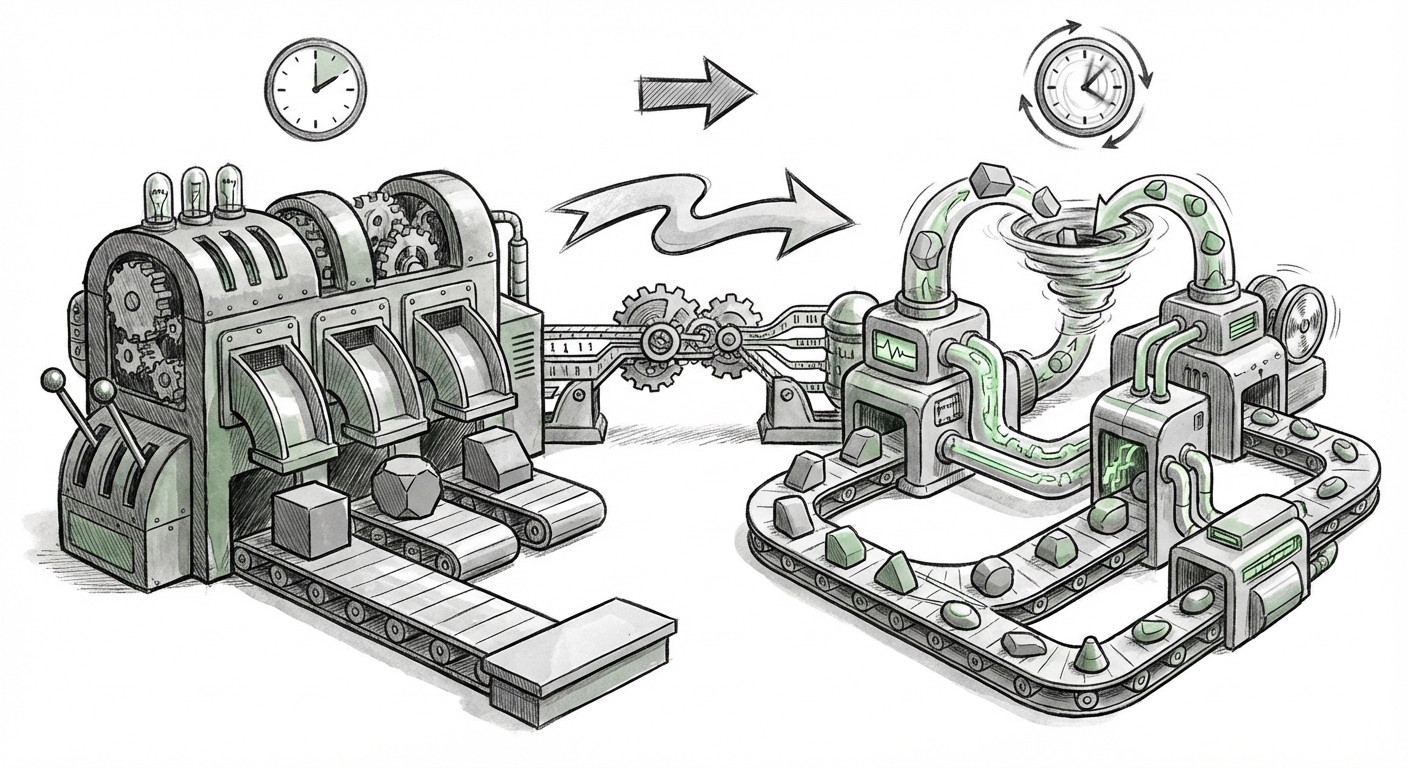
Beyond Passive RAG: How Active Memory Reconstruction Will Reshape AI Agents
For the past few years, the standard recipe for giving an AI agent knowledge has been simple: chop documents into chunks, turn them into vectors, and at question time pull back the closest matches. This is Retrieval-Augmented Generation, or RAG. It works. It is cheap to build. And it is now hitting a ceiling.
The next step is not better search. It is active memory reconstruction, a design where the agent decides what it needs to remember, writes memories in a structured way, and rebuilds the right context at the moment it needs it instead of dumping a fixed pile of text into the prompt. This shift sounds technical. In practice, it changes what AI agents can do, what they cost to run, and how much businesses can trust them.
The Quiet Problem With Passive RAG
Passive RAG treats memory like a filing cabinet. You store text, you look it up by similarity, and you paste the result into the model's context window. The model never decides what it needs. A fixed pipeline decides for it.
That creates several predictable failure modes:
- Similarity is not relevance. A chunk can look statistically close to a question and still be the wrong fact, an outdated fact, or a fact about a different customer.
- Memory never updates. If a policy changes, an old chunk and a new chunk sit side by side. The model has to guess which one wins.
- Nothing is forgotten. Stale details pile up and crowd out the useful ones.
- Context gets bloated. Stuffing more chunks into the prompt raises cost, slows responses, and actually hurts accuracy once the signal is buried in noise.
- The agent cannot reason about its own memory. It cannot ask "what do I actually know about this account?" or "is this fact still true?"
In short, passive RAG retrieves text. It does not manage memory. And the gap between those two things is exactly where agents start to feel unreliable in production.
What Active Memory Reconstruction Actually Means
Active memory reconstruction flips the model. Instead of retrieval being a single lookup bolted onto the front of a prompt, memory becomes a loop the agent runs on purpose. Three things change at once.
1. Memory is written, not just indexed
When an agent learns something, a user preference, a resolved issue, a decision, a correction, it stores that as a structured memory with metadata: what it is, where it came from, when it was true, and how confident the system is. It is closer to a note in a well-kept logbook than a random paragraph in a pile.
2. Memory is reconstructed at read time
At question time, the agent plans its retrieval. It may run several queries. It may pull raw records, summaries, or both. It may compare conflicting entries and resolve which one is current. Only then does it assemble a focused context, small, fresh, and purpose-built for the task at hand.
3. Memory is maintained
Memories get merged, superseded, scored for importance, and allowed to fade. The system has an opinion about what still matters. That is the difference between a database and a memory.
The Write Path: Teaching Agents What to Remember
Most teams building agents today spend almost all their effort on retrieval. The write path is where the real gains hide. A workable write path has four steps.
- Extraction. After each interaction, pull out candidate facts: entities, preferences, commitments, outcomes, corrections. Ignore chatter.
- Deduplication. Check whether this fact already exists. Merge instead of piling up near-duplicates.
- Conflict resolution. When a new fact contradicts an old one, mark the old one as superseded rather than deleting it. History matters for audits and for understanding why a decision was made.
- Importance scoring. Not every fact deserves permanent storage. Score by relevance to future tasks, stability, and how often it gets used. Low-value memories should decay.
Done well, the write path does something passive RAG never can: it lets an agent get better at a job over time without retraining the model.
The Read Path: Planning Instead of Searching
On the read side, the agent becomes a researcher rather than a search bar. A typical active read loop looks like this:
- Decompose the task. What does this request actually require me to know?
- Plan queries. Issue targeted lookups for each piece of needed knowledge instead of one broad similarity search.
- Iterate. Use what comes back to decide what to look for next.
- Reconstruct. Synthesize the findings into a short, coherent working context, including timestamps and provenance.
- Verify. Check the reconstructed memory against the current situation before acting. If confidence is low, say so or ask.
This loop costs more reasoning steps but often uses fewer tokens, because the context that reaches the model is tighter and cleaner. For agents doing multi-step work, handling a support ticket, drafting a proposal, reviewing a contract, debugging code, that trade is usually worth it.
Why This Matters for the Future of AI
The industry is moving from chat assistants to agents that persist. Persistence requires memory that behaves like memory. Three consequences follow.
First, memory becomes a product layer. Expect dedicated memory services, schemas, and benchmarks that measure not just retrieval accuracy but whether an agent remembers the right things at the right time. Memory quality will be a competitive differentiator the way model quality is today.
Second, agents get cheaper to run well. Passive RAG scales by adding chunks, which scales cost. Active reconstruction scales by being smarter about what it fetches. Long-running agents with years of history become viable instead of drowning in their own context.
Third, personalization gets real. An agent that remembers your preferences, your past decisions, and your corrections, and knows which ones are still valid, feels less like a tool and more like a colleague. That is the promise most AI products have been making without the infrastructure to deliver it.
Practical Implications for Businesses
The shift is not academic. It changes how teams should build and buy.
- Customer support: agents that recall a customer's history, prior fixes, and open issues, and drop details that are no longer true, cut repetition and wrong answers.
- Sales and account work: reconstructed context means the agent knows what was promised, when, and by whom, instead of returning vaguely similar call notes.
- Regulated industries: explicit provenance and supersession give auditors a trail. "Why did the agent do that?" becomes answerable, which passive RAG struggles with.
- Internal knowledge work: policy changes stop breaking agents, because old memories are marked stale rather than silently competing with new ones.
For buyers, the practical question changes. Stop asking "what is your retrieval accuracy?" Start asking "how do you decide what to forget, and how do you handle contradictions?" Those questions separate real memory from a vector database with good marketing.
Risks and Guardrails
More autonomous memory means more ways to go wrong. Four deserve attention from day one.
- Memory poisoning. If an attacker can write a false memory, it persists and spreads. Treat memory writes as a trusted operation with validation.
- Hallucinated recall. An agent can "remember" something that was never stored. Reconstructed context should always be traceable to a source record.
- Privacy and deletion. "Forget this" must mean something real. Build deletion into the memory schema, not as an afterthought.
- Over-trust. Users assume memory is accurate. Surfacing when a memory is old or low-confidence keeps expectations honest.
How to Get Started
Teams do not need to rebuild everything. A staged approach works.
- Audit your retrieval failures. Collect cases where the right document existed but the agent missed it. Most will be memory architecture problems, not search problems.
- Add a write step. Even a simple structured log of facts, sources, and timestamps will outperform raw chunk dumps quickly.
- Introduce query planning. Let the agent generate two or three targeted lookups before answering. Measure token use and task success together.
- Add supersession, not deletion. Mark old facts as replaced. Keep the history.
- Evaluate on tasks, not on retrieval. Track end-to-end success, cost per task, and whether the agent used the right memory at the right time.
The Bottom Line
Passive RAG was the right first answer to a hard problem: how do you give a model knowledge it was not trained on? It got the industry a long way. But agents that persist, act, and improve need something more like human memory, selective, editable, time-aware, and rebuilt to fit the moment.
Active memory reconstruction is that next step. It is less glamorous than a new model release and far more consequential in production. The teams that treat memory as a designed system, rather than a search box attached to a prompt, will build agents that feel reliable. Everyone else will keep shipping demos that impress in week one and disappoint in month three.