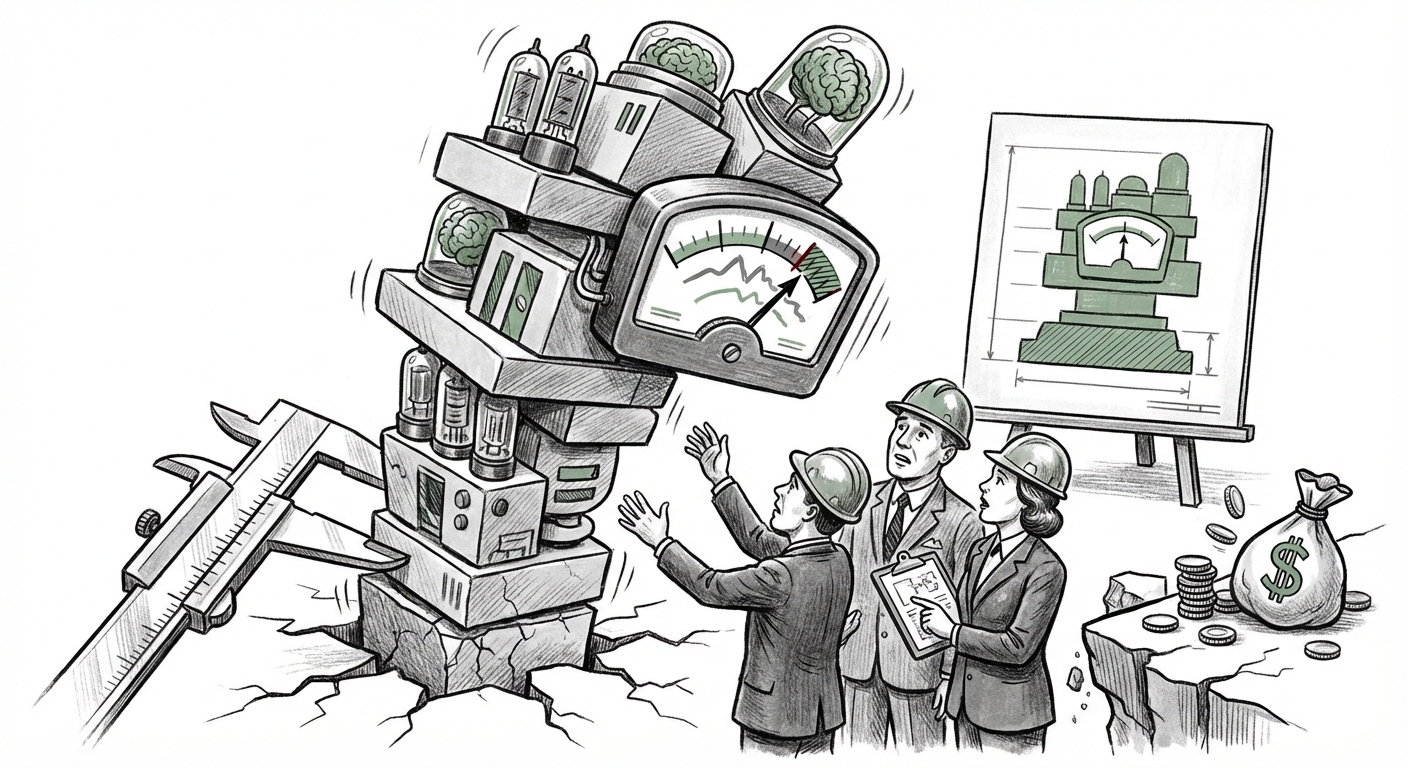
Why AI Can’t Solve What Matters Most, And How Leaders Should Use It Instead
There is a quiet assumption behind many AI plans: if we feed enough data into a powerful system, it will find the formula for our hardest problems. That assumption feels natural. AI is excellent at finding patterns, ranking options, and speeding up work that has clear rules. But the problems that matter most to people and organizations rarely have clear rules. They are messy, human, and full of trade-offs. The title of the argument says it best: there is no formula. AI cannot solve what matters most by itself. That is not a reason to ignore AI. It is a reason to use it differently.
This is the central shift leaders need to understand. AI is not an oracle that hands down answers to strategy, fairness, trust, or meaning. It is a tool for thought. It can help people see more, ask better questions, and move faster through bounded work. But it cannot carry the weight of judgment, accountability, or values. The future of AI will be shaped less by how smart the systems become and more by how wisely people use them.
The Power and Limit of Formulaic Intelligence
AI shines when a problem can be turned into a formula. Give it a clear goal, stable rules, lots of examples, and a fast way to check results, and it can often outperform humans at speed and scale. Think of sorting, matching, predicting, summarizing, or spotting anomalies in a large set of records. These tasks have a target. They have feedback. They can be measured.
But most important decisions are not like that. A company deciding whether to close a factory is not solving a math problem. A hospital deciding how to allocate limited care is not optimizing a single score. A school deciding how to teach children is not ranking content. A government deciding whom to trust is not classifying data. These decisions involve competing values, unequal power, long-term consequences, and people who will live with the results. There is no clean target variable for justice, loyalty, dignity, or public trust.
AI can help with parts of these decisions. It can gather evidence, model scenarios, surface possible risks, and draft options. But it cannot decide what matters. That is a human job. The moment an organization treats AI output as a final answer, it has confused a calculation with a judgment.
Why the Problems That Matter Most Resist Formulas
1. The goals are unclear or contested
In formulaic work, everyone agrees on what success means. In real leadership, success is often disputed. Growth for whom? Safety at what cost? Efficiency versus resilience? Speed versus fairness? AI can optimize a goal, but it cannot settle which goal is right. If the goal is wrong, the AI will be wrong at scale.
2. The context is thick and changing
Human problems are full of context that is hard to write down. A team’s history, a community’s trust, a customer’s fear, a worker’s dignity, these shape what a good decision looks like. AI can process text about context, but it does not live in it. It does not feel the room. It does not carry responsibility. It does not know what will be forgiven and what will not.
3. The feedback is slow or missing
AI learns best when it gets quick, clear feedback. But the biggest decisions may take years to play out. Did the merger work? Did the policy build trust? Did the product improve lives? By the time the answer arrives, the context has changed. There is no clean training loop for wisdom.
4. Accountability cannot be outsourced
When a decision affects people, someone must answer for it. A model cannot be called into a meeting, asked to explain its values, or held responsible for harm. Accountability is a human relationship. AI can support it, but it cannot absorb it. This is why “the algorithm decided” is not a defensible answer in a serious organization.
5. Values are not data points
Fairness, care, courage, and honesty are not just variables to be weighted. They are commitments that shape how we live together. AI can help us see trade-offs more clearly. It cannot tell us which trade-off is right. That requires deliberation, empathy, and legitimacy, things that happen between people, not inside a model.
What This Means for Businesses
The practical lesson is not “use less AI.” It is “use AI where it fits, and stop pretending it fits everywhere.” Companies that treat AI as a formula machine for strategy will waste money and erode trust. Companies that use AI to improve human judgment will gain a real edge.
Here is what that looks like in practice:
- Separate bounded tasks from judgment calls. Use AI for drafting, summarizing, searching, matching, forecasting, and generating options. Keep decisions about people, values, and long-term direction in human hands.
- Define decision rights before deployment. Who can accept an AI recommendation? Who can override it? Who is accountable when it fails? Write this down. If no one owns the outcome, the project is not ready.
- Measure decision quality, not just speed. Faster bad decisions are still bad. Track error costs, reversibility, customer trust, and employee confidence. Ask whether the AI is improving the quality of the conversation, not just the volume of output.
- Use AI to widen the option set. A good use of AI is to generate scenarios, surface blind spots, and challenge assumptions. It is a thinking partner, not a verdict machine.
- Build “no formula” reviews. For high-stakes projects, ask: What is the goal? Who disagrees? What values are at stake? What happens if the model is wrong? What can we not measure? These questions protect against false confidence.
- Invest in human judgment. Train managers to question AI output, read uncertainty, and explain decisions. The scarcest skill in an AI-heavy organization is not prompt writing. It is disciplined judgment.
This approach also changes how AI projects are sold inside a company. Instead of promising a system that will “solve” a complex problem, leaders should promise a system that will help people make better decisions under uncertainty. That is a smaller promise, but a more honest one. It is also more likely to deliver real value.
What This Means for Society
The same lesson applies outside the boardroom. AI is being used in hiring, lending, policing, health care, education, and public benefits. In each area, the hardest questions are not technical. They are about fairness, due process, dignity, and public trust. A model can score a person. It cannot decide whether the score is just.
This creates a social risk: automation bias, the human tendency to trust a machine’s answer more than we should. When people are busy or afraid of blame, they may stop asking hard questions. That is dangerous. The more AI is used in high-stakes settings, the more we need human review that is real, not decorative.
Societies should focus on three things:
- Accountable systems. People must be able to challenge decisions that affect them. “The model said so” is not enough.
- Transparency about limits. Organizations should be clear about what the AI is doing, what it cannot do, and where humans are in the loop.
- Education for judgment. Schools and workplaces should teach people how to evaluate evidence, question outputs, and reason about trade-offs. Technical skills matter, but judgment is the real civic skill.
None of this means slowing down AI. It means steering it. A society that treats AI as a formula for justice will get neither justice nor good AI. A society that treats AI as a tool for better human deliberation has a chance at both.
The Future: AI as a Partner, Not a Replacement
The most likely future is not one where AI solves everything. It is one where AI becomes a powerful partner in bounded work while humans remain responsible for meaning and values. We will see more hybrid systems: AI generates options, humans choose; AI flags risk, humans investigate; AI drafts, humans decide; AI monitors, humans respond.
This will create new roles. Teams will need AI auditors who check systems for bias and failure. They will need decision stewards who own high-stakes calls. They will need ethics operators who turn values into practical rules. These are not side roles. They are the roles that make AI safe to use at scale.
The future of AI will also depend on better interfaces for doubt. Today, many AI tools sound confident even when they are uncertain. That is a design problem. Systems should show what they know, what they do not know, and what evidence would change their answer. They should invite challenge, not shut it down. The goal is not to make AI sound human. It is to make it useful to humans who must decide.
Most importantly, the “no formula” insight should shape how we measure AI success. A system that helps a team make a wiser decision is more valuable than a system that makes a bad decision faster. A tool that surfaces a hard trade-off is more valuable than one that hides it. We should reward AI that improves human judgment, not AI that pretends to replace it.
Actionable Insights for Leaders
If you are planning an AI initiative, start with these questions:
- Is this problem formulaic or judgment-heavy? If it is judgment-heavy, use AI to inform, not decide.
- What is the cost of being wrong? High-cost, hard-to-reverse decisions need more human review.
- Who is accountable? Name the person, not the platform.
- What values are at stake? Write them down before you see the model output.
- How will we know it is working? Define success in terms of decision quality and trust, not just speed.
- What can we not measure? Treat that gap as a warning sign, not a detail.
These questions do not make AI less useful. They make it more useful because they put it in the right place. AI is at its best when it expands human attention, not when it replaces human responsibility. The organizations that understand this will build better systems and keep more trust. The ones that do not will learn a hard lesson: you cannot automate what matters most.
Conclusion
The argument is simple and uncomfortable. AI is a remarkable tool for problems that can be turned into formulas. But the problems that matter most, how to treat people, how to build trust, how to choose between competing goods, do not have formulas. They require judgment, accountability, and a willingness to sit with uncertainty. AI can help us do that work better. It cannot do it for us.
The future of AI will not be decided by how many tasks we automate. It will be decided by how well we use AI to support human wisdom. That is a harder path, but it is the only one that leads to technology people can trust. There is no formula for that. There is only practice.