AI Building AI: What Recursive Self-Improvement Really Means for the Future of Technology
For most people, artificial intelligence is still something you use. You type a question, you get an answer. You upload a photo, you get a summary. But inside the places where these systems are actually made, something stranger is happening. The people building AI are increasingly using AI to do the building.
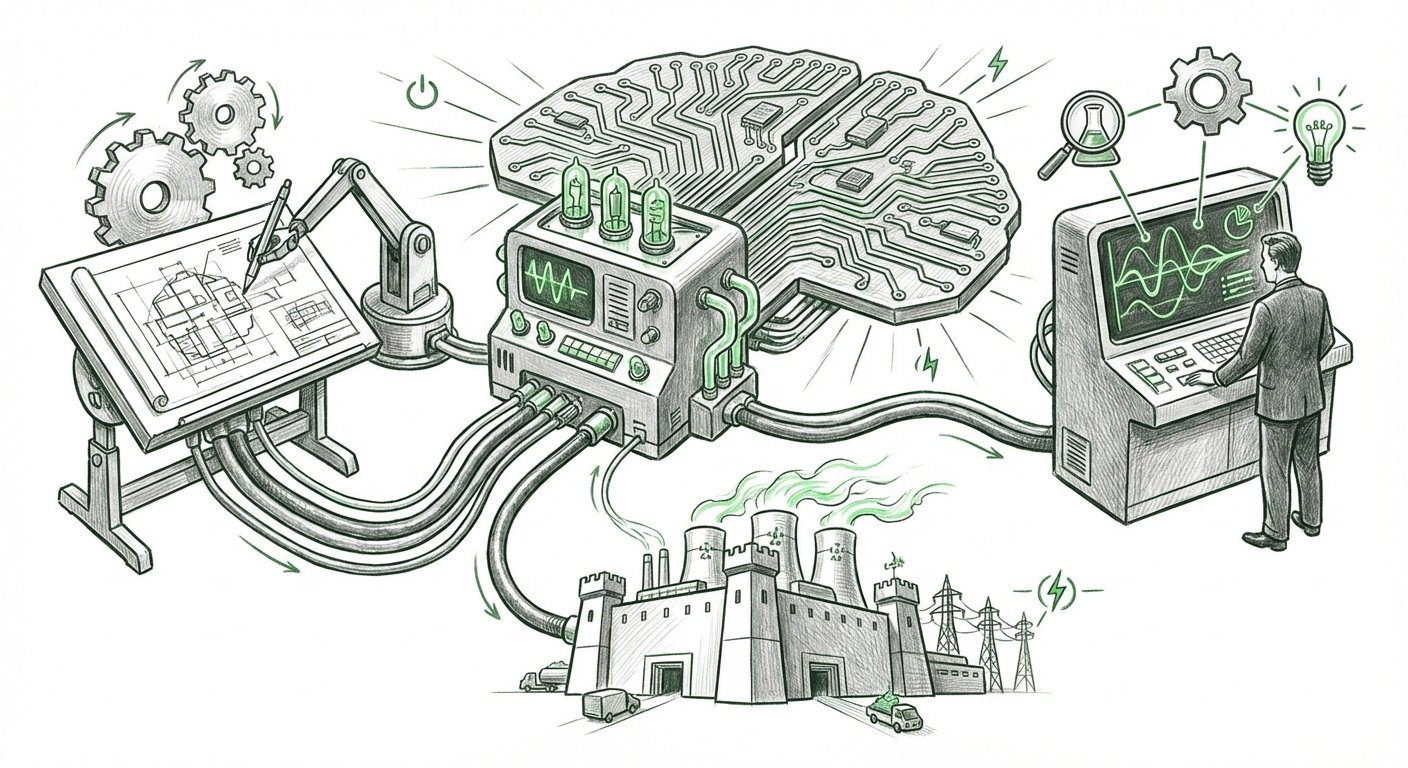
That shift has a name in research circles: recursive self-improvement, or RSI. It sounds like science fiction. In practice, it is a lot more ordinary, and a lot more important. Instead of one big dramatic moment where a machine rewrites itself into something smarter, we are watching a slow grind of small automation wins. Models write code. Models clean data. Models test other models. Models suggest experiments. Each of those steps saves human hours, and each saved hour speeds up the next round.
The real question is not whether this is happening. It is happening. The real question is the one that rarely gets asked out loud: who sets the agenda? Who decides what "better" means, which problems get solved first, and which risks get pushed to the back of the line?
What Recursive Self-Improvement Actually Means
Stripped down to basics, RSI is a loop. A system does some of the work needed to make the next version of itself. That next version is a little better at doing the work. So the round after that goes a little faster. Repeat.
The key word is loop. A single AI tool that helps a programmer is useful. An AI tool that helps build the AI tool that helps the programmer is a different category of thing. It is a feedback system. And feedback systems are the ones that change industries, because their gains stack instead of adding up in a straight line.
What makes this moment different from earlier waves of automation is where the loop is being closed. In the past, software tools helped humans write software. Now the tools are being pointed at the pipeline that produces the tools. That includes the unglamorous parts, the bug fixes, the test suites, the data labeling, the documentation, the benchmark design. Those parts are where most of the real time goes, and they are exactly the parts that are easiest to hand off.
It is not a runaway. It is a ratchet.
Popular imagination jumps to a machine that improves itself with no limits. The honest picture is messier. Progress gets blocked by compute, by data, by the cost of running experiments, and above all by verification, the hard work of proving that a change is actually an improvement rather than a new failure mode in disguise.
That last bottleneck matters more than people think. When a system can generate a thousand candidate improvements in a day, the limit is no longer ideas. The limit is your ability to check them. Which means the human role shifts from making to judging. And whoever writes the judging criteria holds enormous power.
The Four Places AI Is Already Helping Build AI
To understand the trend, it helps to see where the automation is showing up. Four areas stand out.
1. Code and infrastructure
Writing, reviewing, and debugging code is the most visible front. Modern AI assistants do not just autocomplete lines. They propose whole functions, flag likely failures, and draft the test cases that catch regressions. For a research team, that means fewer engineers stuck on plumbing and more time on the parts of the problem that still require human taste.
2. Data work
Training a model is mostly a data problem. AI systems are now used to sort, filter, label, and generate training material at a scale no human team could match. This is one of the most powerful accelerants in the loop, and also one of the riskiest. If the data used to train a model is produced by another model, small biases can echo and amplify through each round. The loop speeds up; it does not automatically correct itself.
3. Evaluation and red-teaming
Testing is where AI help is quietly most valuable. Systems can probe other systems at volume, hunting for weaknesses, strange behaviors, and failure cases humans would never think to try. But there is a paradox here. If you use AI to grade AI, you are trusting the same kind of system you are trying to check. Evaluation is exactly the place where independence is worth paying for.
4. Research direction
The newest layer is the most consequential. AI tools now help suggest experiments, summarize prior work, and point at promising avenues. This is where the agenda question becomes impossible to dodge. A model that proposes experiments is, in a small way, deciding what gets studied.
Who Sets the Agenda?
Every optimization needs a target. In machine learning, the target is defined by a metric, a benchmark, or a set of human preferences. Choose the target and you choose the direction of travel.
That sounds technical. It is really about values. If you optimize hard for user engagement, you get systems that hold attention. If you optimize for accuracy on a narrow test, you get systems that ace the test and sometimes miss the point. If you optimize for speed of shipping, you get speed, and whatever safety shortcuts come with it.
Recursive loops multiply whatever direction they are pointed in. That is the whole story. A fast loop pointed at a narrow goal will get very good at that narrow goal very quickly, and may drift somewhere nobody intended along the way.
Right now, the agenda is set by a small number of organizations with the compute, the data, and the talent to run these loops at scale. Their priorities are not secret, but they are also not chosen by anyone outside. Commercial pressure rewards shipping. Safety work rewards slowness. When the loop is spinning fast, the pressure to ship tends to win the tie.
The transparency gap
There is a practical problem underneath all of this. When AI systems help design AI systems, the reasoning behind key decisions becomes harder to trace. A human engineer leaves a paper trail: a design doc, a review, a comment explaining a tradeoff. An automated search leaves a result. Over time, teams can find themselves shipping systems whose behavior nobody can fully explain, because the explanation was never written down, it was just a search that found something that worked.
That is not a reason to stop. It is a reason to build records as carefully as you build models.
What This Means for Businesses
The practical impact will hit companies well outside the AI labs, and it will arrive through a few clear channels.
- Speed becomes the baseline, not the advantage. If your competitor can run ten experiments in the time you run one, the gap compounds. Most firms will respond by buying tools rather than building them, which pushes more capability into a handful of vendors.
- Moats move. When everyone has access to similar models, the edge shifts to proprietary data, deep process knowledge, and the judgment to know which problems are worth automating. The model is not the moat. The workflow is.
- Verification becomes a job title. The scarcest skill in an AI-heavy organization is not prompt writing. It is the ability to look at machine-generated work and reliably tell good from bad. Firms that invest in that muscle will capture the gains. Firms that skip it will ship their mistakes faster.
- Governance stops being paperwork. If a system helped build the system you are deploying, you need a clear record of who approved what, on what evidence, and against which criteria. Regulators and customers will ask. The answer needs to exist before the question.
Practical steps that make sense right now
None of this requires waiting for a breakthrough. A few moves are available today.
- Write down your optimization targets. For every AI system you deploy, state clearly what it is being rewarded for and what it is being punished for. If you cannot explain it in one sentence, it is not a target, it is a wish.
- Keep a human in the verification loop, and give that person real authority. A reviewer who cannot say no is not a control.
- Track your AI-generated artifacts. Know which code, data, and documents came from a model. When something breaks, you will want that map.
- Audit for echo. If model output feeds back into model training, build checks for narrowing and drift. Speed without diversity is a slow-motion failure.
- Assign an owner to the agenda. Someone in the room should be responsible for asking whether the thing being optimized is the thing that matters.
What It Means for Society
Zoom out and the stakes get clearer. Recursive improvement compresses timelines. Work that used to take a research team a year may take months. That is genuinely good, it means faster progress on medicine, materials, education, and climate modeling.
But compression also shortens the window for public debate. Technologies that once arrived slowly enough for laws and norms to catch up may now arrive in a series of quick iterations, each one reasonable on its own, adding up to something none of us chose. The mechanism of accountability, courts, regulators, standards bodies, journalists, runs at human speed. The loop does not.
There is also a concentration question. If the ability to run these loops depends on huge amounts of compute and rare talent, then the benefits pool in a few places. That is not inevitable, but it is the default. Open tooling, shared benchmarks, and independent evaluation are the counterweights, and they need support before they are needed.
And there is a labor story that is easy to oversimplify. The tasks most exposed are not the ones that require the most skill, they are the ones that are easiest to check. Junior coding work, first-draft writing, routine data prep. Those have long been the training ground where people build judgment. If the training ground is automated away, the pipeline that produces senior experts narrows. Companies that care about their future talent should think about that now, not later.
The Bottom Line
AI helping build AI is not a distant scenario. It is the current state of the field, and it is accelerating the pace of everything downstream. The technology is impressive, but the technology is not the story. The story is the direction.
A loop is only as good as its target. The organizations that get this right will be the ones that treat choosing what to optimize as a first-class engineering problem, documented, reviewed, and owned by someone with the standing to say stop. The ones that get it wrong will build faster than anyone else, right up until they build the wrong thing.