Why "True" Recursive Self-Improvement Still Isn't Here, and What It Means for the Future of AI
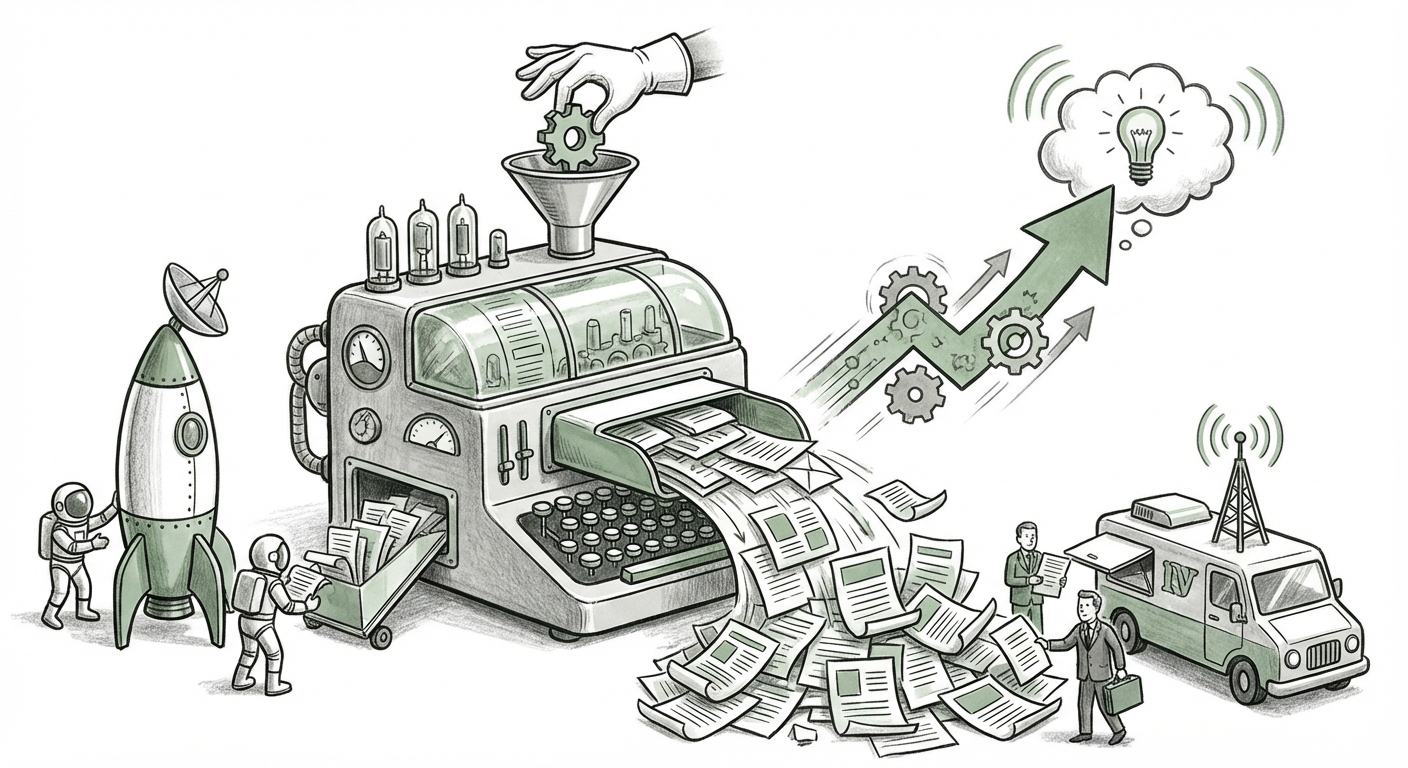
Every few months, someone announces that artificial intelligence is about to start improving itself. The story usually goes like this: a model writes better code, that code builds a smarter model, and the smarter model writes even better code. The loop spins faster and faster until the technology races past human understanding. That idea has a name, recursive self-improvement, or RSI, and it powers a lot of the loudest predictions about where AI is headed.
But there is a very real gap between the story and the reality. The case against "true" RSI holds up better than most people expect. And understanding why matters a great deal, because the timeline for self-improving AI shapes everything from chip spending to hiring plans to regulation.
What People Actually Mean by Recursive Self-Improvement
Strip away the jargon and RSI is simple. It means a system gets better at the job of making itself better. That is different from a system that merely gets better at a task.
A model that writes cleaner code is useful. A model that writes cleaner code for building AI models, and then uses that code to build a stronger version of itself, is something else entirely. That is the loop. The output feeds the input, and each turn of the cycle should be faster and bigger than the last.
The concept is not new. It has been part of AI thinking for decades, and it sits underneath a lot of the excitement around automated research, AI-assisted coding, and agents that can work on long projects without a human in the loop. When people say a system could "accelerate AI research," they are usually describing a partial version of this loop.
So the question is not whether AI can help build AI. It clearly can, in narrow ways. The question is whether the loop closes, whether it becomes self-sustaining and compounding, rather than a helpful tool that still needs people at every turn.
The Three Gaps Between Tools and a True Loop
Look closely at the evidence people cite for RSI, and it usually falls into one of three categories. Each one is real progress. None of them is a self-improving system.
1. Benchmark Gains Are Not Self-Improvement
The most common proof point is a rising score. A model does better on a coding test, a math test, or a reasoning test than the version before it. That is a genuine achievement. But it is progress made by people, researchers who changed the training data, the architecture, or the post-training process.
The model did not choose those changes. It did not evaluate whether they were the right ones. It did not run the experiment, read the results, and decide what to try next. The improvement came from outside the system. That is a tool getting better, not a system improving itself.
2. Narrow Automation Is Not a General Loop
AI systems today are good at narrow pieces of the research pipeline. They can draft code, summarize papers, generate test cases, or suggest a tweak to a training setup. Each of those saves real time.
But research is not a pile of separate tasks. It is a chain of judgment calls, where the value comes from knowing which question to ask next and which result is meaningful. Automating steps in the chain while a human still makes the decisions is powerful engineering. It is not a closed loop. The human is still the thing holding the cycle together.
3. Evaluation Is the Bottleneck Nobody Talks About
Here is the part that gets less attention than it deserves. To improve itself, a system has to know whether a change made things better. That means measuring quality reliably, and measuring quality is hard.
Tests can be gamed. Models can be tuned to pass benchmarks without becoming more capable in any useful sense. And the qualities that matter most, sound reasoning, good judgment, real understanding, are exactly the ones that are hardest to score automatically. A loop that cannot tell good from bad will not compound. It will drift, or it will plateau, or it will optimize for the wrong thing very efficiently.
What "True" RSI Would Actually Require
This is where the skeptic's argument gets sharp. A genuinely self-improving system would need several things at once:
- A reliable internal judge. It must be able to evaluate its own ideas without a human signing off on each one, and that judge must be trustworthy.
- Closed-loop experimentation. It must run real experiments, read real results, and update its approach based on what it finds, not just generate plausible text about what might work.
- Transfer across domains. Gains in one area must carry over to others. Otherwise you get isolated wins, not compounding returns.
- Resource headroom. Improvement costs compute, data, and time. If each round costs more than the last, the loop can stall even when the ideas are good.
- Error correction. Small mistakes compound just as fast as small gains. A loop without strong self-correction can spiral downward.
Each of these is a hard research problem on its own. Getting all of them working together, reliably, is a much bigger ask. That is the core of the case against true RSI: the individual ingredients exist in partial form, but the assembly has not been demonstrated.
Why Skepticism Is Not the Same as Dismissal
It is tempting to read doubt about RSI as a claim that AI progress will slow down. That is a mistake, and it is the most costly misreading in this whole debate.
The skeptic's position is narrower: the loop has not closed. That is entirely compatible with very fast progress. AI tools are already changing how software gets written, how research gets done, and how companies staff their teams. A system that gives every researcher a tenfold speedup does not need to be self-improving to reshape an industry.
In fact, the more honest framing is that we are in an era of human-in-the-loop acceleration. People are using AI to move faster. The gains are real. They are also partly bounded by how fast humans can review, decide, and steer. That bound is high, but it is not infinite, and it is not the same as a runaway loop.
Confusing the two leads to bad decisions. Companies that assume RSI is imminent may over-invest in moonshot infrastructure and under-invest in the unglamorous work of integrating AI into real workflows. Companies that assume RSI is impossible may under-invest in the automation that is already paying off today.
What This Means for Businesses Right Now
The practical takeaway is less dramatic than the headlines and more useful.
Build for augmentation, not replacement
The highest-return AI deployments today put a model next to a skilled person and remove friction. Drafting, reviewing, searching, summarizing, testing, these are places where the technology is proven and the human judgment layer is still essential. Design your systems around that reality instead of waiting for a fully autonomous version.
Treat evaluation as a first-class investment
If evaluation is the bottleneck for the technology, it is also the bottleneck for your deployment. Teams that can measure whether their AI systems are actually working will get more value than teams that can only measure whether they are running. Build your own test sets. Track quality over time. Do not trust a vendor's benchmark score as a stand-in for your use case.
Watch for compounding, not for announcements
The signal that RSI is arriving will not be a press release. It will be a measurable change in the rate of progress, shorter gaps between meaningful capability jumps, with less human effort in each one. That is the thing to track. Until then, treat claims of a closed loop as hypotheses, not facts.
The Road Ahead
None of this means recursive self-improvement is impossible. The history of this field is a long series of things that were dismissed and then happened. The honest position is that the burden of proof sits with the claim, and the claim has not yet been met with evidence that would convince a careful observer.
What we have instead is something more interesting and more immediate: a technology that is genuinely transforming how work gets done, driven by people who are learning to use it well. That is a story worth paying attention to. It is also a story that does not need a runaway feedback loop to be one of the most important shifts of the decade.
The gap between the RSI narrative and the RSI reality is not a reason to be complacent. It is a reason to be precise. The organizations and individuals who understand exactly where the automation ends and the judgment begins will be the ones who capture the value, whatever the timeline turns out to be.