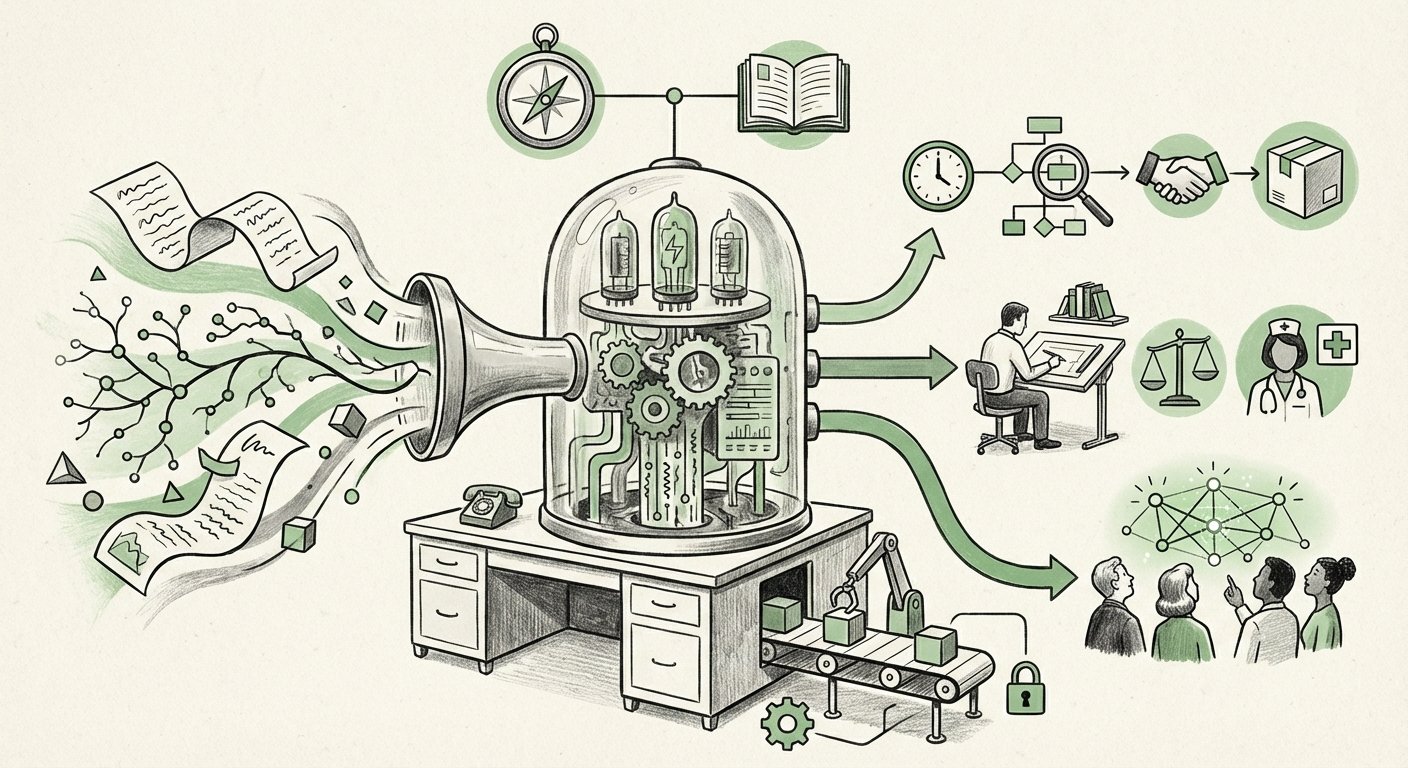
AWS's $1 Trillion Bet: Why Massive AI Spending Comes First
Amazon's cloud division is now aiming at a number that used to sound impossible. Andy Jassy, Amazon's chief executive, says AWS will become a $1 trillion business. But there's a catch in that headline, and it matters far more than the round number: before AWS gets there, it intends to spend big.
That single sentence tells you almost everything about the next phase of the AI boom. The companies building the foundation of artificial intelligence are no longer in a phase where clever software and modest server farms are enough. They are in a phase where the winners are decided by who can buy the most land, pour the most concrete, connect the most power, and fill the most racks with chips, and who can keep doing it long enough for the revenue to catch up.
For anyone running a business, working in tech, or just watching where the AI economy is heading, the AWS plan is a useful lens. It shows how the money actually flows in AI, where the bottlenecks are, and what the rest of us should be preparing for.
The Headline and the Hidden Half of It
Jassy's $1 trillion target is a statement of ambition about where AWS is going. The "spend big" part is a statement about how it plans to get there. Those two ideas travel together. You cannot reach a trillion-dollar revenue run rate in cloud and AI services without first building an enormous amount of physical infrastructure, and that infrastructure has to be paid for years before it starts returning money.
This is the central tension of the AI era, and AWS is far from alone in facing it. Across the industry, cloud providers are committing to enormous construction programs while their investors watch two numbers closely: how fast AI revenue is growing, and how much profit margin is being eaten by depreciation on all that new equipment.
Why the spending has to come first
AI workloads are different from the web hosting and database workloads that built the first wave of cloud computing. A traditional website can be served from a modest number of machines and scaled smoothly. A large AI model needs thousands of specialised processors working together at the same time, enormous amounts of very fast memory, and network links fast enough that the chips don't sit idle waiting for data.
Those systems cannot be spun up in a weekend. They require:
- Land and buildings, data centres that take years to design, permit, and construct.
- Electrical power, massive, reliable, and increasingly hard to secure at the scale AI demands.
- Cooling and water, because dense racks of chips generate intense heat.
- Specialised chips, the accelerators that do the actual AI math, in very short supply relative to demand.
- Networking, the high-speed fabric that ties thousands of chips into one working cluster.
Every one of those items has a long lead time. So a cloud provider that waits for demand to arrive before building will simply lose the customer. The spending is a bet placed years ahead of the payback.
What This Signals About the Future of AI
1. Compute is becoming the new electricity
When a company says it expects to become a trillion-dollar business largely on the back of cloud and AI, it is telling you that AI compute is turning into a utility. Not a luxury. Not a research curiosity. A basic input that nearly every company will buy the way it buys electricity today.
That shift changes the competitive landscape. In an electricity-style market, the winners are the ones with the most generation capacity and the best distribution, not necessarily the cleverest app. The same logic is now playing out in AI: the companies that control large amounts of reliable compute will have outsized influence over which AI products get built, how fast they ship, and what they cost.
2. The bottleneck has moved from software to atoms
For a decade, the limiting factor in tech was talent and code. Today the limit is physical: power connections, transformer supply, construction crews, chip fabrication capacity. That is a profound change. It means the AI race is now partly an industrial race, and industrial projects move at the speed of permits and supply chains, not the speed of a software release.
Watch for this to reshape corporate strategy. Expect more long-term energy deals, more direct investment in power generation, more interest in siting data centres where electricity is cheap and available, and more attention to cooling efficiency as a competitive advantage rather than a facilities footnote.
3. Custom silicon becomes a strategic weapon
At this scale, buying every chip from outside suppliers is expensive and leaves you exposed to someone else's supply schedule. So large cloud providers increasingly design their own accelerators tuned to their own workloads. Doing so can lower cost per unit of AI work and reduce dependence on any single vendor.
The implication for AI's future is straightforward: the price of running AI will fall faster than the price of the underlying hardware, because the biggest buyers will optimise the whole stack themselves. Cheaper inference means more AI features get shipped, which means more demand, a loop that feeds itself.
4. The gap between the biggest players and everyone else widens
Not every company can commit to multibillion-dollar construction programs years before the revenue arrives. That creates a widening gap between a handful of "AI infrastructure" firms and everyone else, who become renters of compute rather than owners. This concentrates power in a small number of hands, a fact regulators, enterprises, and startups all need to think about.
Practical Implications for Businesses
The cost conversation is about to get sharper
When providers spend heavily, they eventually need to earn it back. That doesn't necessarily mean higher sticker prices, scale and custom chips push unit costs down. But it does mean pricing structures will get more complex, with more tiers, more commitments, and more differentiation between cheap batch work and expensive real-time work. Finance teams that treat cloud AI spend as a single line item will get surprised.
Capacity is a negotiation, not a guarantee
In a world where the newest AI chips are scarce, access to capacity is a commercial relationship. Large customers who sign long-term commitments will get priority. Smaller customers may find that the newest hardware is unavailable on demand, or available only at a premium. Planning around this reality is now part of doing business with AI.
Portability and exit costs deserve real attention
The more of your business you run on one provider's AI stack, the more leverage that provider has over you. Smart teams are designing for portability: keeping data in open formats, wrapping model calls behind their own internal interface, and testing at least a second provider so switching remains possible. This costs a little efficiency today and buys a lot of negotiating power tomorrow.
Energy and sustainability become procurement issues
As AI infrastructure grows, so does scrutiny of its power use and water consumption. Companies with public sustainability commitments will increasingly need to ask their cloud providers hard questions about where and how their AI workloads run. Expect "carbon-aware" scheduling and regional workload placement to move from novelty to standard practice.
Risks Worth Watching
Big spending plans are not risk-free, and it's fair to name the risks plainly.
- Timing risk. If AI demand grows slower than expected, enormous infrastructure commitments become very expensive idle capacity. Depreciation doesn't wait for customers.
- Margin pressure. Heavy capital spending drags on profitability in the near term, which can spook investors even when the long-term story is sound.
- Supply chain fragility. Concentrated dependence on a small number of chipmakers and equipment suppliers leaves the whole buildout exposed to a single disruption.
- Power constraints. Electricity may become the hardest limit of all. Grid connections can take longer to secure than the data centres themselves take to build.
- Overbuilding in a boom. Every infrastructure gold rush in history has produced some excess. The question is whether the excess is a speed bump or a crisis.
Actionable Takeaways
If you're a business leader, here's what to do with this information right now:
- Model your AI costs in tiers. Separate training, fine-tuning, and everyday inference. Cheap and expensive AI work should not share a budget line.
- Negotiate before you need it. Talk to providers about committed capacity early, while you still have alternatives.
- Build an abstraction layer. Keep your application code independent of any single model provider's API so you can move as prices and availability shift.
- Track unit economics, not totals. Know your cost per AI task, per user, and per transaction. Totals hide the trends that matter.
- Watch the power story. Where a provider can get electricity cheaply and reliably is now a leading indicator of where AI capacity, and AI pricing, will be best.
- Plan for cheaper AI. Falling inference costs mean features that don't pay off today may pay off in a year. Keep a backlog of "too expensive for now" ideas and revisit them regularly.
The Bigger Picture
The $1 trillion target matters less as a number than as a signal. It says that the companies closest to the AI buildout believe we are still early, early enough to justify pouring capital into physical infrastructure on a scale that would have seemed reckless a few years ago.
That belief has consequences that reach well beyond one company's balance sheet. It means AI capability will keep getting cheaper and more abundant. It means the firms that own compute will hold unusual influence over the wider economy. It means energy, land, and chip supply chains will be as important to the future of AI as algorithms and talent. And it means every business should assume that AI is becoming a standard input, priced, negotiated, and budgeted like any other.
The spending comes first. Then comes the trillion. And in between sits the most consequential infrastructure buildout of our generation.