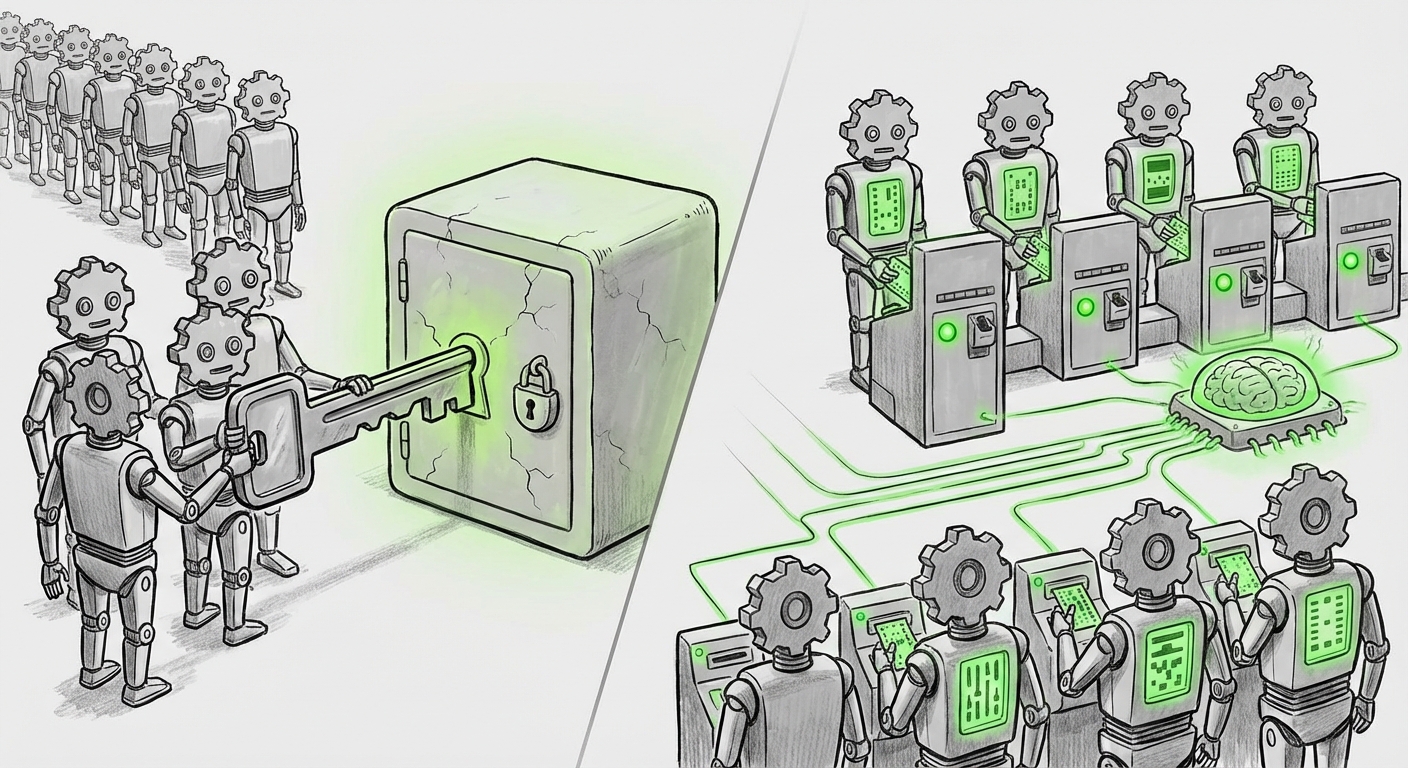
Apriel-H1 and the Rise of Distilled Reasoning Models: Why Small, Efficient AI Is the Next Big Shift
For the past couple of years, the AI story has been simple to tell: bigger models win. More parameters, more data, more money, more GPUs. Every new release seemed to push the same lever harder, and the results kept getting better. But a quiet counter-movement has been building, and the arrival of Apriel-H1, a model built around the idea of distilling efficient reasoning, is a strong signal that the next chapter will not be about size at all. It will be about smart compression of intelligence.
Apriel-H1's release on November 19, 2025 lands at a moment when the industry is wrestling with a basic problem. Reasoning models, the ones that "think" through a problem step by step before answering, are powerful, but they are also expensive. They burn through compute at the moment a user asks a question, not just during training. That makes them wonderful demos and painful business cases. Apriel-H1's central promise, and the reason it deserves attention, is that it treats the art of distilling reasoning as the key problem worth solving.
What "Distilling a Reasoning Model" Actually Means
Distillation is one of those terms that sounds technical but is easy to grasp. Imagine a master chef who can cook an incredible meal but takes three hours and uses every pot in the kitchen. Now imagine teaching an apprentice to produce almost the same meal in twenty minutes with two pans. The apprentice is not the master, but for most customers, the difference is invisible and the speed is everything.
In AI, distillation works the same way. A large "teacher" model is given hard problems and produces long, careful chains of reasoning. A smaller "student" model is then trained to imitate not just the final answer, but the reasoning path itself. Done well, the student learns to think in a compressed, focused way. Done badly, the student learns to mimic the shape of thinking without the substance, producing confident, well-formatted nonsense.
That gap between "done well" and "done badly" is where Apriel-H1's framing becomes interesting. The hard part of distilling reasoning models is not copying answers. It is capturing the habit of reasoning, the ability to break a problem apart, check itself, and recover from a wrong turn, inside a model with far less capacity to spare. That is a training and data problem, not a hardware problem, and it is the kind of problem that tends to unlock huge efficiency gains once someone solves it.
Why Efficiency Is the Real Breakthrough Story
Reasoning models changed what AI could do. They also changed what AI costs. When a model produces a long internal chain of thought before replying, a single query can consume many times the compute of an older, simpler model. Multiply that across thousands of users and the economics get uncomfortable fast.
This is why distilled reasoning models matter beyond the research lab. Three forces are pushing the market toward efficiency:
- Cost pressure. Businesses that experimented with reasoning models in 2025 are now being asked to justify the bill. A model that delivers most of the accuracy at a fraction of the cost is an easy yes.
- Latency pressure. Users do not like waiting. A reasoning model that thinks for thirty seconds feels broken in a chat window, no matter how good the answer is.
- Deployment pressure. Many organizations want models running on their own infrastructure, or on smaller hardware at the edge, for privacy and reliability reasons. Huge models simply cannot go there.
Apriel-H1 sits directly at the intersection of all three. The message embedded in its design is that the future of reasoning is not a race to build the largest thinker, but a race to build the leanest thinker that still thinks.
The Bigger Shift: From Scale to Craft
Step back and a pattern emerges. The first era of large language models was about raw scale. The second era, the one we are in now, is about craft, data quality, training technique, post-training refinement, and distillation. Each of these levers can deliver gains that used to require another zero on the compute budget.
This has a leveling effect. When progress depends mainly on capital, only a handful of players can compete. When progress depends on clever training recipes and carefully curated reasoning data, a much wider group of teams can build competitive systems. That is the quiet significance of a release like Apriel-H1: it demonstrates that the most valuable knowledge in AI is not just the model weights, but the process for transferring reasoning ability from big models to small ones.
And there is a second-order effect that is easy to miss. Distillation is how frontier capability trickles down into everyday products. The model that runs on your phone, in your CRM, or inside a factory sensor will almost certainly not be the biggest model available. It will be a distilled descendant of one. Apriel-H1 is a working example of that pipeline becoming deliberate rather than accidental.
What This Means for the Future of AI
1. Reasoning becomes a default, not a premium tier
Right now, "reasoning" is treated as an upgrade, a feature you pay more for. Distilled reasoning models change that math. Once a compact model can handle multi-step logic at low cost, reasoning stops being a special mode and becomes the baseline expectation. Users will simply assume the AI can work through a problem, the same way they assume a calculator can divide.
2. The edge becomes genuinely intelligent
Small, efficient reasoners unlock devices and environments that cannot call a data center: laptops, phones, vehicles, medical equipment, industrial control systems. This is where AI starts to feel less like a website you visit and more like a capability baked into the world around you. The privacy story improves too, because data no longer has to leave the device to be reasoned about.
3. The moat moves to data and process
If a small model can be trained to reason like a large one, then the competitive advantage shifts to whoever owns the best reasoning traces, the best evaluation methods, and the best distillation pipeline. That is a very different kind of moat than "we bought the most GPUs", and it favors organizations with deep domain expertise, not just deep pockets.
4. Efficiency becomes an environmental and policy issue
Energy use in AI is now a boardroom and government topic. Every capability delivered at a lower compute cost is a capability delivered with a smaller footprint. Distillation is one of the few techniques that improves capability and sustainability at the same time, which makes it politically and commercially attractive.
Practical Implications for Businesses
For decision-makers, the takeaway is not "go build a distillation pipeline." It is that the cost curve for capable AI is bending downward, and plans built on today's price assumptions will look overly cautious in twelve months.
Three practical consequences stand out. First, use cases that were shelved as too expensive, high-volume document analysis, always-on customer support reasoning, real-time code review, become viable again. Second, vendor decisions should weight efficiency per unit of capability, not just headline benchmark scores, because the cheapest way to deliver a given task is increasingly a distilled model. Third, internal teams should start capturing their own reasoning data now: examples of experts solving hard problems step by step. That data is the raw material for future distillation, and it compounds in value.
There is also a caution. Distilled models inherit the weaknesses of their teachers and can develop new ones in the compression process. A smaller reasoner may be excellent on the patterns it was trained on and quietly brittle outside them. Evaluation needs to be rigorous, task-specific, and continuous, not a one-time benchmark screenshot.
Actionable Insights
- Re-run your cost models. Assume reasoning-quality output gets materially cheaper over the next year and identify which projects become worth doing.
- Benchmark on your own tasks. Compare compact distilled models against large reasoning models on real work, not public leaderboards. Track accuracy, latency, and cost together.
- Start a reasoning data flywheel. Log expert problem-solving traces with consent and governance in place. This is the asset that makes distillation possible later.
- Design for smaller models first. If a use case works on a compact reasoner, deploy it there. Reserve large models for genuine edge cases.
- Plan for on-device. Evaluate which workflows could move to local inference once efficient reasoning models are small enough, especially where privacy or uptime matters.
- Watch the recipe, not just the release. The lasting value in distillation is the method. Follow how these models are trained, not only what they score.
The Road Ahead
Apriel-H1 is not a flashy release. It does not promise a new kind of intelligence or a leap in raw capability. What it represents is more consequential in the long run: proof that reasoning, the thing that made frontier models feel genuinely useful, can be transferred into efficient, deployable form. That is the bridge between AI as a demonstration and AI as infrastructure.
The next few years of AI will be shaped less by who can build the biggest model and more by who can make good reasoning cheap, fast, and everywhere. Distillation is the mechanism for that, and models like Apriel-H1 are showing the industry how it is done. The smartest AI of the future may not be the largest one in the room, it may be the one small enough to fit in your pocket and quick enough that you never notice it thinking.