Binance's $6.34B Safety Net After a $6.3B Hack: What This Means for the Future of AI
When a single security failure can wipe out billions in minutes, the way a company responds tells you almost everything about how it plans to survive the next one. Binance has now put a very large number on that plan: it says it has reserved $6.34 billion or more in company funds to deal with the fallout from a $6.3 billion hack, and that reserve includes $5 billion already held in the very token assets that were impacted.
On the surface, this is a story about money. A big number, a bigger loss, and a cushion large enough to cover it. But look closer, and there is a second story running underneath, one about machines. The systems that move, watch, and protect digital assets today are increasingly run by software that learns, predicts, and reacts faster than any human team could. That shift is exactly why a hack of this size is possible, and it is also the strongest argument for why the money alone will not be enough.
What Happened: A $6.3B Hack and a $6.34B Answer
The facts are unusually blunt. Binance disclosed that it has set aside more than $6.34 billion in company funds to handle the consequences of a $6.3 billion hack. Of that total, $5 billion is already sitting in the impacted token assets themselves, not parked somewhere else, waiting to be swapped in. That detail matters. It means the reserve is matched to the shape of the problem, not just the size of it.
Reserving in the affected assets rather than in a separate currency is a statement about liquidity. If users want their holdings back in a particular token, a pile of something else does not solve the problem, especially during a panic, when everyone runs for the same exit at the same moment and prices on the way out are ugly.
What the disclosure does not do is explain how the breach happened, or who was behind it. That silence is not unusual in the hours and days after a major incident, but it leaves the industry with a hard question: if a platform this large can lose $6.3 billion, what exactly is protecting everyone else?
Why Reserves Are an AI Story, Not Just a Money Story
Here is where artificial intelligence enters the frame, not as a buzzword, but as the operating layer of modern crypto infrastructure.
Large exchanges are not run by people clicking buttons. They run on thousands of automated processes: pricing engines, matching systems, withdrawal queues, risk checks, wallet-sweeping scripts, and monitoring tools. Every one of those processes makes decisions on a schedule no human can follow. When something goes wrong, the damage does not spread at the speed of a meeting. It spreads at the speed of the network.
That is precisely the environment where AI has moved from "nice to have" to "the only thing fast enough." The same automation that lets a platform serve millions of users in real time is the automation that can drain it in minutes if a control fails. And the tool now being asked to close that gap is machine learning: models that watch behaviour, flag anomalies, and cut off flows before a human even opens a dashboard.
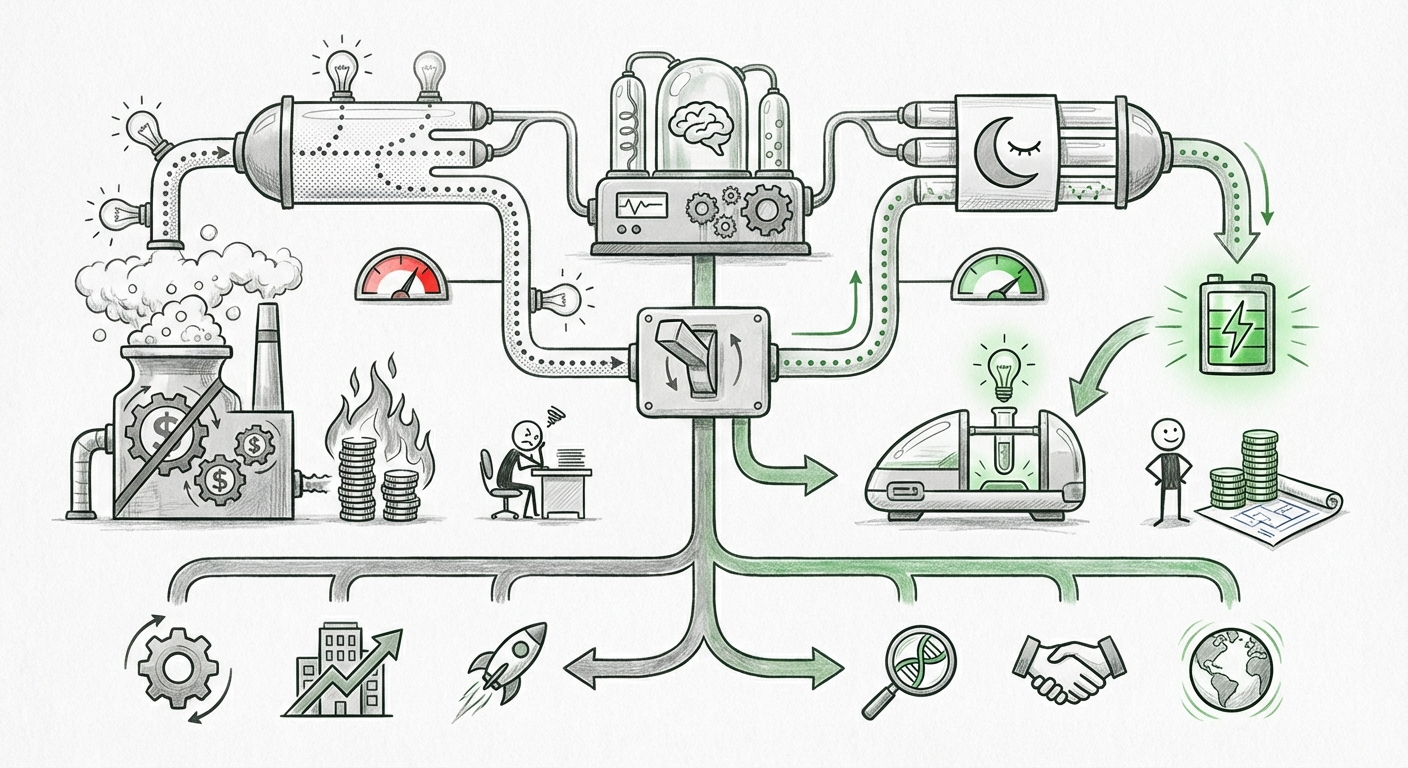
Seen this way, Binance's $6.34 billion reserve is the visible half of a two-part strategy. The reserve is the after. The AI is supposed to be the before.
AI at the Front Line: Spotting the Next Attack Before It Lands
Traditional security rules are written in advance. They say: block this address, cap this withdrawal, refuse this pattern. The weakness is obvious, attackers already know the rules. They build around them.
Machine learning flips the approach. Instead of being told what bad looks like, models learn what normal looks like for millions of accounts, and then raise a hand when something drifts. A login from an unusual place, a wallet that suddenly starts moving funds in odd increments, a burst of activity that resembles a pattern seen in earlier incidents, none of these need a written rule to be noticed.
Applied to an event of this scale, that capability becomes urgent in three places:
- Attack detection. Models that score transactions in real time and slow down anything that looks wrong, rather than waiting for a review queue.
- Containment. Automated systems that quarantine a compromised key or wallet instantly, limiting how far damage can spread before a human decision is made.
- Forensics. Graph-based AI that follows stolen funds across chains and through mixing services, mapping where value moves and who touches it.
The last one deserves attention. Tracing funds is a needle-in-a-haystack problem at a scale no analyst team can handle manually. AI does not get tired, does not lose track, and can cross-reference millions of addresses while investigators sleep. That is the difference between a hack that stays a mystery and one that gets partly reversed.
Autonomous Defense: When AI Agents Guard the Wallet
The next step is already being tested across the industry: AI agents that do not just flag problems, but act on them. These are systems given narrow, specific authority, pause this flow, rotate this key, freeze this account, alert this team, and then left to execute within limits.
This is powerful and unnerving in equal measure. The upside is speed no human team can match. The downside is that an autonomous defender is still software, and software can be tricked. An agent trained to spot fraud can be fed inputs designed to make it look the other way. So can the models that score credit risk, verify identity, or decide whether a withdrawal is legitimate.
The lesson the industry is slowly absorbing is that AI in security must be layered, not singular. One model watches the money. Another watches the first model. Human reviewers own the highest-stakes decisions. No single point of failure, human or machine, should be able to unlock billions on its own.
Treasury Management Gets a Machine Brain
There is another, quieter place where AI is reshaping this story: the reserve itself.
Holding $6.34 billion is not a static act. Someone has to decide how much of it sits in which assets, how much stays liquid enough to meet withdrawals on a bad day, and how to rebalance without moving markets. Those are forecasting problems, and forecasting is one of the areas where machine learning earns its keep, modelling withdrawal pressure under stress, projecting liquidity needs across scenarios, and flagging when a reserve that looks large on paper is actually thin in the currency people want.
This is the unglamorous side of AI in finance, and arguably the most valuable. It does not make headlines. It just quietly keeps a cushion as big as $6.34 billion pointed at the right problem at the right moment.
The Trust Problem: AI Can't Spin Bad News
Money answers the balance sheet. It does not answer the question users are really asking, which is: can I trust the systems holding my assets?
AI makes that question harder, not easier. A model that decides in milliseconds whether a withdrawal goes through is also a model that cannot explain itself in the same milliseconds. When a $6.3 billion loss happens, "the algorithm flagged it" is not an answer anyone accepts. Users want to know what was seen, what was missed, and what has changed.
This is the emerging discipline of explainable AI in finance, models that can show their reasoning, and audit trails that let an outside reviewer reconstruct a decision after the fact. Firms that treat explainability as a compliance checkbox will keep losing trust. Firms that build it into the security stack will find that it doubles as the fastest incident report they will ever produce.
Practical Implications for Businesses
For crypto platforms
A reserve of this size sets a new expectation. Customers will ask why one exchange publishes a cushion of $6.34 billion and another publishes nothing. AI-driven, always-on reserve monitoring, with the results shared publicly, is becoming table stakes rather than a differentiator.
For traditional finance
Banks do not face identical risks, but the pattern transfers. Automated systems fail at machine speed. If your fraud detection, payments routing, or settlement logic is not watched by something that learns, you are relying on rules written for a world that has moved on.
For AI builders
The demand signal is clear: anomaly detection, graph analysis, autonomous containment, and explainable decision logs. The customers are not asking for general intelligence. They are asking for narrow, auditable, fast.
Actionable Insights
- Assume machine speed. Design incident response for seconds, not hours. If a human must approve every step, the attack will finish first.
- Match your reserves to your risks. Holding assets that users actually want, not just a headline number, is what turns a cushion into a working one.
- Layer your defences. Combine rule-based controls, learned anomaly detection, and human judgment. No single layer should be trusted alone.
- Log everything an AI decides. Decision trails are not overhead; they are the evidence you will need on the worst day.
- Test your models against attackers. Run red-team exercises aimed specifically at the AI, not just the infrastructure.
- Publish your numbers. In a market built on confidence, disclosure is a security feature.
The Limits We Should Expect
It would be dishonest to treat AI as a fix. Models miss novel attacks because they have never seen them. They inherit the biases of their training data. They can be poisoned, fooled, and gamed. And a $6.3 billion breach is a reminder that determined attackers will always find the seam.
That is why the reserve matters. AI buys warning time; reserves buy recovery time. A platform with only one of the two is half-protected. The $6.34 billion figure is not a replacement for better defence, it is what you need when the defence fails anyway.
Conclusion: Reserves Buy Time, AI Buys Warning
Binance's disclosure is a large number with a small print message: the industry now expects losses of this magnitude, and it expects to survive them. That is a mature posture, and a sobering one.
The deeper shift is in how these systems are defended. Reserving $6.34 billion, including $5 billion in the impacted token assets, shows a company that has planned for the aftermath. But the next $6.3 billion hack, and there will be a next one, will be decided in the seconds before anyone notices. That contest is fought by models: watching, scoring, tracing, and sometimes acting alone.
The winners in the coming decade will not simply be the platforms with the biggest cushions. They will be the ones whose machines saw it coming, and whose humans could explain afterwards exactly what happened.