DeepMath and the Future of Lightweight Math Reasoning Agents: Why Small AI Agents Matter
The AI conversation has spent years chasing bigger models, bigger training runs, and bigger promises. But a quieter shift is gaining ground: small, focused agents that do one job well. DeepMath, a lightweight math reasoning agent built with smolagents, is a clear example of that shift. It was published in December 2025, and its importance is not that it tries to be the biggest model on the block. Its importance is that it points to a more practical future for AI.
Math is one of the hardest tests for any reasoning system. A model can sound confident and still be wrong. A lightweight math agent has to break problems into steps, check its work, and deliver answers that people can trust. That makes DeepMath more than a narrow tool. It is a signal about how AI will be built, sold, and used in the years ahead: smaller agents, clearer tasks, and more human oversight.
Why Math Is the Perfect Stress Test for AI Agents
Math is unforgiving. There is usually a right answer, and a wrong answer is easy to spot. That makes math a powerful testing ground for AI reasoning. A math agent cannot rely on vague language or a persuasive tone. It has to show a path from problem to solution.
This matters far beyond classrooms. Math reasoning sits under finance, engineering, logistics, health care analysis, software testing, and everyday business decisions. If an AI agent can help with a pricing model, a budget check, or a unit conversion, it can save time. But if it makes a quiet arithmetic error, the cost can be high. That is why math agents are both attractive and risky.
DeepMath's lightweight design fits this reality. A small agent can be tested on narrow tasks. It can be checked against known answers. It can be deployed where a giant general model would be too costly or too hard to control. In that sense, math is not just a subject. It is a proving ground for trust.
What "Lightweight" Really Changes
The word "lightweight" is doing a lot of work here. It suggests lower compute, faster response, and simpler deployment. Those are not small benefits. They change who can use AI and where it can run.
A lightweight math reasoning agent can lower the cost per task. It can make experiments cheaper. It can be easier to update and easier to audit. For a business, that means more room to test a use case before committing to a large rollout. For a school or a small team, it means access to a reasoning tool that does not require a massive budget.
Lightweight does not mean "better at everything." It means focused. A small math agent may handle well-defined problems and still struggle with messy, open-ended ones. The practical answer is not to replace large systems outright. It is to route each task to the right tool. Use a lightweight agent for clear math steps. Escalate to a larger system when the problem is ambiguous or high-stakes. Keep a human in the loop when the answer matters.
That routing idea is central to the future of AI. The winning systems will not be one model that does everything. They will be networks of tools, each chosen for the job. DeepMath's release is a small but useful reminder that "small" can be a strength, not a compromise.
The smolagents Signal: Agents Are Becoming Building Blocks
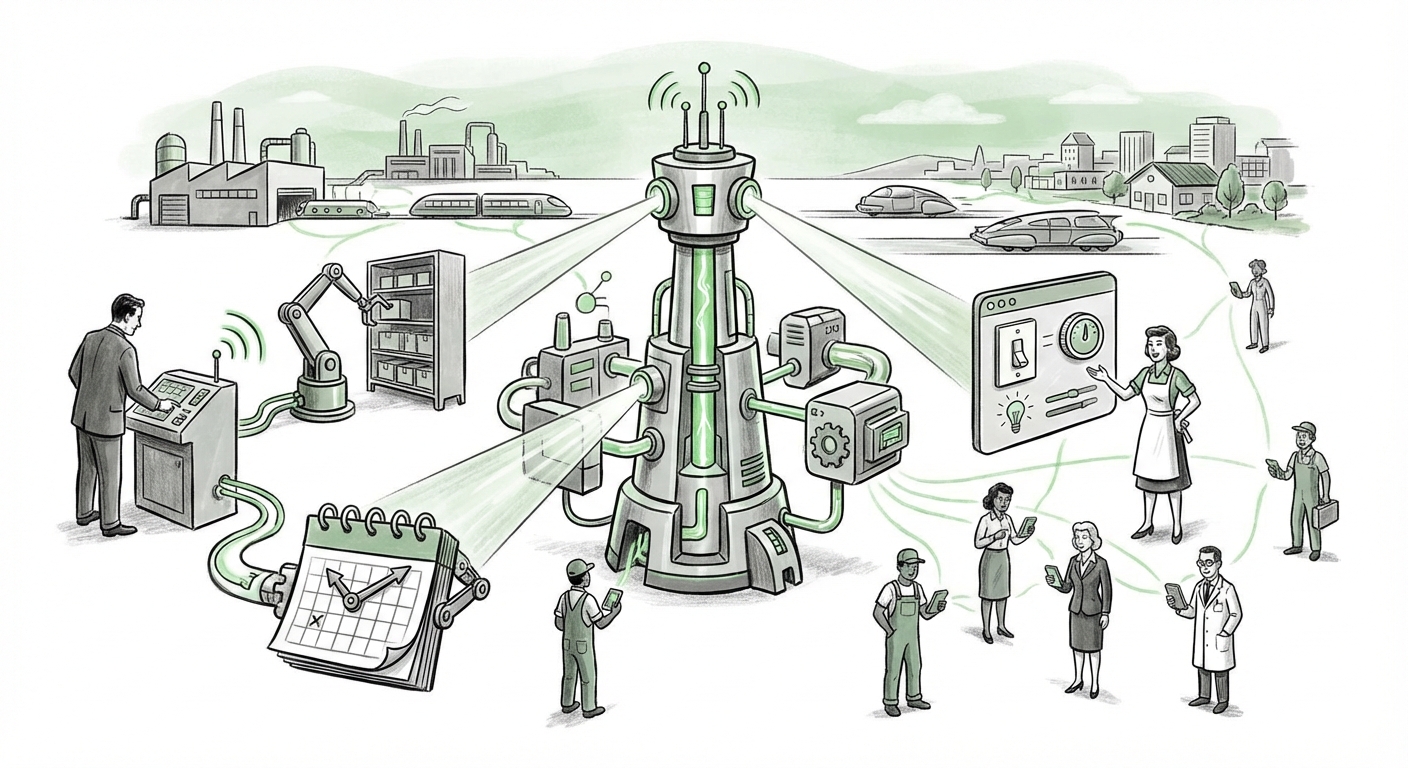
DeepMath is built with smolagents, and that choice matters. It places the project in the growing world of agent-first AI. Instead of treating a model as a single chat box, agent systems are designed to plan, act, check, and improve. A math agent can break a problem into parts, work through them, and review the result.
The larger trend is clear: agents are becoming building blocks. A math agent can sit inside a finance workflow. It can support a tutoring product. It can act as a checker inside a software pipeline. It can feed a larger system that handles a complex business process. Each agent stays small enough to test, replace, or improve.
This is a healthier model for AI adoption. It is easier to govern ten narrow agents than one giant black box. It is easier to measure where errors come from. It is easier to fix a single weak link. The rise of lightweight agents like DeepMath suggests that the next wave of AI will be less about one huge model and more about many focused ones working together.
From Big Models to Focused Workflows
For years, the default question was: "How big is the model?" The better question is now: "What is the workflow?" A math reasoning agent is useful only if it fits into a real process. That means clear inputs, clear outputs, and a clear place for human review.
Think about a loan review team. A lightweight math agent could help check repayment calculations. A human officer would still make the final call. Think about a classroom. A math agent could give step-by-step practice hints, while a teacher sets the lesson and watches for confusion. Think about an operations team. A math agent could flag a mismatch in a shipment total, and a manager could decide what to do next.
In each case, the agent is not the product. The workflow is the product. The agent is a helper inside it. That is the mindset businesses need. The question is not "Can we add an AI agent?" The question is "Where can a small, verifiable reasoning step remove drudgery without removing accountability?"
What This Means for Businesses
The business impact of lightweight math agents will be uneven, and that is fine. The best early uses will be narrow, repeatable, and easy to check. Finance teams can use them for routine calculations and reconciliation support. Education companies can use them for guided practice. Operations teams can use them for unit checks, cost estimates, and error spotting. Software teams can use them to test logic and catch simple mistakes before they reach customers.
But the value depends on discipline. A math agent that is right most of the time can still be dangerous if people treat it as right all the time. Businesses should measure three things before scaling: accuracy on the target task, the cost per solved problem, and the rate at which the agent needs human help. If the agent cannot be checked, it is not ready.
There is also a competitive angle. Lightweight agents are cheaper to test, so smaller companies can experiment. That lowers the barrier to entry. A small firm may not be able to build a giant model, but it can build or adopt a focused agent for a specific workflow. Over time, that could spread AI deeper into the economy, not just inside the largest tech companies.
Actionable steps for business leaders
- Start with a narrow task. Pick a math-heavy step that has a clear right answer and a low cost of error.
- Measure before you scale. Track accuracy, speed, cost, and how often humans must correct the output.
- Keep a human in the loop. Use the agent as a helper, not the final authority, in high-stakes decisions.
- Log the reasoning. Keep a record of inputs, outputs, and corrections so you can audit and improve.
- Plan for escalation. Send hard or ambiguous cases to a larger system or a person.
What This Means for Society
The social impact could be just as important. Math is a gatekeeper subject. Students who struggle with it often lose access to higher-paying fields. A patient, low-cost math agent could offer practice and feedback to learners who cannot afford a tutor. That is a real opportunity.
But access is not the same as understanding. If students use an agent to get answers without learning the steps, the tool can weaken the skill it was meant to build. The same risk applies to workers. If people stop checking arithmetic because an agent handles it, they may lose the ability to spot when the agent is wrong.
There is also a trust gap. People may overtrust a system that sounds confident. A math agent should show its work, mark uncertainty, and invite review. Schools and workplaces should teach people how to question AI outputs, not just how to use them. The goal is not to replace human judgment. The goal is to strengthen it.
Risks and Guardrails
Lightweight agents are not automatically safe. A small model can still make mistakes. It can still be confidently wrong. It can still reflect bad training data. And if it is connected to real systems, a wrong calculation can spread quickly.
The guardrails are not exotic. They are basic engineering and governance. Test the agent on real problems, including tricky edge cases. Keep versioned logs. Set clear limits on what the agent can do without approval. Review failures, not just successes. Make sure private data stays private. And be honest with users about what the agent can and cannot do.
There is also a governance question. Who is responsible when an AI math agent gives bad advice? The answer should be clear before deployment. A lightweight agent may be small, but the decisions it supports may not be. That is why math is a good place to start: the errors are easier to catch, and the lessons are easier to carry into other domains.
The Road Ahead
DeepMath is a small release with a large signal. It shows that AI is moving toward focused, testable, affordable agents. The future of AI will not be only about the largest model in the room. It will be about the right agent for the right job, with the right checks around it.
Expect more lightweight agents in math, science, finance, and operations. Expect them to be combined into workflows. Expect the winners to be the organizations that can measure trust, not just demo intelligence. The big lesson is simple: small agents can do serious work, but only when they are used with clear boundaries and human judgment.
For technical teams, the message is to build for verification. For business leaders, the message is to start narrow and measure carefully. For society, the message is to widen access while keeping people in charge. DeepMath may be lightweight, but the questions it raises are heavy. How we answer them will shape how AI is used for years to come.