Lumentum and Marvell's Massive AI Connectivity Deal: What the "Enormous" Opportunity Means for the Future of AI
One word did a lot of work when Lumentum's chief executive described the company's sweeping AI connectivity deal with Marvell: enormous. That word was not really about a single contract. It was about a shift in where the AI buildout is being won and lost.
For the past few years, the story of artificial intelligence has been a story about chips. Bigger models needed faster processors, and faster processors needed to be packed into data centers by the tens of thousands. That story is not over. But as AI clusters grow, the hardest problem quietly moves. It moves away from the processor itself and toward everything that connects processors to each other: the wires, fibers, lasers, and optical engines that carry data at incredible speed.
That is the layer Lumentum and Marvell are now betting on together. And the confidence in that bet tells us a great deal about what the next phase of AI will look like.
Why Connectivity Suddenly Matters So Much
Here is the simple version. A modern AI data center is not a box with one smart chip inside. It is a huge team of chips working together on one problem. To train a large model, those chips must constantly pass information back and forth. If the links between them are slow, the chips sit idle. If the links are fast but burn too much power, the whole facility runs into a wall.
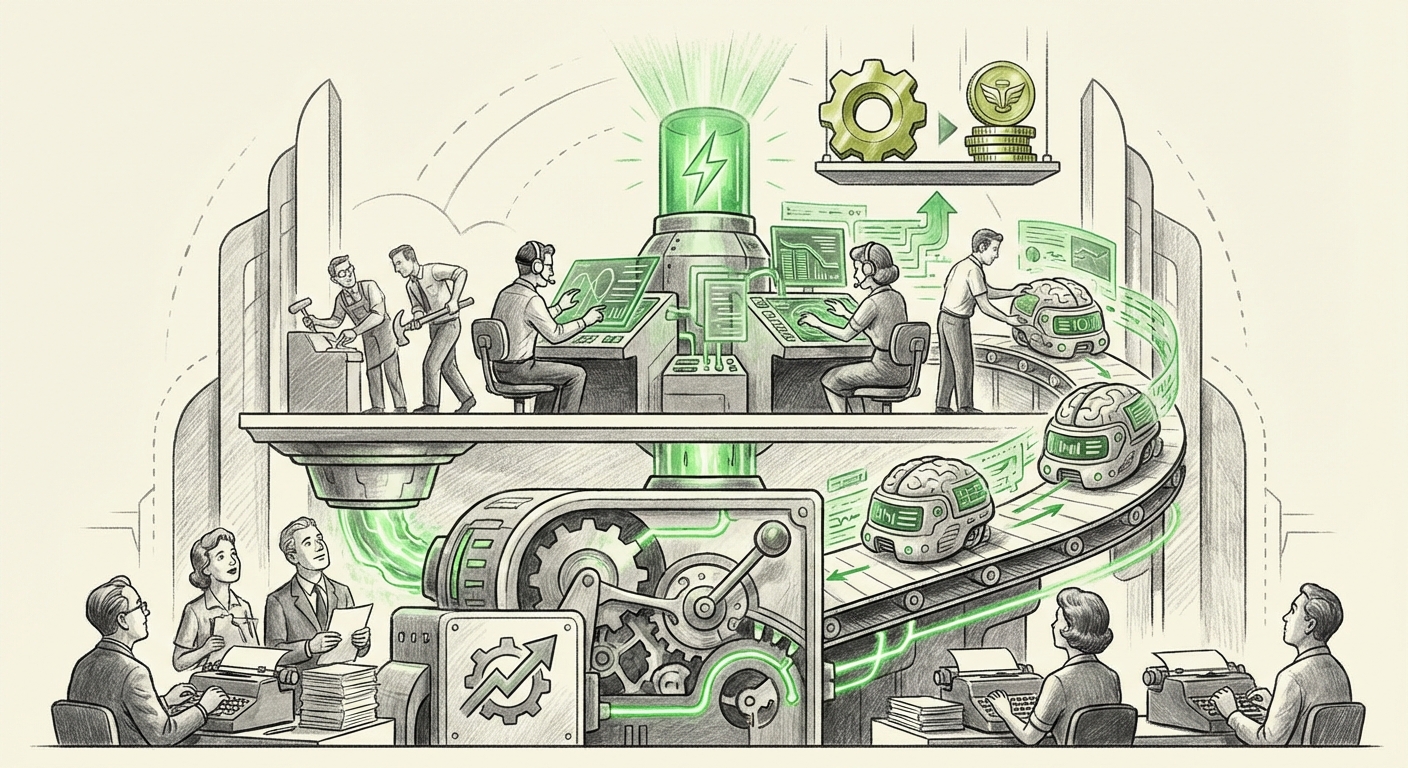
Think of it like a factory. You can buy the best machines in the world, but if the conveyor belts can't keep up, the machines stand still. Connectivity is the conveyor belt of AI.
For years, engineers solved this with copper cables. Copper is cheap and familiar, and it works well across short distances inside a single rack. But copper has limits. Push more data through it, and it wastes more energy as heat. Push it further, and the signal weakens. At the scale AI now demands, copper stops being a convenience and starts being a ceiling.
Optical connections, which use light instead of electricity, break through that ceiling. Light moves more data, over longer distances, with less energy lost along the way. That is why optical components have moved from a back-room purchasing decision to a front-page strategic one.
What the Deal Signals: The Bottleneck Has Moved
The partnership pairs two very different kinds of expertise. Marvell is known for the silicon that moves and manages data, the connectivity chips and custom processors that sit at the center of modern data center networks. Lumentum is known for the optical side: the lasers and photonic components that turn electrical signals into pulses of light and back again. Bringing those two halves closer together is a statement about where the industry sees the hardest engineering problem.
The strategic logic is easy to follow:
- AI clusters are getting larger. The more chips you link, the more links you need. The number of connections can grow faster than the number of chips themselves.
- Power is becoming the binding constraint. Data center operators are now as worried about megawatts as they are about performance. Every watt spent moving data is a watt not spent computing.
- Custom silicon is the new normal. Large cloud and AI players increasingly design their own chips, which means they also get to specify exactly how those chips talk to each other. Component makers must be ready to build to order.
- Integration wins. When optics and connectivity silicon are designed together rather than bolted together, you can cut power, cut parts, and cut failure points.
In other words, networking used to be the plumbing that nobody talked about at the product launch. Now it is a performance feature, listed right next to compute and memory.
The Bigger Picture: From Computing to AI Factories
The phrase "AI factory" has taken hold for a reason. These facilities are not general-purpose computer rooms. They are single-purpose industrial plants whose output is trained models and inference responses. And like any factory, their economics depend on throughput, uptime, and energy efficiency, not on any one machine.
That reframing changes what "good" looks like. A slightly slower chip with excellent connectivity may beat a faster chip that starves for data. A cluster that runs at higher utilization for the same power bill is a better investment than one that peaks higher but idles more often. Once you accept those trade-offs, the components that keep data flowing stop being commodities and start being competitive advantages.
This is why a connectivity partnership can carry the word "enormous" without exaggeration. It touches the part of the system where gains are now cheapest to find.
What This Means for the Future of AI
1. Models will keep growing, because the plumbing allows it
Every leap in model capability has depended on someone solving a systems problem first. Faster interconnects mean larger clusters can work as one machine. Larger clusters mean more ambitious training runs. The connectivity layer quietly sets the upper bound on what is practical to build.
2. Power efficiency becomes the real scoreboard
As optical links replace power-hungry copper, the energy saved can be redirected into actual computation. Over the next few years, expect efficiency, not raw speed alone, to become the headline metric that AI infrastructure teams report.
3. The supply chain gets more specialized, and more intertwined
No single company can own the whole stack. The winners will be the ones that form deep, tightly coordinated partnerships, where optical design and silicon design inform each other from day one. The Lumentum–Marvell tie-up is an early, explicit example of that model.
4. Inference at scale becomes the dominant workload
Training is dramatic, but inference, actually running the model for users, is where the long-term money sits. Inference is spread across many locations and demands low latency and high reliability. That favors connectivity that is efficient, compact, and manufacturable in very large volumes.
5. Geographies and vendors diversify
As connectivity becomes strategic, buyers will want more than one source for critical parts. That opens room for specialist suppliers who can prove they are reliable at scale, not just clever in a lab.
Practical Implications for Businesses
You do not have to run a hyperscale data center to be affected by this. Here is where it shows up in everyday business decisions.
- Cloud pricing and availability. When providers spend more on interconnect, those costs shape the price and scarcity of AI compute. Expect capacity to remain tight in the most sought-after tiers.
- Latency-sensitive products. Faster links make real-time AI, voice agents, live translation, interactive design tools, feel instant. Products that felt impossible two years ago become ordinary.
- Vendor roadmaps. If you are buying AI infrastructure, ask how the system handles data movement between accelerators, not just how fast the accelerators are. The answer predicts real-world performance better than a spec sheet.
- Energy planning. Efficiency gains in connectivity can meaningfully change the power profile of a facility. That matters for site selection, cooling design, and sustainability reporting.
Actionable Insights
- Benchmark on utilization, not peak speed. Ask vendors what percentage of the time your expensive compute will actually be busy. Connectivity is usually the reason the number is low.
- Treat interconnect as a first-class line item. In budgets and architecture reviews, give data movement the same scrutiny you give processors.
- Ask about integration depth. Find out whether optical and silicon components were co-designed or merely bundled. The difference shows up in power draw and reliability.
- Plan for multi-sourcing. Concentration risk in any critical component is a business risk, especially in a market moving this fast.
- Watch the optics supply chain as an early indicator. Optical component demand tends to signal where AI capacity is actually being built, ahead of official announcements.
- Revisit your latency assumptions. If your product roadmap assumed slow links, it may be time to redesign around near-instant data movement.
Risks and Open Questions
Optimism about connectivity is not the same as certainty. Several things could slow the story down. Manufacturing optical components at very high volume is hard, and yields matter. Deep partnerships between two companies can create real advantages, but they also create execution risk, if one side slips, both feel it. Demand for AI infrastructure has been extraordinarily strong, and any cooling in spending would ripple through the supply chain quickly. And standards still matter: the industry needs common ways for parts to work together, or integration gains get lost in compatibility work.
There is also a simpler risk: hype. The word "enormous" is inspiring, but investors and buyers will eventually want to see capacity come online, products ship, and power savings show up in real deployments.
The Bottom Line
The Lumentum–Marvell deal is a small headline with a large meaning. It confirms that the AI race has moved past the processor alone and into the system around it. The companies that can move data faster, with less energy, and at greater scale will decide how big the next generation of AI can actually be.
For business leaders, the lesson is straightforward. The most important question about AI infrastructure is no longer only "how fast is the chip?" It is "how well does everything around the chip work together?" The answer to that question is where the enormous opportunity really lives.