Model Routing in AI: Why Picking the Right LLM Is Simple Until It Isn't
Every team that builds with AI eventually hits the same wall. You have a chat box, an agent, or a document-handling pipeline. A request comes in. Which model should answer it?
At first, the answer feels obvious. Send the easy stuff to a small, cheap model. Send the hard stuff to a big, powerful one. Write a quick rule, ship it, move on.
That is model routing. And it is simple, right up until the moment it isn't.
Model routing is quickly becoming one of the most important control points in the entire AI stack. It decides what your product costs to run, how fast it feels, and whether the answers are good. It is also where a lot of confident architecture diagrams quietly fall apart. Understanding why is key to understanding where enterprise AI is heading next.
What Model Routing Actually Is
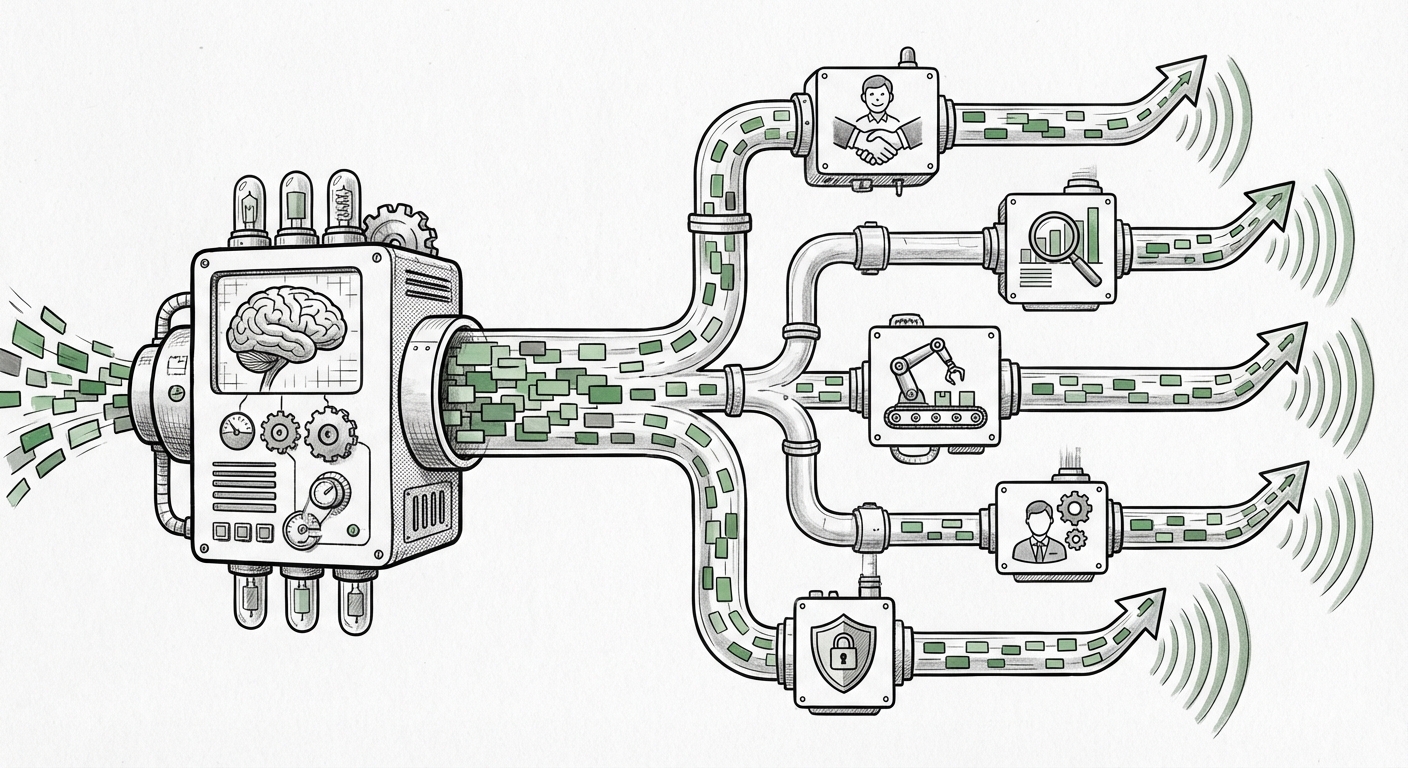
Model routing is the layer that sits between a user's request and the model that handles it. Instead of wiring your app to a single AI model, you put a decision step in front. That step looks at the incoming request and picks a destination.
The idea borrows from something old and unglamorous: load balancing and traffic management in web infrastructure. But AI traffic is different. Two requests that look identical can demand completely different levels of reasoning.
Consider a customer support app. One message says, "Where is my order?" Another says, "I was double-charged, the order arrived broken, and I want to cancel the whole subscription and speak to a manager." Both are support tickets. One needs almost no thinking. The other needs careful, multi-step reasoning and a careful tone.
A good router notices that difference. A naive router does not, and that is where the trouble starts.
Why It Looks Simple at First
The first version of a router is almost always a simple rule set:
- Short prompt? Use the small model.
- Long prompt or code involved? Use the big model.
- Contains certain keywords? Route up.
- User is on a paid plan? Route up.
This works surprisingly well in a demo. It cuts costs. It makes responses faster. Everyone feels clever.
Then real traffic arrives. Real traffic is messy. People write in fragments. They paste long documents and ask one-word questions. They switch languages mid-sentence. They ask something that looks trivial but requires careful reasoning. They ask something that looks hard but has a canned answer.
Prompt length stops being a signal. Keywords start firing at the wrong times. The rule set grows. Soon you have a stack of conditions that nobody fully understands, and every new rule risks breaking an old one.
Where Model Routing Breaks Down
The Cost Trap
The first reason teams build a router is to save money. Big models are expensive per token. Small models are cheap. It is tempting to push as much traffic as possible to the cheap side.
But the true cost of a wrong routing decision is not the token bill. It is the failed answer. A cheap model that mangles a refund request can trigger a support escalation, a lost customer, or a compliance problem. That one bad answer can cost far more than a month of running every request through a stronger model.
Cost per call is easy to measure. Cost per mistake is not. Most routers are tuned on the first number and blind to the second.
Quality Is Not a Single Number
Teams often imagine a leaderboard where one model sits on top and another sits below it. Routing would then just mean drawing a line.
Reality is messier. Models differ by task. One may be excellent at summarizing a long document and mediocre at writing code. Another may be strong at structured output and weak at conversational nuance. A third may be very good at following strict formatting rules but slow.
So "which model is best?" is the wrong question. The real question is "which model is best for this request, under this budget, at this speed, with this reliability requirement?" That question has a different answer for every workload, and the answer changes over time.
Routing on the Way In Versus on the Way Out
Most routing happens before a single token is generated. The system guesses how hard the request is, then commits.
But guessing is hard. A request can look simple and turn out to require deep reasoning. A request can look complex and turn out to be a routine lookup. This is a classic problem: you are trying to predict difficulty using only the surface of the question.
More advanced systems flip the approach. They start cheap, watch the model work, and escalate when confidence drops or the problem turns out to be harder than expected. That is closer to how a careful human works, try the quick path first, call in help when needed. It is also much harder to build, because it requires reliable confidence signals and a way to hand off mid-task without losing context.
Model Churn
Here is a problem unique to this era: the menu of models keeps changing.
New models launch. Old ones get updated. Behavior shifts. Pricing moves. A routing policy that was carefully tuned last quarter may be quietly misaligned this quarter, because the model it depended on behaves differently now or has been replaced.
This means a router is not a project you finish. It is a living system that needs to be re-tested every time the underlying models change. Most teams underinvest in this, and their routing quietly degrades in ways no dashboard shows.
The Evaluation Gap
You cannot route well without knowing which model actually performs better on your specific traffic. And you cannot know that without an evaluation set built from your own real requests.
This is the quiet bottleneck. Public benchmarks measure general capability on public tasks. They tell you very little about whether a model handles your industry's jargon, your formatting rules, or your customers' tone.
Strong teams build a small, curated set of real prompts with known good answers, then run every candidate model against it. That set becomes the source of truth for routing decisions. Without it, routing is guesswork dressed up as engineering.
What This Means for the Future of AI
Model routing is not a temporary workaround. It is becoming a permanent layer of the AI stack, and that shift has real consequences.
First, AI products stop being tied to one model. The companies that build well will treat models as interchangeable parts, chosen per task and swapped when something better or cheaper arrives. Locking a product to a single model is starting to look like locking a web app to a single server.
Second, evaluation becomes a core product skill. As models multiply, the teams that win will be the ones who can measure quality on their own traffic quickly and reliably. Evaluation is turning from a nice-to-have into the steering wheel.
Third, cost control becomes a design feature, not an afterthought. Instead of picking the most powerful model and hoping the bill works out, teams will design the routing path from day one, much like how cloud teams design for cost before they deploy.
Fourth, the gap between good and bad routing will widen. Two products built on the same models can end up with very different economics and very different user experiences, purely because of the routing layer in the middle. That layer is becoming a competitive advantage in its own right.
A Practical Playbook for Teams
If you are building with AI today, here is how to approach routing without drowning in complexity.
- Start simple, but instrument everything. Log which model handled each request, what it cost, how long it took, and whether the answer was accepted or corrected. You cannot route well without this data.
- Build a real evaluation set early. Collect a few hundred real requests with known good answers. Grow it over time. This is the single most valuable asset for routing decisions.
- Route by task, not by vibe. Group your traffic into a handful of clear task types, lookup, summarization, code, open-ended reasoning, structured extraction. Set a policy per task instead of one global rule.
- Measure cost per mistake, not just cost per call. Track how often cheap-model answers get escalated, retried, or corrected. That number decides whether your savings are real.
- Design for escalation. Make it easy to send a request up to a stronger model when confidence is low or a check fails. Build the handoff before you need it.
- Re-test on every model change. Treat new model releases as events that require re-running your evaluation set. Do not assume yesterday's policy still holds.
- Add guardrails, not just routers. Format checks, safety filters, and fallback paths matter as much as the choice of model. A router that picks the right model but skips validation is only half a system.
The Bigger Picture
The reason model routing is so much harder than it looks is that it sits at the intersection of everything: cost, quality, latency, reliability, and the messy reality of human requests.
That is also why it matters. As AI moves from demos into daily operations, the winning systems will not be the ones with the single smartest model. They will be the ones that know which tool to reach for, notice when the choice was wrong, and get better over time.
In other words, the future of AI is not just about building bigger models. It is about building smarter traffic systems around them, and the teams that treat routing as serious engineering, rather than a quick if-statement, will be the ones that ship AI people actually trust.