When Will the Average Person Actually Feel AI's Impact? A Reality Check for 2026
Ask almost anyone about artificial intelligence and you will get one of two reactions. Either they are amazed by what it can do, or they shrug and say, "It hasn't changed my life at all." Both reactions are honest. Both are also incomplete.
The big question hanging over the entire industry right now is simple: when will average people actually feel AI's impact? Not the researchers. Not the software engineers. Not the investors. The person who works at a warehouse, teaches a sixth-grade class, runs a small bakery, or handles insurance claims at a mid-size office.
That question has no single date attached to it. But it does have a shape, and once you see the shape, the timeline becomes much easier to reason about. The honest answer is that the impact is already here in some places, on its way in others, and still blocked by real barriers in many more. Here is a clear-eyed look at where things stand, why change feels slow, and what would actually signal that the wait is over.
The Gap Between the Headlines and the Kitchen Table
AI has become the most talked-about technology in the world. Companies build products with it. Schools debate it. Governments write rules about it. Yet for many households, the day-to-day routine looks the same as it did a few years ago.
Part of this is because of a simple misunderstanding. People already use AI every day without calling it AI. Your phone sorts your photos. Maps reroute you around traffic. Your bank flags a strange charge. Your inbox filters spam. A streaming service suggests a show you actually want. All of that is machine learning doing quiet work in the background.
So why doesn't it feel like a big shift? Because none of those tools require you to think about them. The new wave of AI is different. It talks back. It writes, plans, and completes tasks. That is far more visible. And that visible version is exactly what most people mean when they ask, "Where is this thing everyone keeps talking about?"
Why AI Arrives in Layers, Not All at Once
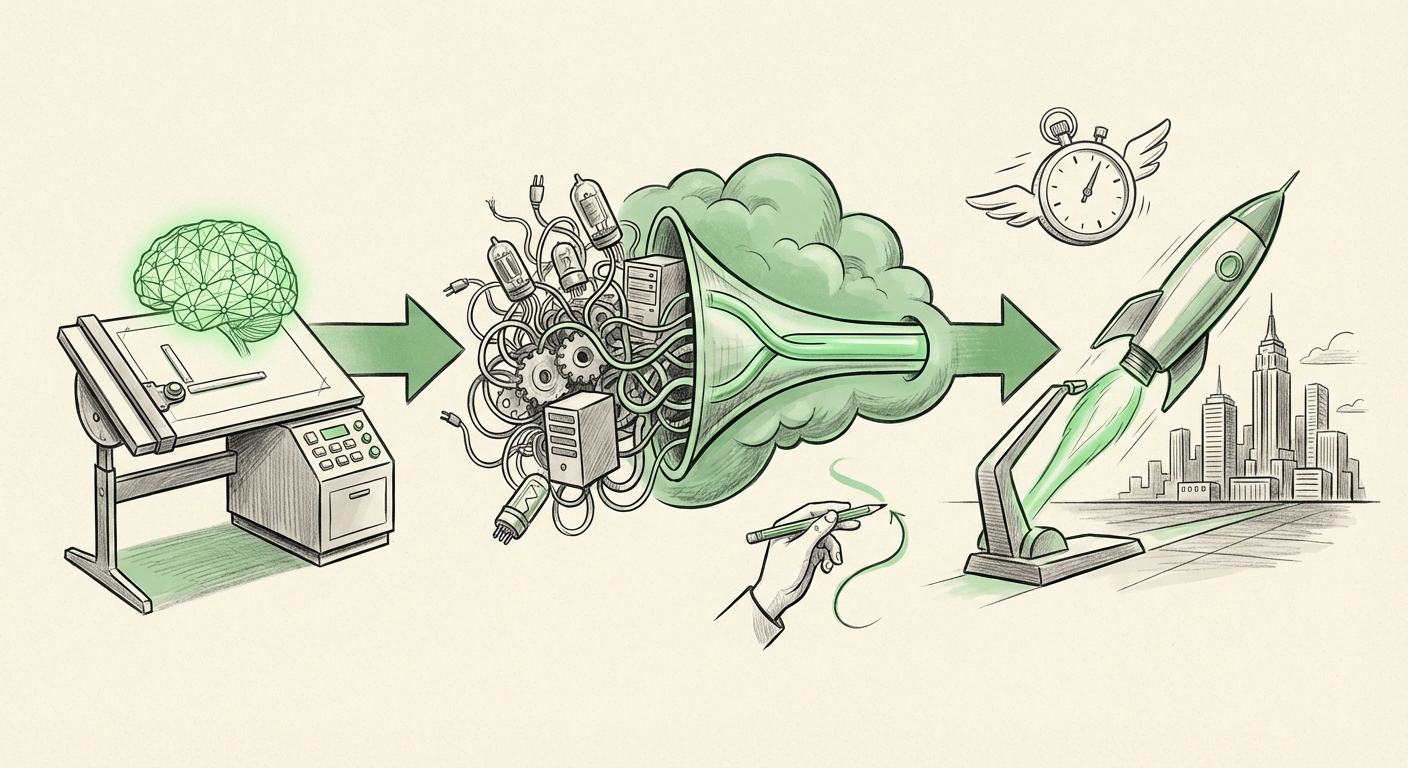
New technology rarely lands evenly. Electricity took decades to reach every farm and factory. The internet arrived for families through schools, then work, then phones. AI is following a similar path, but faster and stranger.
Layer One: The novelty phase
The first thing average people saw was the chat window. You type, it answers. It was impressive, sometimes wrong, and often treated as a toy. This phase convinced people AI existed, but not that it mattered to their paycheck or their commute.
Layer Two: The invisible back office
This is where the real work is happening right now. Businesses are putting AI behind the scenes: drafting emails, summarizing documents, sorting support tickets, checking forms, writing code, and flagging errors in spreadsheets. Customers rarely see it. But the work gets faster.
This layer matters more than it looks. If a company can answer a support request in one pass instead of four, or process a claim in hours instead of weeks, the savings eventually show up in price and speed. That is how technology reaches the kitchen table. First it changes the cost of doing business. Then it changes the price you pay and the service you get.
Layer Three: The task-completing agent
The next jump comes when AI stops answering and starts completing. Booking the appointment. Filling the form. Comparing the policies. Chasing the refund. Building the itinerary. This is the layer average people will notice most, because it removes chores rather than adding conversation.
Layer Four: Ambient AI
The final stage is when AI disappears into everyday objects. Cars that watch the road. Appliances that order what you are out of. Health tools that flag a problem before you feel it. In this stage, no one says "I used AI today." They just say the day went smoothly. That is when the impact becomes permanent.
The Real Bottlenecks: Why It's Not Faster
If the tools are so capable, why is everyday life not already transformed? A few stubborn reasons keep showing up.
- Trust. People will not hand over a task until they believe the tool will not fail in an expensive or embarrassing way. One bad mistake can cancel out dozens of good results.
- Reliability thresholds. A tool that is right most of the time is fine for a draft. It is not fine for a medical note, a tax filing, or a loan decision. Crossing that line takes more than a better model.
- Liability. When an AI agent books the wrong flight or files the wrong form, someone must be accountable. Companies move slowly until that question is settled.
- Integration cost. Connecting AI to old systems, messy records, and real workflows is slow, unglamorous work. This is where most projects quietly stall.
- Habit. People are loyal to routines. Even a clearly better tool has to be adopted, learned, and trusted before it becomes the default.
- Cost per task. For AI to reach everyone, it has to be cheap enough to use on small, low-value jobs, not just high-stakes ones.
None of these are permanent walls. They are speed bumps. But together they explain the strange feeling of living through a revolution that has not quite arrived at your front door.
What "Feeling It" Will Actually Look Like
People tend to imagine AI's arrival as a dramatic moment. In practice, it will show up as a series of small frictions disappearing. Watch for these signals:
- You stop waiting on hold. Support issues get resolved in one contact because the system already knows your history and can act on it.
- Paperwork shrinks. Forms are pre-filled. Renewals happen without a phone call. Claims move without three follow-ups.
- Scheduling gets easy. Appointments, repairs, and deliveries coordinate themselves across calendars.
- Prices and turnaround times shift. Services that used to be slow or costly become fast and ordinary.
- You choose it without being told. The moment people pick the AI-assisted option because it is simply better, adoption is no longer a marketing problem.
- You stop noticing it. The strongest sign of all. When the tool is boring, it has won.
What This Means for Businesses
For companies, the practical takeaway is that waiting is riskier than experimenting. But experimenting badly is also risky. A few grounded moves make sense:
- Start with one workflow, not ten. Pick a process that is high-volume, low-risk, and measurable. Fix it completely before expanding.
- Measure outcomes, not pilots. Count hours saved, errors reduced, and response times improved. A demo is not a result.
- Keep a human in the loop where trust is thin. Build in easy undo, clear escalation, and visible reasoning. Trust grows through recovery, not perfection.
- Train the people, not just the system. The biggest gains come from staff who know how to check, correct, and direct the tool.
- Plan for customer expectations. Once people experience fast, clean service anywhere, they expect it everywhere. Patience for slow processes is dropping.
- Pass savings along, at least partly. If efficiency gains never reach the customer, the public will feel the cost of AI without the benefit, and that gap fuels backlash.
What This Means for Society
The social side is where the timeline gets harder to predict and more important to get right.
Work will change at the edges first
Entry-level tasks, the ones that teach people how a job works, are the easiest to automate. That does not mean entry-level jobs vanish. It means the ladder changes shape. Junior roles will lean more on judgment, checking, and communication, and less on repetitive production.
The skills that matter are shifting
Verification is becoming a core skill. So is clear writing, good questioning, and knowing when to stop trusting a machine. These are teachable, and they should be taught early.
Access is the real dividing line
The biggest risk is not that AI arrives too fast. It is that it arrives for some people and businesses and not others. Small firms without technical staff, and households without good devices or connections, can fall behind quickly. Public access, low-cost tools, and clear guidance matter as much as the technology itself.
Rules will shape the pace
Disclosure requirements, liability rules, and safety standards decide how fast AI moves into health, finance, education, and public services. Good rules do not slow progress. They make adoption possible by giving people a reason to trust it.
How to Tell We're Getting Close
Rather than guessing a single date, watch for these markers. Each one is a real signal that the impact has reached ordinary life:
- When AI agents can reliably finish multi-step errands without a person watching.
- When a small business owner can adopt AI without hiring a consultant.
- When customer service improves in a way customers can feel, not just measure.
- When the cost of common services falls and quality holds.
- When people stop asking whether AI is real and start asking which tool to use.
- When the technology stops being a topic of conversation and becomes part of the furniture.
The Bottom Line
The average person's experience of AI will not change in a single dramatic moment. It will change the way most big shifts do: slowly, unevenly, and then all at once. The behind-the-scenes work happening now is setting up that shift. The barriers are real but temporary. Trust, reliability, cost, and integration are all moving in the same direction.
For businesses, the smart play is to build competence now, with tight focus and honest measurement, so that when the wave arrives you are not starting from zero. For everyone else, the useful move is to learn how these tools work, where they fail, and how to check them. The people who understand the tools will notice the change first, and they will be the ones who shape how it lands for everyone else.
The question is no longer whether AI will touch everyday life. It is how soon the touch becomes ordinary, and who gets to feel it first.