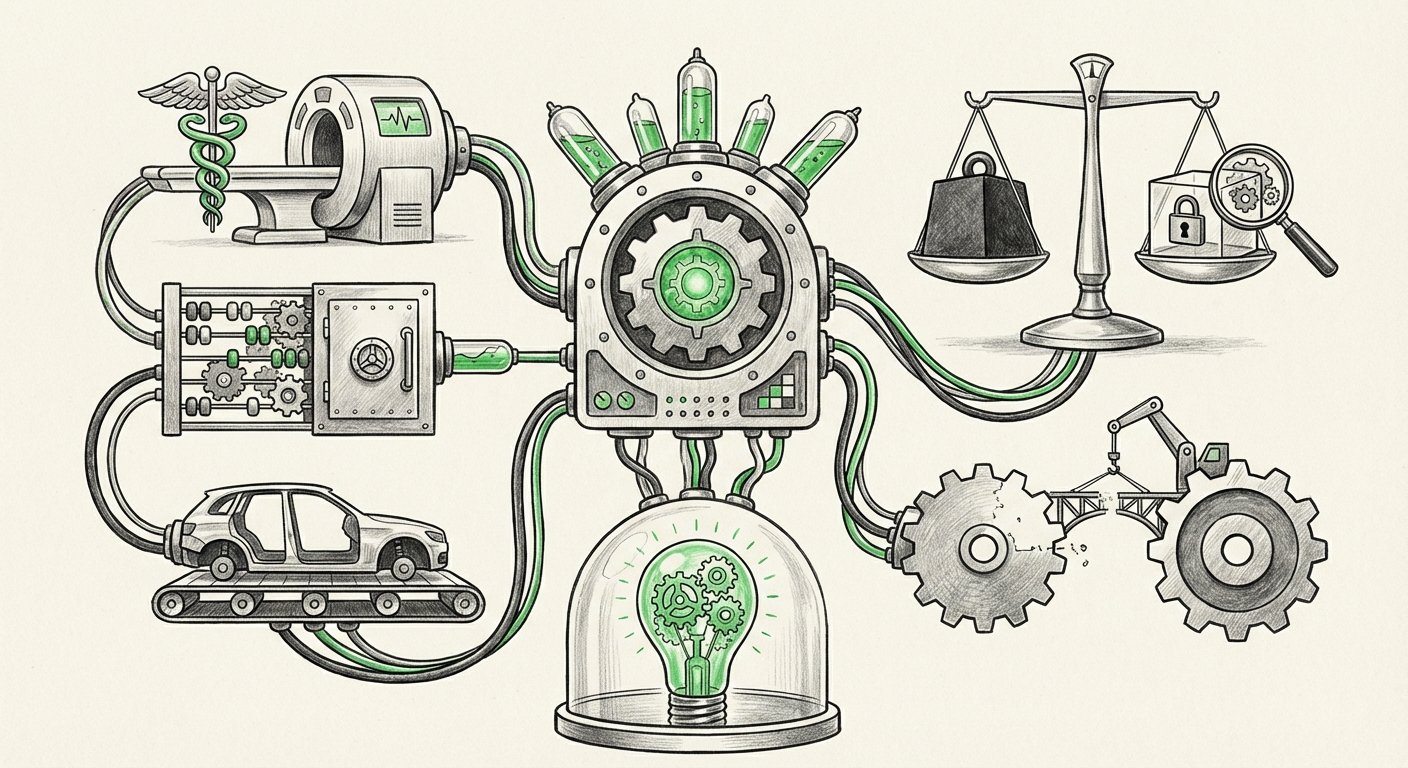
Decision Models and the Jevons Paradox: Why AI Efficiency Will Drive More AI Use
A quiet but powerful shift is happening in artificial intelligence. We are moving from AI that simply predicts, like guessing what movie you might like, to AI that makes decisions. These new systems, called decision models, don't just forecast; they recommend actions, allocate resources, and even run entire workflows on their own. And as they become more efficient, something surprising is happening: we are using them far more than anyone expected. This is the Jevons paradox in action, and it will reshape how businesses and society use AI.
What Are Decision Models? A Big Step Beyond Prediction
Most AI we know today is predictive. Think of spam filters, product recommendations, or credit scoring. These models look at data and estimate what is likely to happen. Decision models go further. They use those predictions to choose an action, often in real time. For example, a decision model might not just predict that a delivery will be late; it might reroute the truck, notify the customer, and adjust inventory, all without a human touching it.
This shift matters because decisions are where value is created. A prediction alone doesn't save money or delight a customer. A decision does. Decision models are already appearing in supply chains, energy grids, healthcare, and finance. They are the engines behind autonomous systems, dynamic pricing, and personalized medicine. As they mature, they will become the core of how companies operate.
The Jevons Paradox: Efficiency That Increases Consumption
In the 19th century, economist William Stanley Jevons noticed something odd. When coal-powered engines became more efficient, Britain didn't use less coal, it used more. Efficiency made coal cheaper and more useful, so people found new ways to burn it. The same pattern has repeated with computing power, electricity, and now AI.
As AI models become cheaper and faster, we don't use less AI. We use it everywhere. A decade ago, running a large model was a major expense. Today, many tasks cost pennies. That drop in cost has opened the floodgates. Companies now deploy AI for dozens of small decisions they would never have automated before, choosing the best email subject line, optimizing a delivery route, or adjusting a thermostat by a fraction of a degree. Each use is tiny, but together they add up to a massive increase in total AI activity.
Decision models accelerate this trend. Because they act autonomously, they can be deployed at a scale that would be impossible for humans to manage. And because they improve with more data and more feedback, companies are incentivized to run them constantly. The result: more decisions, more models, more compute, and more energy, even as each individual decision becomes more efficient.
Why This Matters for the Future of AI
The Jevons paradox has three big implications for AI's future.
1. Energy and Resource Use Will Rise, Not Fall
It is tempting to think that more efficient AI will shrink its carbon footprint. But history suggests the opposite. As decision models become embedded in everything from traffic lights to factories, total energy demand from AI will likely grow. This doesn't mean we should ignore efficiency, it means we need to plan for a world where AI is ubiquitous and power-hungry. Companies will need to invest in clean energy and efficient data centers just to keep up.
2. Economic Growth Will Come from Small, Automated Decisions
The biggest economic gains from AI won't come from one giant model that does everything. They will come from millions of tiny decisions, each optimized by a specialized model. A retailer might use decision models to set prices every hour. A logistics firm might use them to reroute packages every minute. These micro-decisions compound into major efficiency gains. But they also mean that businesses must rethink their entire workflow, from data pipelines to human oversight.
3. Governance and Accountability Become Urgent
When AI makes decisions, someone needs to be responsible. If a decision model denies a loan or rejects a job applicant, who is at fault? The Jevons paradox makes this harder because decision models will be everywhere, often making choices that humans never review. Regulators and companies will need new frameworks for auditing, explaining, and challenging AI decisions. The more we use decision models, the more we need clear rules for how they operate.
Practical Implications for Businesses
For business leaders, the rise of decision models and the Jevons paradox mean three things:
- Plan for more AI, not less. Budgets for AI compute will grow, not shrink. Treat AI as a core utility, like electricity or bandwidth. Negotiate long-term contracts with cloud providers and invest in efficiency where it matters most.
- Focus on decision quality, not just model accuracy. A prediction model can be 99% accurate and still lead to bad decisions. Decision models need to be evaluated on outcomes, revenue, customer satisfaction, safety, not just on how well they predict.
- Build human oversight that scales. You cannot manually review every decision. Instead, use techniques like exception-based review, where humans only step in when a decision is unusual or high-risk. This keeps costs down while maintaining accountability.
What It Means for Society
The Jevons paradox also has a social dimension. As decision models become cheaper, they will spread into areas like healthcare, education, and public safety. This could improve services and reduce costs. But it could also lead to over-automation, situations where we use AI simply because it is cheap, not because it is better. For example, a school might use an AI to grade essays not because it improves learning, but because it saves money. Society will need to decide where decision models add real value and where human judgment must remain central.
There is also a risk of widening inequality. Companies that master decision models will outperform those that don't, creating a gap between AI-rich and AI-poor organizations. Workers whose jobs involve routine decisions may see those tasks automated, while workers who design, oversee, and improve decision models will be in high demand. Education and retraining programs will be essential.
Actionable Insights: How to Prepare Today
You don't need to wait for the future to arrive. Here is what you can do now:
- Audit your decisions. List the top 20 decisions your business makes every day. Which ones could be improved with better data and faster feedback? Start with low-risk, high-volume decisions.
- Invest in decision infrastructure. Decision models need clean data, fast feedback loops, and the ability to take action. Many companies have prediction models but no way to act on them. Build the plumbing first.
- Measure total AI consumption. Track how much compute and energy your AI systems use. As you deploy more decision models, this will grow. Set targets for efficiency and sustainability.
- Create an AI ethics board, even a small one. Someone needs to ask, "Should we automate this decision?" A simple review process can prevent costly mistakes.
- Experiment with simulation. Decision models often need to test actions before taking them. Simulation environments let you train and validate decision models safely.
The Road Ahead
The rise of decision models is not just a technical change. It is an economic and social shift. The Jevons paradox tells us that efficiency will not reduce AI's footprint, it will expand it. That is both exciting and challenging. Exciting because decision models can solve problems we've struggled with for decades, from supply chain waste to personalized medicine. Challenging because we must manage the growth responsibly.
The organizations and societies that thrive will be those that embrace decision models while keeping a clear eye on total usage, accountability, and human values. The future of AI is not about doing less, it is about doing more, smarter, and with intention. The question is not whether we will use decision models everywhere. It is whether we will use them well.