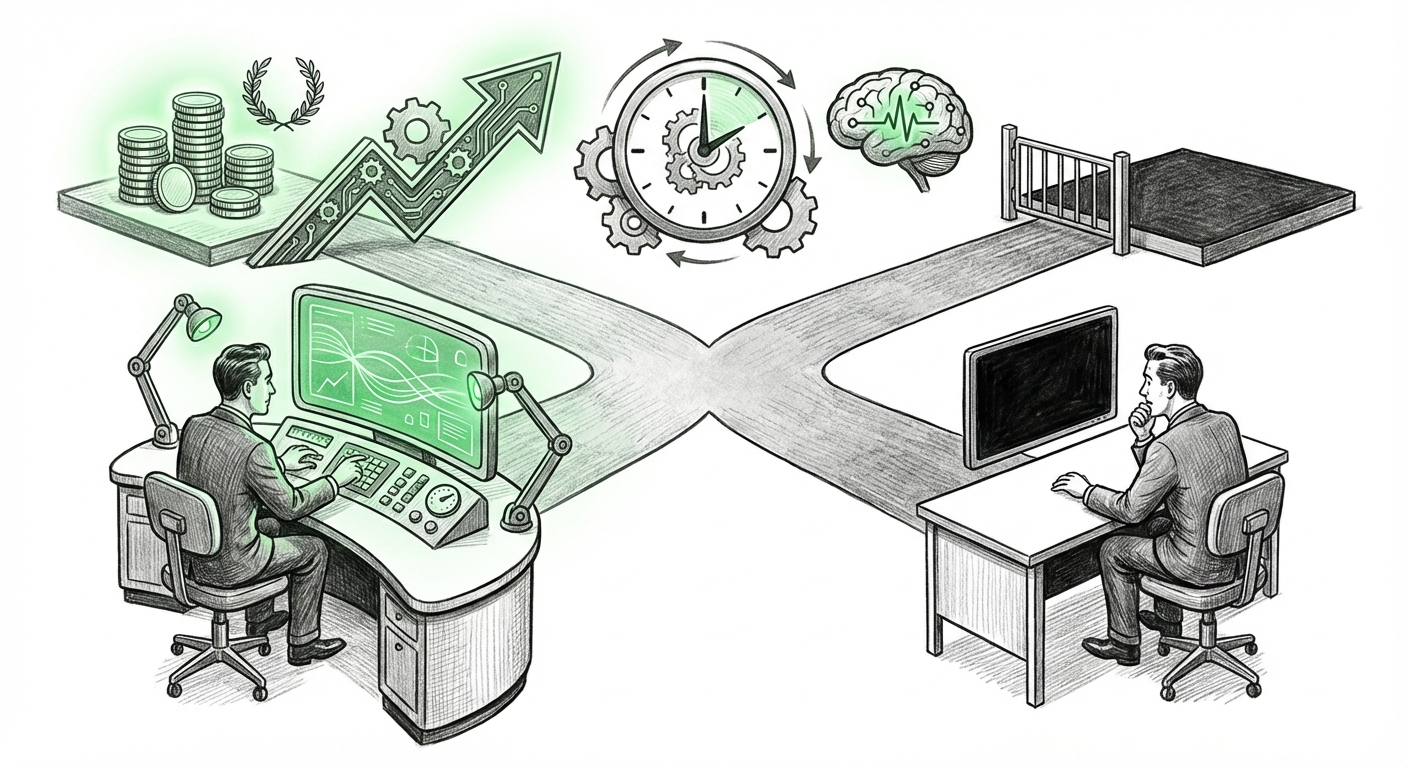
AI's Golden Age Is Being Invented in Real Time, Here's Why That Matters
The Renaissance is one of the most famous eras in history. But the people who lived through it did not call it that. The label came later. It was a story told after the fact, a story about a "rebirth" that followed a "dark age." That story was powerful. It shaped what we value, what we fund, and what we fear. Today, the same thing is happening with artificial intelligence. The AI era is being named while we are still inside it. And the names we choose will shape what gets built, who gets heard, and what gets left behind.
The Renaissance Was a Later Label, Not a Self-Aware Era
Historians have long noted that the Renaissance was "invented", not in the sense that the art and ideas were fake, but in the sense that the idea of a single, clean era was constructed later. The term itself was applied centuries after the fact. It framed a "rebirth" of classical learning after a "dark age." That framing was not neutral. It elevated certain kinds of art, certain texts, and certain people. It also erased a lot. The "dark ages" were not uniformly dark. They included advances in agriculture, law, and technology. But the story needed a dark age to make the golden age shine.
This is how periodization works. We chop time into chunks and give them names. Then we forget we did the chopping. The names start to feel natural, like weather. But they are choices. They are tools. They can be used to sell a program, justify a break from the past, or dismiss what came before. That is true for the Renaissance. It is also true for AI.
How Golden and Dark Ages Are Constructed
Golden and dark ages are built through three simple moves. First, selective memory. We remember the highlights of a "golden age" and the lowlights of a "dark age." Second, contrast. A golden age needs a dark age to push against. The brighter the rebirth, the darker the before. Third, institutional need. A label can legitimize a new regime, a new market, or a new budget line. If you can name the era, you can claim to lead it.
These moves are not always cynical. Sometimes they help people make sense of complex change. But they always involve a trade-off. Something gets highlighted. Something gets hidden. And the people who name the era often gain power over the story. That is why it matters who gets to say "this is a Renaissance" or "this is a dark age."
AI Is Already Being Periodized
AI has its own era names. "AI boom." "AI winter." "The AI Renaissance." "The fourth industrial revolution." These labels are applied in real time. Investors use them to signal. Journalists use them to frame. Founders use them to raise money. And the labels can become self-fulfilling. A "winter" can chill funding and scare talent. A "renaissance" can inflate expectations and attract capital. The danger is treating these stories as natural weather rather than human choices.
AI winters are a real historical pattern. Periods of hype have been followed by periods of disappointment. But the story of a "winter" can also be used to consolidate power. If everyone believes a freeze is coming, only the biggest players can survive it. The same is true for a "renaissance." If everyone believes a golden age is here, it becomes harder to ask hard questions about cost, labor, and risk.
The "New Renaissance" Sales Pitch
Many people now say AI will bring a new Renaissance. It is a compelling story. It promises a rebirth of creativity, productivity, and science. It suggests that AI will unlock human potential and sweep away old, tired ways of working. That story is already being used to sell products, raise funds, and shape policy.
But the original Renaissance was not a clean break. It was messy, contested, and named later. AI's "Renaissance" is being branded before the results are in. That does not make the promise false. It makes it a claim that needs evidence. Businesses should ask a simple question: What is being erased in this story? Which workers, practices, or kinds of knowledge are being cast as the "dark age" that AI will replace? That question is not just philosophical. It affects budgets, hiring, and strategy.
Dark Ages as a Control Tool
Doom narratives are powerful too. If people believe an AI dark age is coming, a collapse of jobs, truth, or safety, they may accept restrictions they would otherwise reject. Sometimes that is wise. Guardrails matter. But fear can also be used to justify fatalism or central control. If the future is doomed, why try to shape it? If the technology is out of control, why demand a say?
The "dark ages" label was used in history to dismiss a whole period. In AI, "winter" talk can be used to scare competitors or to concentrate power. The lesson is not to ignore risk. The lesson is to ask who benefits from the story. A dark age narrative can be a warning. It can also be a weapon.
AI Can Mass-Produce Historical Narratives
There is a new twist. Generative AI can write history, summarize eras, and produce convincing narratives at scale. That can democratize access to knowledge. It can also flood the zone with simplified stories. If AI training data overrepresents certain narratives, it can amplify the golden-versus-dark binary. It can make one story feel like common sense.
The future of AI therefore includes AI as a narrator. It will help write the stories we tell about the past, and about itself. That makes "periodization literacy" a core skill. We need to ask: Who named this era? What evidence supports it? What is being left out? Can we trace the source? Those questions are as important for AI-generated history as they are for AI-generated code.
What This Means for the Future of AI
The future of AI will not be a single, natural era. It will be a contested set of stories. If the "golden age" story wins, expect more investment, more hype, and less caution. If the "dark age" story wins, expect more regulation, more fear, and slower adoption. The most likely path is a mix: bursts of excitement, moments of disappointment, and uneven adoption across industries.
The key is to avoid being captured by either story. Treat era labels as hypotheses, not facts. Use evidence. Build feedback loops. Watch for the moment when a narrative becomes an excuse. "We are in a Renaissance" can become an excuse to ignore labor displacement. "We are heading for a winter" can become an excuse to stop experimenting. Both stories can be true in part. Neither should be allowed to run the show.
Practical Implications for Businesses
For business leaders, the lesson is practical. First, audit your AI narrative. Are you selling a renaissance or a dark age? What evidence backs it up? Second, map AI to workflows, not eras. Concrete pilots beat grand periodization. Third, watch for dark-age framing in vendor pitches and internal resistance. Fear and hype are both sales tools. Fourth, preserve institutional memory. Do not let AI erase prior knowledge as "legacy." Fifth, use historical analogies carefully. They are tools for thought, not predictions. Sixth, design for narrative transparency. Label AI-generated content. Keep provenance. Make it easy to see how a story was built.
These steps are not about being anti-AI. They are about being pro-clarity. The companies that thrive will be the ones that can separate the story from the substance. They will use AI where it works, question the hype, and avoid the trap of thinking they are living in a naturally occurring era.
Actionable Insights
- Run a narrative audit. List the era stories your organization tells about AI. For each, write down the evidence for and against. Look for missing voices.
- Replace era thinking with capability mapping. Instead of asking "Are we in an AI Renaissance?", ask "Which tasks can AI improve, for whom, and at what cost?"
- Train teams in periodization literacy. Teach people to ask who named an era, what it includes, and what it leaves out. This is a transferable skill for reading AI hype.
- Build provenance into AI tools. When AI generates summaries or histories, keep sources visible. Make it easy to challenge the frame.
- Watch for the "dark age" excuse. If someone says AI will destroy everything, ask what action that belief justifies. If someone says AI will save everything, ask the same question.
Conclusion: The Story Comes First
The Renaissance was invented. AI's era is being invented now. That is not a reason for cynicism. It is a reason for agency. The stories we tell about AI will shape what gets built, funded, and allowed. We can choose better stories, ones that include evidence, acknowledge trade-offs, and do not require a dark age to make a golden age shine. The future of AI is not just a technical outcome. It is a narrative outcome. Build accordingly.