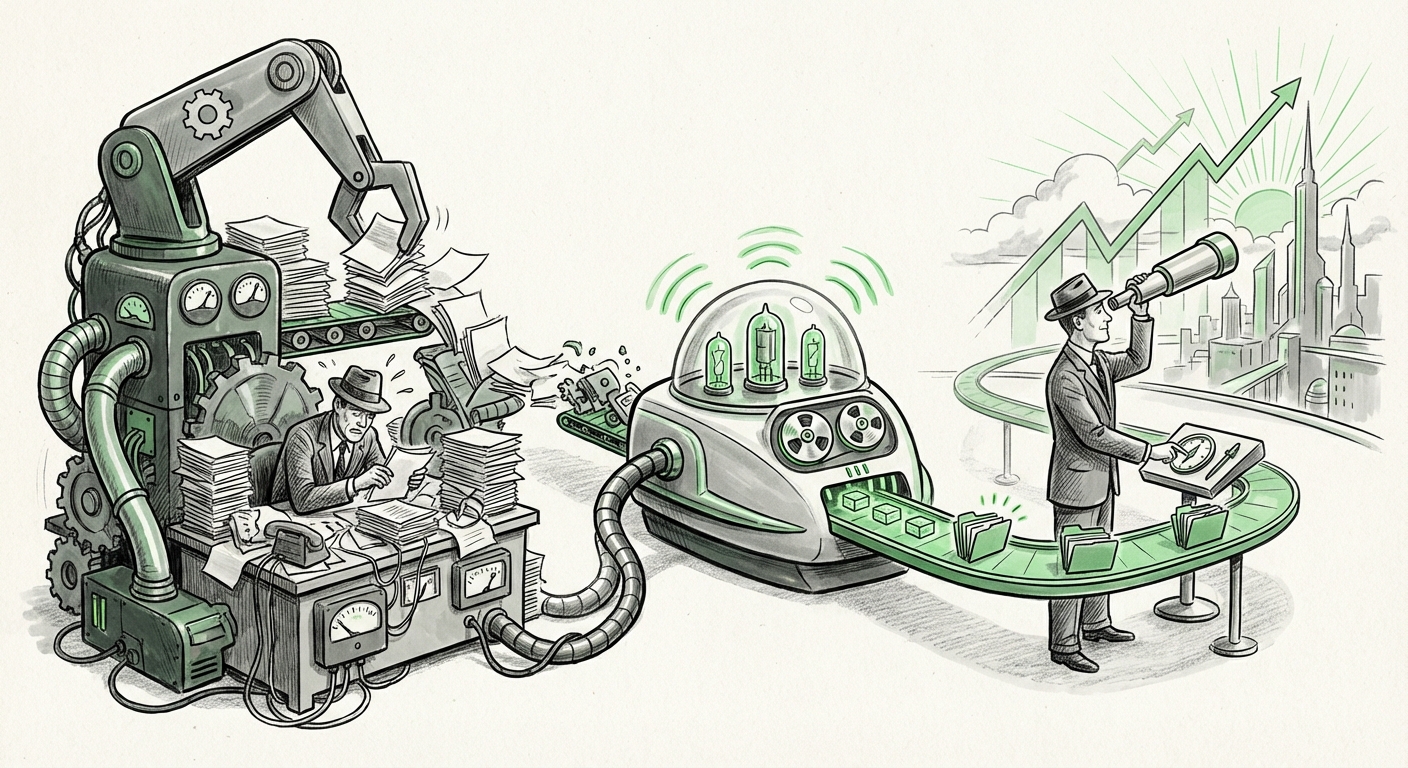
The Agentic Shift: What the Next Wave of AI Means for Business, Work, and Everyday Life
Something important has changed in the way people talk about artificial intelligence. A year or two ago, the conversation was mostly about answers. Could the model write a decent email? Summarize a long document? Draft a slide deck? Today, the questions are different. Can it book the meeting, file the ticket, update the record, and check its own work before anyone looks at it?
That shift, from AI that responds to AI that acts, is the single most important trend in the field right now. It changes what the technology can do, who gets value from it, and where the risks land. It also changes the job of every business leader who has to decide what to buy, what to build, and what to trust.
This article breaks down the trends driving that change and what they mean in practical terms. No hype, no doom. Just a clear look at where things are heading and how to get ready.
The Big Picture: From Answers to Actions
Most people first met AI as a chat box. You type, it types back. Useful, but limited. The system has no memory of your world, no ability to do anything, and no way to check whether it got the facts right.
The newer pattern is different. Instead of one big answer, the system plans a series of small steps. It picks a tool. It runs the tool. It looks at the result. It tries again if something breaks. Then it reports back with what it did and why.
In the industry, this is often called agentic AI, or simply agents. The name matters less than the behavior. An agent is software that can take action toward a goal with less hand-holding at every step.
Why now? Three things lined up:
- Better reasoning. Models have gotten noticeably better at breaking a messy problem into steps and staying on task.
- Tool use. Modern systems can call software, search, databases, calendars, code runners, internal apps, instead of only generating text.
- Lower cost. Running a model has become cheap enough that using it many times inside one workflow is finally practical.
Put those together and the economics change. A tool you use once a day is a novelty. A tool you can run a thousand times an hour, cheaply, starts to look like infrastructure.
Why Agents Are the Defining Trend
From Chatbot to Coworker
The clearest way to see the change is to compare two requests. "Write me a summary of this contract" is a chat request. "Review every vendor contract in this folder, flag any clause that conflicts with our standard terms, and put the results in a spreadsheet sorted by risk" is an agent request.
The second one is closer to real work. It has a goal, a set of steps, and a checkable output. It's also the kind of task that used to require a person's full attention for a whole afternoon.
For businesses, this is where the return on investment starts to become obvious. Chat tools save minutes. Agents can save hours, or remove a task from someone's plate entirely.
The Trust Ladder
Nobody smart hands an agent the keys on day one. In practice, adoption follows a ladder:
- Suggest. The agent proposes an action; a human approves it.
- Act with review. The agent acts, and a human checks the work afterward.
- Act within limits. The agent operates freely inside clear guardrails, spending caps, approved systems, defined scope.
- Act and escalate. The agent handles the routine and only pulls in a person when something looks unusual.
Most organizations sit on the first two rungs today. The winners will be the ones that build the guardrails to climb safely, rather than the ones that skip straight to the top and get burned.
The Cost Curve Is the Quiet Story
Everyone watches the headlines about new model releases. The less flashy story is that the price of intelligence keeps falling. That single fact reshapes everything else.
When each request is expensive, you ration it. You use AI for the highest-value cases only. When each request is cheap, you stop rationing. You put AI in places you'd never have considered: every support ticket, every invoice, every line of code, every meeting transcript.
This is a classic pattern in technology. When something gets dramatically cheaper, it doesn't just get used more, it gets used differently. Cheap compute gave us smartphones and cloud services. Cheap intelligence will give us software that reads, reasons, and acts as a normal part of how business gets done.
For leaders, the practical takeaway is simple: design for volume. If a workflow is only worth doing when AI is expensive, it's probably not the workflow that will matter in two years.
Multimodal AI and the End of the Text Box
Another trend that's easy to miss: AI is no longer just about text. Modern systems can look at images, listen to audio, watch video, and read charts and screens.
That matters because most real-world information isn't typed. It's a photo of a broken part on a factory floor. A voicemail from a frustrated customer. A scanned invoice. A dashboard screenshot in a slide.
When a system can handle all of those, the range of tasks it can take on expands fast. Field technicians can point a phone at equipment and get a diagnosis. Customer service can process a voice message the same way it processes an email. Compliance teams can search video footage the way they search documents.
The text box was never the destination. It was just the first door.
Small Models, Big Deployment
Not every task needs the biggest model available. A growing share of real deployments use smaller, faster models that run cheaply and sometimes on the device itself.
This is a healthy sign. It means the field is maturing from "one giant model for everything" to a portfolio approach: big models for hard reasoning, small models for high-volume routine work, specialized models for narrow tasks.
For businesses, this has two benefits. First, cost control, you're not paying top-tier prices for a task a small model handles fine. Second, privacy and latency, some work can stay on a local device or inside your own network, which matters for regulated industries and for anything that needs an instant response.
What This Means for Businesses
Start With Workflows, Not Tools
The most common mistake is shopping for software before understanding the work. A better approach: pick one painful, high-volume process and map it step by step. Where does information get stuck? Where do people copy and paste? Where do things wait for a human to notice them?
Those are the seams where AI creates real value. Buy the tool after you understand the seam, not before.
Your Data Is the Moat
Everyone has access to roughly the same base models. What they don't have is your history: your policies, your past tickets, your product docs, your customer records. That material is what turns a generic assistant into something that knows your business.
Companies that have cleaned up and connected their internal knowledge will get far more out of the same technology than companies that haven't. This is unglamorous work. It is also where the advantage lives.
Redesign Jobs, Don't Just Add Copilots
Dropping a copilot into an unchanged process usually produces a small bump and a lot of frustration. The bigger gains come from redesigning the process around what the technology is now good at.
Ask: if a junior teammate could handle the first draft, the first pass, or the routine case instantly, how would we restructure this job? What would the human spend their time on instead? Usually the answer is judgment, relationships, and exceptions, the parts that are hardest to automate and most valuable to a customer.
Measure Something Real
AI pilots often die because nobody agreed on what success looks like. Before you start, pick the number: time per case, cost per ticket, error rate, cycle time, revenue per rep. If the number doesn't move, the pilot failed, and that's useful information, not a disaster.
What This Means for Society and Workers
The honest answer is that the impact will be uneven. AI is very good at work that is digital, repetitive, and text-heavy, drafting, summarizing, classifying, translating, checking. It is much weaker at work that requires physical presence, trust built over time, and responsibility for a real-world outcome.
That means the pressure lands hardest on entry-level knowledge work: the first-draft tasks that used to be how people learned a profession. This is a real concern, and it deserves a real response. Firms that replace all junior work with automation may find themselves with no senior talent in ten years.
The more useful framing is task-level, not job-level. Most jobs are bundles of tasks. Some parts of the bundle shrink. Others grow. The organizations that handle this well will be the ones that invest in helping people move up the bundle, from doing the work to directing and checking it.
There's also a broader public good here. Cheap intelligence can widen access to expertise that used to be expensive: tutoring, legal guidance, medical triage, translation, benefits navigation. Whether that potential is realized depends less on the technology and more on how it's packaged, priced, and governed.
Governance, Risk, and the Trust Gap
As AI moves from answering to acting, the risk profile changes. A wrong answer is annoying. A wrong action, a payment sent, a record deleted, a contract signed, is a different category of problem.
That's why the mature conversation has shifted from "is the model accurate?" to "what are the controls?" Practical guardrails look like this:
- Least privilege. Give an agent access only to what it needs for the task.
- Human checkpoints. Require approval before irreversible actions.
- Full logging. Record every step so you can reconstruct what happened.
- Rollback plans. Assume something will go wrong and know how to undo it.
- Clear ownership. A named person is accountable for each automated workflow.
None of this is exotic. It's the same discipline companies already apply to financial controls and IT access. The gap is that many teams are moving faster on AI than their control systems can keep up with.
A Practical Playbook
If you want to act on this rather than just read about it, here's a short list:
- Pick three workflows where volume is high, steps are repeatable, and mistakes are cheap to catch.
- Map the seams, the handoffs, copy-paste steps, and waiting points where work slows down.
- Run a four-week pilot with a single agreed metric and a named owner.
- Build the boring parts first: clean data, access controls, logging, and an escalation path.
- Train managers, not just users. The bottleneck is usually knowing what to delegate to a machine and what not to.
- Review quarterly. The technology is moving fast enough that a decision made in January may be wrong by summer.
What to Watch Next
Three signals will tell you how fast this is really moving.
First, reliability. Agents that work most of the time aren't useful for real work. Watch for systems that can check their own output and know when to stop and ask for help. That's the difference between a demo and a deployment.
Second, integration. The winners in enterprise AI won't be the ones with the best model. They'll be the ones that plug cleanly into the systems where work already happens.
Third, accountability. Clear rules on who is responsible when an automated system causes harm will decide how quickly companies are willing to hand over real tasks. That's as much a business question as a legal one.
The Bottom Line
The story of AI is no longer about smarter chat. It's about software that can carry out work, planning, using tools, checking itself, and handing back a finished result. That shift is happening now, and the cost of running it keeps falling, which means it will spread into places most companies haven't thought about yet.
The organizations that benefit most won't be the ones with the flashiest tools. They'll be the ones that understand their own workflows, clean up their data, set sensible guardrails, and treat their people as the point of the exercise rather than an obstacle to it.
The technology will keep changing. Those fundamentals won't.
TLDR: AI is moving from answering questions to taking actions, planning tasks, using software tools, and checking its own work. Falling costs mean this will spread into high-volume everyday business processes, not just premium use cases. The practical winners will be companies that start with real workflows, fix their data, build simple guardrails like approval steps and logging, and redesign jobs around human judgment rather than just bolting a copilot onto old processes. Expect uneven impact on workers, heaviest on entry-level digital tasks, and watch reliability, integration, and accountability as the signals that decide how fast adoption really goes.