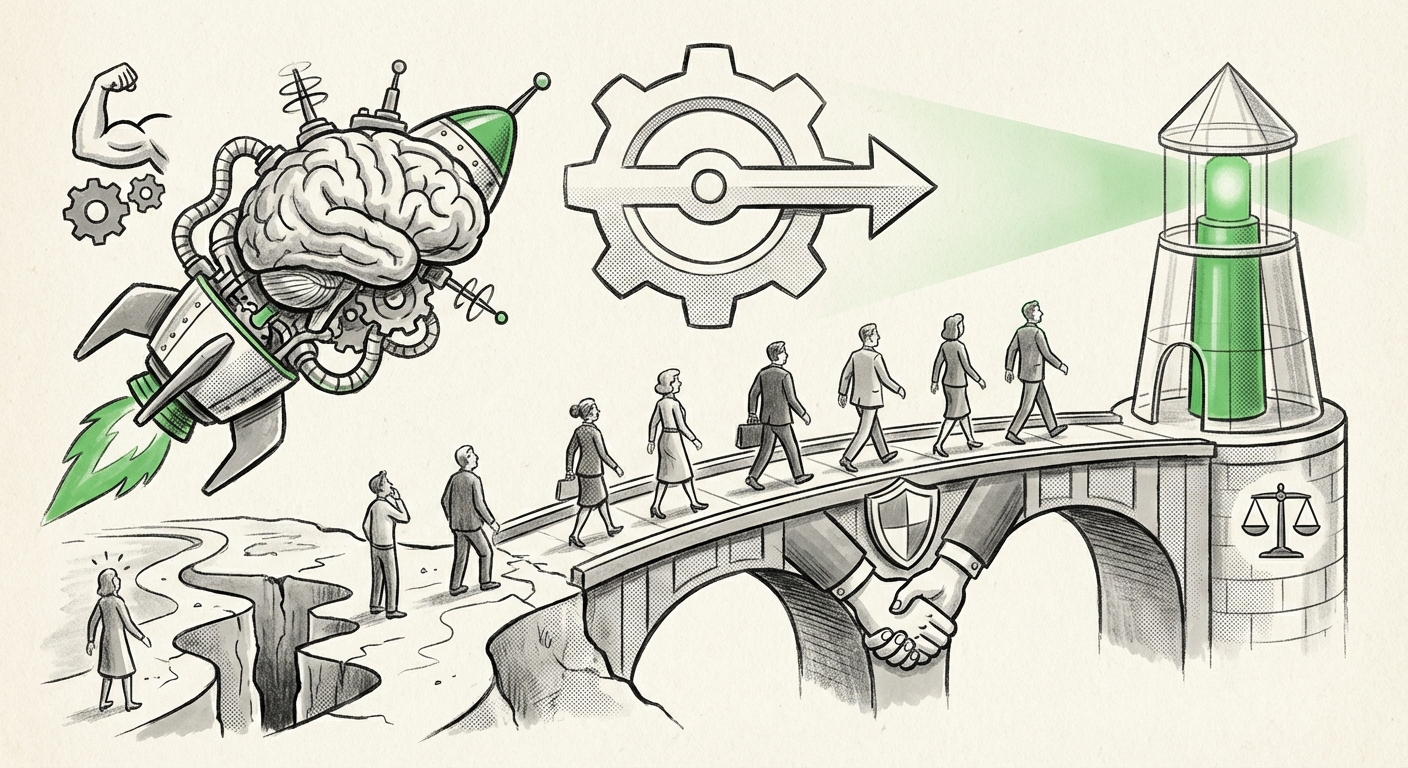
Billionaire-Backed AI Is Eating Venture Capital, and That Changes Everything About How AI Gets Built
Something quiet but enormous has happened to the way new technology gets funded. Most venture capital is now flowing to companies that are founded or led by billionaires. Not to scrappy founders in a garage. Not to the first-time team with a clever idea and a laptop. The money is pooling at the very top, and it is pooling fast.
This matters far more than it sounds like it should. Venture capital is the fuel line of the tech economy. When that fuel starts skipping the small engine and pouring straight into the biggest one, the whole shape of the industry changes, and no industry is more exposed to that shift right now than artificial intelligence.
Because AI is expensive. Very expensive. And expensive things tend to end up owned by people who already have money.
The New Funding Reality: Capital Follows the Already-Funded
The pattern is hard to miss. The largest pools of private money are concentrating into ventures where the founder or the chief executive is already a billionaire, someone with a public track record, a personal network of deep-pocketed backers, and the credibility to raise enormous sums quickly.
On paper, this looks like rational investing. Venture capital is a hits business. A small number of winners pay for a long tail of losses. So when an investor has to choose between an unproven founder and a billionaire who has already built something huge, the billionaire looks like the safer bet, even when the price is high.
But there is a self-reinforcing loop hiding inside that logic. Wealth attracts capital. Capital attracts talent. Talent builds the product. The product attracts more capital. Each turn of the loop makes the next turn easier for the person already at the center, and harder for everyone standing outside it.
Why AI Specifically Pulls Money Toward the Top
Artificial intelligence has a cost structure that almost seems designed to favor incumbents. Three forces are doing most of the work:
1. Compute Is a Fixed Cost That Never Stops Growing
Building and running frontier AI systems requires massive amounts of computing power. That means data centers, chips, electricity, and cooling, long-term commitments that only very large balance sheets can carry. A first-time founder cannot simply promise a supplier a multi-year commitment. A billionaire can.
2. Talent Has a Price Tag Only a Few Can Meet
The small pool of people who genuinely know how to train and deploy large models is tiny. They are expensive, they know it, and they tend to join teams that look certain to succeed. Certainty, in this market, usually means money that is already there.
3. Distribution Rewards the Already-Distributed
The best model in the world is close to worthless if no one can reach it. Companies with existing products, existing users, and existing sales teams can drop AI features into a ready-made channel overnight. Startups have to build the channel first, while paying for compute the whole time.
Put those three forces together and you get a market where the money does not spread out. It stacks.
What This Means for the Future of AI
If the current trend holds, the next chapter of AI will look less like a gold rush and more like an airline industry: a handful of enormous players, a layer of specialized suppliers, and far fewer independent experiments in between.
That has real consequences.
Fewer Shots on Goal
Venture capital's real job is not just to fund winners, it is to fund a wide spread of attempts, most of which fail, because nobody can predict which strange idea turns into the next platform. When capital concentrates, the number of attempts shrinks. The ideas that get funded become the ideas that look safe to people who are already rich. That tends to mean enterprise software, infrastructure, and tools that serve other large companies, not the odd, risky, public-interest experiments that so often turn out to matter most.
Consolidation of the Model Layer
Training frontier models is now a capital-intensive industrial activity. That pushes the most advanced systems into the hands of a few organizations. Everyone else builds on top. This is not automatically bad, reliable platforms with staying power are genuinely useful, but it does mean the direction of the underlying technology is set by a very small group of decision-makers.
Faster Deployment, Narrower Vision
Concentration has an upside that gets overlooked. Big, well-funded teams can ship. They can afford safety testing, red-teaming, legal review, and enterprise-grade reliability. They can push AI into real workflows faster than a scattered ecosystem of tiny teams ever could. The trade-off is that the vision behind the technology narrows to whatever serves the funders.
Practical Implications for Businesses
For companies buying AI rather than building it, this shift changes the calculus in concrete ways.
- Expect fewer vendors, not more. The startup that solves your niche problem may struggle to raise money against better-connected competitors. Diversify your bets and avoid building critical systems on a single young supplier.
- Price in lock-in risk. A vendor backed by enormous capital can offer aggressive pricing today and raise it later. Negotiate portability: own your data, keep the ability to swap models, and avoid deep custom integrations that only one provider supports.
- Talent will be pulled upstream. The best AI engineers will increasingly cluster at the best-funded firms. Plan for partnership models with those firms rather than assuming you can hire your way to parity.
- Your competitive advantage moves to data and workflow. When everyone can rent the same powerful model, the differentiator becomes what you know and how you work, not which model you picked.
Practical Implications for Founders and Investors
If you are building a startup, the playbook has changed. Raising money to compete head-on with billionaire-funded incumbents is close to hopeless. The better path is to go where the giants cannot easily follow: deep domain knowledge in a regulated industry, proprietary data nobody else can get, and products that are painful to switch away from once installed.
For investors, the risk is subtler but serious. When capital chases names rather than ideas, valuations drift away from fundamentals. The result is a portfolio that looks diversified on paper but is really one giant bet on a handful of personalities, and personalities are not a durable moat.
What It Means for Society
AI is not a neutral product. It shapes what people see, what they are offered, how they are hired, and how they are treated by institutions. When a small number of extremely wealthy backers set the agenda, the technology's defaults, its safety priorities, its business model, its choice of who gets served first, reflect a narrow slice of human experience.
That is a governance question, not just a market one. Public policy tends to lag behind private concentration. Rules that encourage transparency about how models are trained and evaluated, and that keep markets open to new entrants, become more important as the funding gap widens. Open-weight models, university research, and publicly funded compute all play a role in keeping a second path alive.
Three Things to Watch
- Whether second-tier funding survives. Watch whether the middle of the market, solid Series A and B rounds for non-celebrity founders, holds up or keeps thinning.
- Whether customers push back. Enterprise buyers have real leverage. If lock-in complaints grow, portability standards and model-swapping tools will follow.
- Whether open models close the gap. Every meaningful improvement in freely available models lowers the capital barrier and gives smaller players another route in.
The Bottom Line
The best idea does not automatically win. The best-resourced idea usually wins, and right now the resources are stacking on one side of the table. That is not a reason to despair, but it is a reason to be honest about the world you are building in.
The future of AI is being decided by funding decisions made today, and those decisions are increasingly concentrated among a very small group of very wealthy people. Whether that produces a fast, reliable, safe, broadly shared technology, or a closed, expensive one shaped entirely by its owners, is not settled. It depends on the choices founders, buyers, and regulators make next. The funding trend tells us which way the wind is blowing. It does not tell us it has to keep blowing that way.