OpenAI's AI Produced 722 Math Manuscripts: What It Means for the Future of AI
Something big just happened in the world of artificial intelligence and mathematics. OpenAI's AI has produced 722 math manuscripts. That's not a typo. Seven hundred and twenty-two complete mathematical papers, generated by a machine. This is a watershed moment that raises urgent questions about how AI will be used in research, education, and business. It also gives us a clear preview of the future: AI is moving from helping humans write to producing original work on its own.
For decades, math research has been a deeply human activity. Mathematicians spend years developing proofs, exploring conjectures, and writing up results. Now an AI can churn out hundreds of manuscripts in a fraction of the time. This doesn't mean human mathematicians are obsolete. But it does mean the rules of the game are changing fast. In this article, we'll break down what happened, why it matters, and what it means for the future of AI and how it will be used.
What Happened: AI Wrote 722 Math Papers
OpenAI's AI produced 722 math manuscripts. The number itself is staggering. For context, a single human mathematician might publish a few papers per year. A prolific one might produce a dozen. Seven hundred and twenty-two is more than most math departments produce in a decade. The AI did this without human co-authors, at least in the traditional sense. It generated the content, the structure, and the mathematical arguments.
We don't yet know the quality of every manuscript. Some may be trivial. Some may contain errors. But the sheer volume shows that AI can now operate at a scale that was previously impossible. This isn't about AI helping a human write faster. This is about AI acting as a primary producer of mathematical content. That's a fundamental shift.
The news also signals that OpenAI is pushing hard on reasoning and formal logic. Math is one of the hardest tests for AI because it requires precise, step-by-step thinking. Producing 722 manuscripts suggests the AI can handle long chains of reasoning, maintain consistency across pages, and follow the conventions of mathematical writing. That's a big leap from generating short answers or solving individual problems.
Why This Matters: From Assisting to Producing
Until now, most AI writing tools have been assistants. They suggest sentences, fix grammar, or draft outlines. They help humans do their work faster. But producing 722 math manuscripts is different. It's production. The AI is creating complete works that could, in principle, be submitted to journals, used in classrooms, or shared with researchers.
This shift has huge implications. First, it means AI can generate knowledge, not just process it. Second, it changes the economics of research. If AI can produce hundreds of papers in the time it takes a human to write one, the supply of mathematical content could explode. Third, it forces us to rethink quality control. With so many manuscripts, how do we verify them? Who checks the math? Who decides what's worth reading?
For businesses, this is a preview of what's coming in other fields. If AI can write math papers, it can write technical reports, legal briefs, financial analyses, and product documentation. The ability to generate long, structured, logical documents at scale will transform white-collar work. Companies that learn to use this capability well will have a massive advantage. Those that ignore it will fall behind.
The Quality Question: Can We Trust AI Math?
Producing 722 manuscripts is impressive, but quality matters more than quantity. Math is unforgiving. A single wrong step in a proof can invalidate the whole thing. So the big question is: how many of those 722 manuscripts are correct? How many are original? How many are useful?
We don't have those answers yet. But we can predict the challenges. AI models can hallucinate. They can make plausible-sounding arguments that are actually flawed. They can also reproduce existing work without proper citation. So the 722 manuscripts likely include a mix of good, mediocre, and bad content. That's not a failure of AI; it's a reality of any generation system. The key is to build verification tools and processes that can separate the signal from the noise.
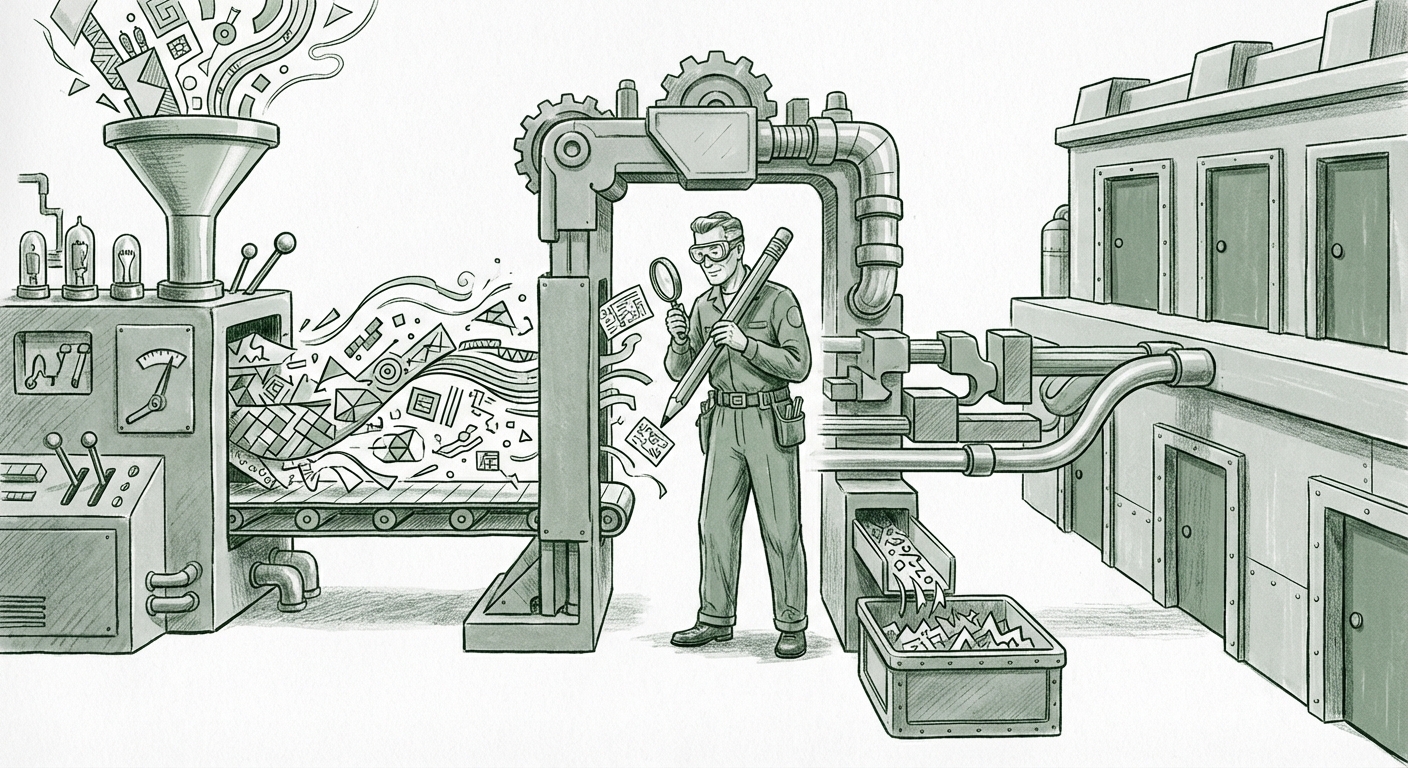
This is where human mathematicians become more important than ever. They won't be writing every paper from scratch. Instead, they'll act as editors, reviewers, and curators. They'll check AI-generated proofs, identify errors, and decide which manuscripts are worth sharing. The role shifts from producer to quality controller. That's a big change, but it's also an opportunity. Human experts can focus on the hardest problems while AI handles the bulk of routine derivations and write-ups.
How AI Will Change Math Research
Math research is just the beginning. The techniques that let an AI produce 722 math manuscripts will spread to other areas. Here's how we can expect research to change:
- Speed: AI can explore many more ideas than humans can. It can test conjectures, try different proof strategies, and generate examples at a pace no person can match.
- Scale: Instead of one paper at a time, researchers can generate hundreds of candidate results, then filter for the most promising ones.
- Access: Smaller institutions and individual researchers can use AI to level the playing field. They can produce high-quality drafts without a large team.
- New questions: AI might spot patterns or connections that humans miss, leading to new areas of inquiry.
But there are risks too. If AI floods the field with low-quality papers, it could overwhelm journals and conferences. Peer review is already stretched thin. Adding hundreds of AI-generated manuscripts per month could break the system. We'll need new ways to evaluate and filter research, possibly using AI to review AI. That's a paradoxical but likely future.
Practical Implications for Businesses
What does this mean for companies that aren't in the math business? A lot. The ability to generate long, logical, structured documents is valuable in almost every industry. Here are some practical implications:
1. Technical Documentation
AI can write user manuals, API docs, and technical specifications. If it can handle math proofs, it can handle step-by-step instructions. Businesses can cut documentation costs and speed up product releases.
2. Financial Modeling
Math is the backbone of finance. AI that can write math manuscripts can also write financial models, risk analyses, and quantitative reports. Analysts can focus on strategy while AI handles the number crunching and write-ups.
3. Legal and Compliance
Legal writing requires precise logic and structured arguments. AI that can produce math proofs can produce contract analyses, compliance reports, and legal memos. Law firms and corporate legal teams should start experimenting now.
4. Research and Development
Companies that do R&D can use AI to generate technical reports, patent drafts, and experiment summaries. This can accelerate innovation cycles and reduce the burden on scientists and engineers.
5. Education and Training
AI-generated math manuscripts can be turned into teaching materials, worked examples, and practice problems. EdTech companies can use this to create personalized learning content at scale.
The common thread is automated expertise. AI is becoming capable of producing expert-level content in domains that require deep reasoning. Businesses that harness this will gain efficiency and insight. Those that don't will face competitors who do.
What Society Should Prepare For
The production of 722 math manuscripts is a warning shot. It tells us that AI is entering territories we thought were safe for humans. Here's what society needs to prepare for:
- New definitions of authorship: If an AI writes a paper, who gets credit? The person who prompted it? The company that built the model? No one? We need clear rules.
- Verification at scale: We need tools that can automatically check AI-generated content for correctness, originality, and bias. This is a major technical and social challenge.
- Education reform: Math education should focus less on computation and more on critical thinking, verification, and asking good questions. Those are skills AI can't easily replace.
- Economic shifts: Knowledge work will be disrupted. Jobs that involve producing structured documents will change. Workers will need to become editors and curators rather than sole creators.
- Ethical guardrails: We need norms and regulations to prevent AI from flooding fields with low-quality or misleading content. Transparency about AI involvement will be key.
None of this is science fiction. It's happening now. The 722 manuscripts are a concrete example of what's possible. The question is whether we'll respond thoughtfully or be caught off guard.
Actionable Insights: What to Do Now
Whether you're a researcher, business leader, or policymaker, here are steps you can take today:
- Experiment with AI writing tools: Don't wait for perfect. Try using AI to draft technical content in your field. Learn its strengths and weaknesses firsthand.
- Build verification workflows: Assume AI output needs checking. Create processes for reviewing AI-generated content before it goes public or gets used in decisions.
- Train your team: Teach employees how to prompt AI effectively and how to spot errors. This is a new skill that will become as basic as using a spreadsheet.
- Engage with policy: Join conversations about AI authorship, quality standards, and disclosure. Help shape rules that make sense for your industry.
- Focus on high-value human work: Let AI handle routine generation. Redirect human talent toward creativity, strategy, and complex problem-solving.
The organizations that thrive will be those that treat AI as a powerful but imperfect tool. They'll use it to amplify human expertise, not replace it blindly.
Conclusion: A New Era of AI-Generated Knowledge
OpenAI's AI producing 722 math manuscripts is more than a headline. It's a signpost. It shows that AI can now generate expert-level content at scale. That's exciting, scary, and transformative all at once. For the future of AI, it means the focus will shift from "can AI write?" to "how do we ensure AI writes well?" For how AI will be used, it means more automation of knowledge work, more need for verification, and more opportunities for those who adapt.
The genie is out of the bottle. We can't put it back. But we can decide how to guide it. By building strong verification systems, updating education, and setting clear norms, we can harness this power for good. The 722 manuscripts are just the beginning. The next wave will be bigger. Let's be ready.