Speech to Text for Content Creators: The AI Captioning Workflow That Turns One Video Into Ten Pieces of Content
Every creator eventually hits the same wall. You have recorded a great hour-long conversation, a tutorial, or a livestream. The recording is good. But the moment you try to turn that one recording into clips, blog posts, newsletters, social captions, and searchable web pages, the work explodes. What used to be a one-person job becomes a small factory.
Speech-to-text AI is quietly becoming the answer to that problem. Not because transcription itself is exciting, it has existed for years, but because of what transcription now makes possible. A clean transcript is no longer just a subtitle file. It has become the raw material that feeds an entire repurposing engine.
This is the story of how a simple captioning workflow is turning into one of the most important AI use cases for anyone who makes content, and what that shift tells us about where AI is heading next.
The Quiet Rise of the Transcript
For a long time, captions were treated as an accessibility add-on. You added them at the end, if you had time, because a small share of viewers needed them. That framing is now out of date.
Two forces changed it. First, most short-form video is watched with the sound off. Captions are no longer a courtesy, they are a growth lever, because a video without readable text loses the majority of people scrolling past it. Second, and more importantly, the transcript itself has become a searchable, reusable asset.
Think about what a transcript actually is. It is your spoken words, converted into structured text, with timestamps attached. That means every idea you ever spoke out loud is now a paragraph you can search, quote, edit, and publish. A video is locked inside a rectangle. A transcript is not. It can become a blog post, a newsletter section, a Twitter thread, a LinkedIn post, a podcast show note, a knowledge base article, or a slide deck.
This is the core shift: speech-to-text is no longer the end of the workflow. It is the beginning of it.
A Modern Captioning and Repurposing Workflow, Step by Step
The creators getting the most out of this are not doing anything exotic. They are following a repeatable sequence. Here is the shape of it.
Step 1: Record With the Transcript in Mind
Good transcripts start before the recording does. That means speaking in complete thoughts, avoiding long stretches of "um" and "so yeah," and stating names and key terms clearly at least once. It also means planning a small bit of structure, an opening hook, three to five clear points, and a closing takeaway. The AI will transcribe whatever you say. If what you say is already structured, the transcript becomes a near-finished outline.
Practical tip: say your section headers out loud. Phrases like "the first thing to know is" or "here is the mistake people make" translate directly into subheadings later. You are essentially writing your article in spoken form.
Step 2: Generate the Transcript
Modern speech-to-text tools handle multiple speakers, background noise, and accents far better than earlier generations did. The output is usually a timestamped transcript with speaker labels. Accuracy is high but not perfect, names, acronyms, product terms, and numbers are the usual failure points.
This is the moment where most people make a mistake. They take the raw transcript and paste it somewhere, then never look at it again. The raw file is not the asset. The cleaned file is.
Step 3: Clean and Segment
A light editing pass does three things. It fixes the errors the AI made. It removes filler words and false starts. And it splits the wall of text into logical blocks that match the structure of the conversation. This is where AI assists rather than replaces, a summarizing or rewriting pass can do most of the heavy lifting, but a human still needs to check the facts and the names.
The output of this step is a source of truth: a clean, structured, accurate record of what was actually said.
Step 4: Build the Captions
From the clean transcript, captions are generated in two formats. The first is a standard subtitle file for the long video. The second is burned-in, word-by-word captions for short clips, because short-form platforms reward text that appears in sync with speech and highlights the current word.
This is largely automated now. The creative decision is stylistic, caption size, position, color, and how much text appears at once.
Step 5: Repurpose Into New Formats
With a clean transcript in hand, repurposing becomes a routing problem rather than a writing problem. Each destination gets a different treatment:
- Short clips, pull the three to five strongest 30-second moments, add captions, and publish vertically.
- Blog posts, restructure the transcript into headings and paragraphs, then rewrite for reading rather than listening.
- Newsletter, extract the single best insight and expand it into a short essay.
- Social posts, turn each major point into a standalone text post with a hook.
- Show notes and summaries, generate a structured recap with timestamps and key links.
- Search-friendly pages, publish the edited transcript so search engines and AI assistants can find and quote your ideas.
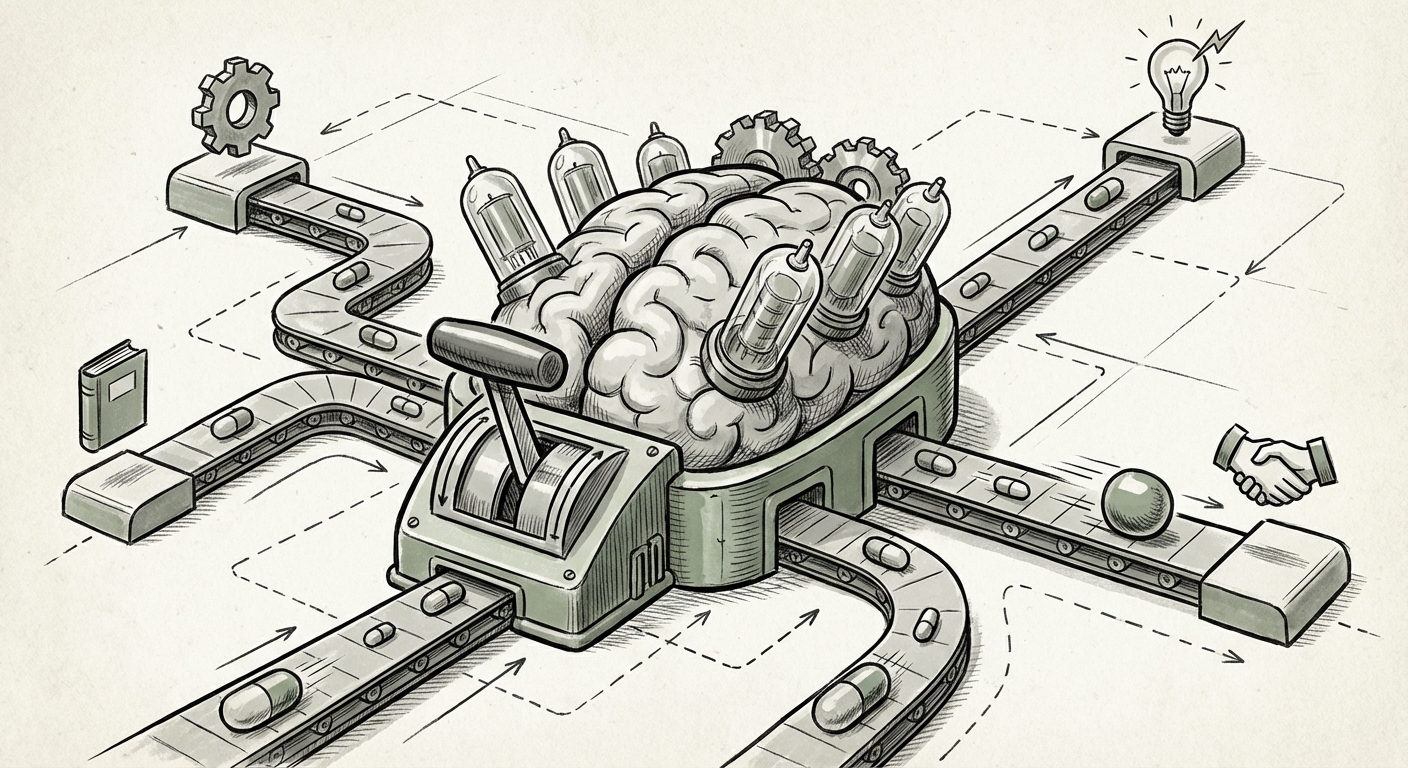
The important pattern here is that all of these outputs come from one recording. The transcript is the hub. Everything else is a spoke.
What This Means for the Future of AI
Captioning workflows look small. But they reveal several larger trends that will define how AI gets used over the next few years.
AI Is Moving From Demo to Plumbing
The most valuable AI tools are not the ones that impress you in a demo. They are the ones that disappear into a workflow and quietly remove hours of tedious work. Transcription is a perfect example. Nobody brags about their captioning pipeline, but it saves more time per week than most flashy AI features combined.
Expect this pattern to repeat across every creative field. The winning products will not be chatbots. They will be invisible steps in a process, the thing that converts one format into another, checks a draft, or fills a gap between tools.
Text Is Becoming the Universal Adapter
Once speech becomes text, it can be moved into any other system. Text is the format that every other tool understands. It can be searched, summarized, translated, turned into a script, fed into a video generator, or used to train a custom assistant.
This makes the transcript a kind of universal adapter between media types. Video in, text out, then text into anything else. As AI systems get better at handling multiple formats at once, this adapter role becomes more valuable, not less.
The Transcript Becomes the Memory Layer
Here is the forward-looking part. If you record everything, meetings, calls, interviews, streams, and transcribe all of it, you build a searchable archive of everything your team or brand has ever said. That archive can answer questions, surface old decisions, and keep a consistent voice across years of content.
This is already the logic behind AI assistants that can search your own documents. Speech-to-text extends that same idea to the spoken word, which is where most organizational knowledge actually lives.
Practical Implications for Businesses
For individuals, this is a productivity story. For organizations, it is a structural one.
Marketing teams get more output per recording. A single webinar or customer interview can supply a month of content, provided someone owns the transcript-to-publish pipeline.
Customer support and sales teams get searchable call records. Transcripts make it possible to spot recurring objections, build better FAQs, and onboard new staff faster.
Training and internal communications get a cheap path to accessible material. Captioned video is more usable in more settings, and a text version is easier to skim and translate.
Small teams benefit most of all, because the leverage is disproportionate. A two-person team with a good transcription workflow can operate like a much larger content operation.
The catch is ownership. Someone has to decide where transcripts live, how long they are kept, who can search them, and what happens when a recording includes a customer who did not expect to be quoted. Those are governance questions, not technology questions, and they show up fast.
Where It Can Go Wrong
No workflow guide is honest without the failure modes. Three stand out.
- Confident errors. Speech-to-text rarely flags its own mistakes. A wrong number or a misheard name can sail straight into a published post. Human review of names, figures, and claims is not optional.
- Homogenized voice. If every piece of content is generated from the same transcript by the same model, everything starts to sound the same. The fix is editing for voice, not just for clarity.
- Consent and privacy. Recording conversations and storing searchable transcripts creates obligations. Creators and companies need clear rules about notice, retention, and deletion.
Actionable Insights: Building Your Own Pipeline
If you want to act on this now, start small and make it repeatable.
- Standardize the workflow. Pick one folder structure and one naming convention for recordings and transcripts. Friction kills adoption faster than bad accuracy does.
- Separate the raw file from the clean file. Never edit in place. Keep the original transcript for verification and work from a copy.
- Build a publication checklist. For each output format, list the steps: extract, restructure, rewrite, fact-check, add links, publish. A checklist beats a clever prompt.
- Keep a "best moments" log. While reviewing the transcript, tag the strongest 30 seconds. This single habit makes clip selection ten times faster.
- Publish the transcript as a page. Edited transcripts are useful to readers, are easy to skim, and give search engines and AI assistants something to quote.
- Measure hours saved, not features used. The value of this workflow shows up in time returned to writing and creating, not in how sophisticated the tool is.
The Bigger Picture
Speech-to-text for creators is a small, practical story that points at something large. The future of AI is not mainly about systems that can do impressive things in isolation. It is about systems that connect the formats we already produce, voice, video, text, images, into one continuous flow, so that nothing we make is trapped in a single container.
The creators who win the next few years will not necessarily be the ones with the best cameras or the biggest budgets. They will be the ones who treat every recording as raw material and every transcript as an asset. That is a workflow decision, and it is available to almost anyone today.