AI Plus Chemistry: How Machine Learning Is Expanding Battery Electrolyte Design
Batteries are having a moment. Electric cars, grid storage, laptops, drones, and a growing list of devices all depend on them. Yet the part of the battery that decides how well it performs, how long it lasts, and how safely it runs is often the least talked about: the electrolyte. It is the liquid or gel that carries charged particles between the two electrodes. Get the electrolyte right, and a battery can charge faster, survive more cycles, and resist catching fire. Get it wrong, and even great electrodes underperform.
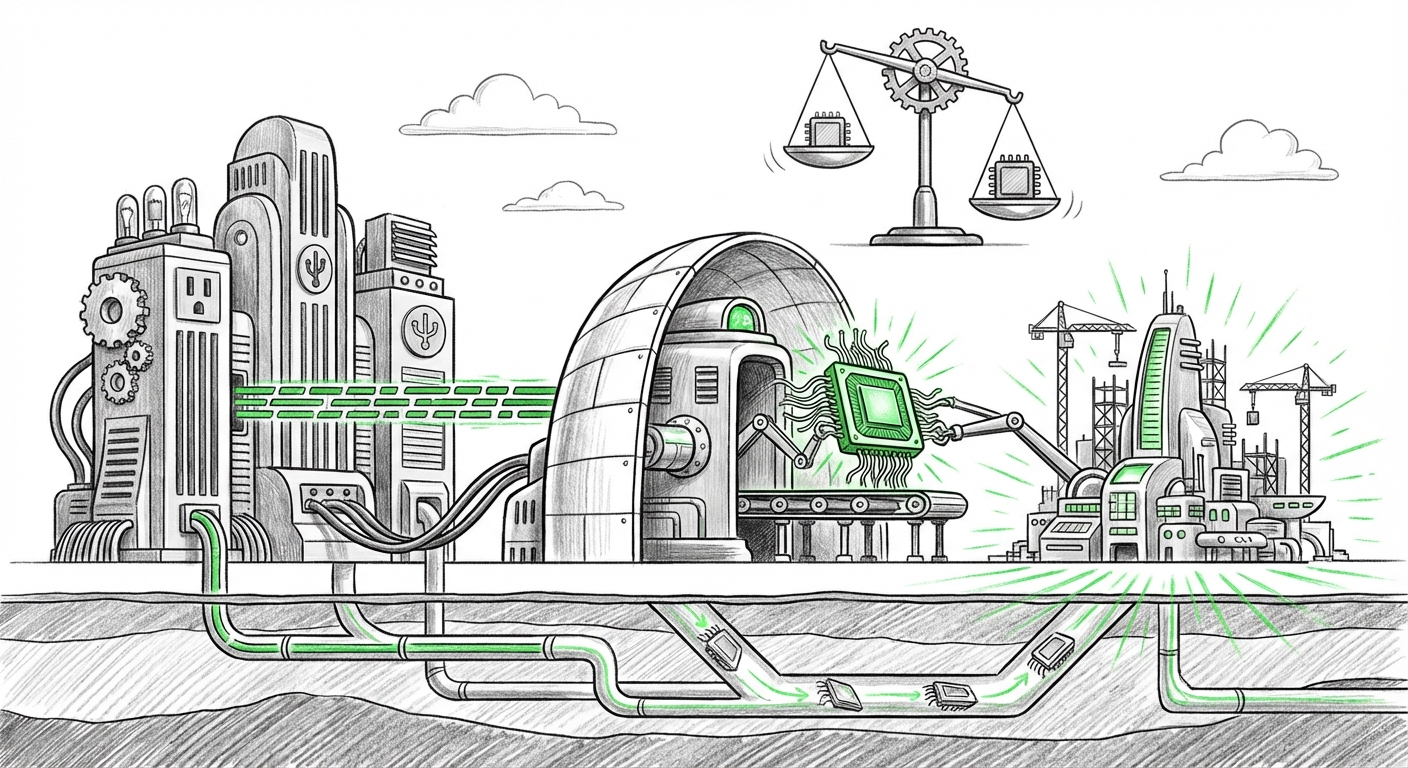
Now a clear trend is taking shape: AI plus chemistry is expanding battery electrolyte design. Instead of relying only on slow trial-and-error in the lab, researchers and companies are using machine learning to search a vast space of possible chemical recipes, predict which ones are worth testing, and close the loop with automated experiments. This article breaks down what is happening, why it matters, and what it means for the future of artificial intelligence itself.
Why Electrolytes Are the Hard Problem
An electrolyte is not one ingredient. It is a mix. You start with a solvent or a blend of solvents. You add salts that supply the charged particles. You drop in small amounts of additives that can quietly change everything, forming a protective film on the electrode surface, suppressing unwanted reactions, or extending life. Each choice interacts with the others, and with temperature, voltage, and the electrode materials themselves.
That means the number of possible combinations is effectively endless. A chemist can adjust a solvent ratio by a few percent, swap one additive for a similar molecule, or change a salt concentration, and the result can swing from excellent to unusable. Traditional design work depends on expert intuition, patient lab work, and a fair amount of luck. It is slow, expensive, and hard to scale.
This is precisely the kind of problem where AI can change the game. Not because AI understands chemistry the way a human chemist does, but because it can explore combinations faster than any team could by hand, and it can spot patterns across thousands of experiments that no single person could hold in their head.
How AI Actually Enters the Loop
The most useful way to think about AI in electrolyte design is not as a single model but as a connected workflow. Several pieces matter.
1. Prediction before the lab
Machine learning models can be trained on existing data, published results, internal lab records, and simulated outcomes, to predict properties such as how well an electrolyte conducts ions, how stable it is at high voltage, or how it behaves at low temperatures. These predictions are imperfect, but they act as a filter. Instead of testing a hundred candidates, a team can test the ten the model thinks are most promising.
2. Physics-informed simulation
Simulation has long been part of chemistry, but it has been slow and costly at the atomic level. Newer AI techniques, often called machine-learned interatomic potentials, learn from expensive physics calculations and then approximate them much faster. That lets teams run far more simulations in the same amount of time, and use them to label data for the next round of model training.
3. Generative and inverse design
Here the direction flips. Instead of asking "what will this molecule do?", researchers ask "what molecule or mixture would give me this target?" Generative models can propose new candidates, including molecules that are not sitting in any catalog. This is where AI stops being a screening tool and starts acting like a design partner.
4. Active learning
The smartest workflows are not one-shot. They are loops. The model suggests an experiment, the experiment is run, the result is fed back, and the model gets sharper. Active learning decides which experiment is most worth doing next, the one that adds the most information. Over time, the system spends lab time on the tests that teach it the most, not just the tests that seem safest.
5. Automated and self-driving labs
The loop only runs fast if experiments can be run fast. Robotic platforms that mix, measure, and log results automatically are increasingly paired with AI planning software. The long-term picture is a lab that runs experiments around the clock, guided by models that decide what to try next. Humans move from doing every experiment to setting goals and judging results.
What This Means for the Future of AI
The battery electrolyte story is a small window into something much bigger: AI is becoming a scientific instrument. That shift has several implications.
Science becomes a data flywheel
In consumer software, more users produce more data, which improves the product, which attracts more users. In science, the flywheel is different but just as powerful: better models suggest better experiments, better experiments generate cleaner data, and cleaner data produces better models. The organizations that build this loop first will pull ahead, because the advantage compounds.
Small, domain-specific models matter as much as large general ones
General-purpose AI gets the headlines, but much of the value in materials work will come from focused models trained on narrow, high-quality data. A model that understands electrolyte stability is not trying to write poetry. It just needs to be right about a specific property, and to know when it is unsure. Reliability in a narrow domain beats breadth in a broad one.
AI's value shifts from answers to direction
The most valuable output of an AI chemistry system is often not a final answer but a ranked list of next steps. It says: try this one first. That is a different kind of intelligence, one built around prioritization and uncertainty rather than raw knowledge. Expect to see this pattern spread into other fields where experiments are expensive, from new catalysts to new coatings to new pharmaceuticals.
Simulation and machine learning merge
The old split between "we simulate" and "we use AI" is fading. The strongest systems blend both, using physics to keep predictions grounded and ML to make them fast. That combination is what makes exploring a design space at scale actually practical.
Practical Implications for Business
For companies, the message is that R&D itself is being rebuilt, not just the products coming out of it.
- Faster time to a workable recipe. Narrowing candidates before the lab shortens the path from idea to prototype, which matters in markets where battery performance is a competitive edge.
- Lower cost per discovery. Fewer wasted experiments means less material, less machine time, and fewer hours of expert labor spent on dead ends.
- Data becomes a strategic asset. Internal experiment records, often locked in spreadsheets and notebooks, turn into training fuel. Companies that organize and standardize their data early will get more out of AI later.
- New roles appear. The people who thrive will be translators, chemists who can work with data teams, and engineers who understand what a model's uncertainty means for a real decision.
- IP questions get harder. When a model proposes a molecule, who owns it? Companies should think about this before the dispute, not after.
For society, the upside is tangible. Better electrolytes feed directly into safer batteries, longer-lived devices, and more practical energy storage. That touches everything from how often you replace a phone to whether a grid-scale storage project pencils out. Progress here is slow, unglamorous, and genuinely important.
Actionable Insights for Teams Getting Started
If you are considering bringing AI into a materials or chemistry workflow, a few practical rules help.
- Start with the data you already have. Before buying tools, audit your historical experiments. Consistency and labeling quality usually matter more than model choice.
- Pick one narrow, measurable target. Broad goals like "better batteries" stall. Specific goals like "predict conductivity within a useful range" get results.
- Keep a human in the loop for validation. Models suggest; experiments decide. Treat predictions as priorities, not conclusions.
- Design the feedback loop on day one. If results never flow back into the model, you have a one-time study, not a system.
- Track uncertainty, not just accuracy. A model that knows when it is guessing is far more useful in a lab than one that is confidently wrong.
- Expect the boring parts to dominate. Data cleaning, standardizing units, and logging failures will take more effort than the modeling. That is normal, and it is where the advantage lives.
The Limits Worth Naming
Honesty matters here. AI does not remove the need for chemistry expertise. Data in this field is often sparse, inconsistent, and biased toward experiments that already worked, because failures are rarely published. Models trained on such data can be overconfident about the wrong things. Extrapolating to genuinely new chemistry is harder than interpolating within known families.
There is also a gap between a promising prediction and a manufacturable product. An electrolyte that looks great in a small cell must still survive real-world conditions, scale, cost targets, and safety testing. AI can shorten the front end of that journey; it cannot skip the back end. Teams that treat a model's output as a shortcut past validation will learn expensive lessons.
Conclusion
AI plus chemistry is expanding battery electrolyte design because it attacks the real bottleneck: the sheer size of the search space and the cost of each experiment. Prediction narrows the field, simulation speeds up the physics, generative models propose new candidates, active learning chooses the next test, and automation runs the loop. None of these pieces is magic on its own. Together, they change how fast a lab can learn.
The broader lesson goes well beyond batteries. AI's most durable impact may not be in chatbots or content generation but in the quiet work of scientific discovery, where a modest improvement in the pace of experimentation compounds into better products over years. The organizations that build these loops thoughtfully, with strong data habits and healthy respect for real-world validation, will be the ones that turn AI from a novelty into an engine.