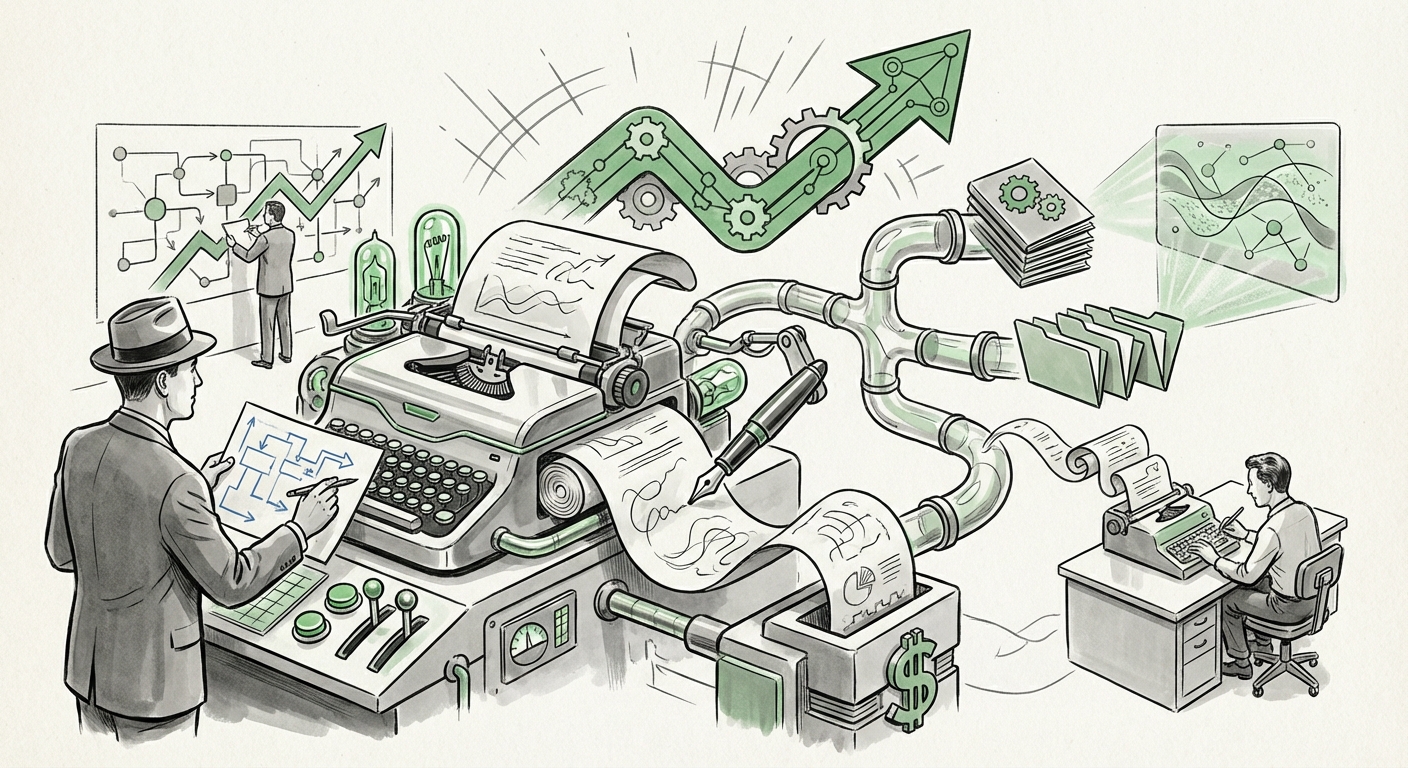
How to Build AI Agents in 2026: You're Not Behind (Yet)
Every few weeks, someone posts a demo of an AI "agent" that books a flight, files an expense report, or refactors a codebase while its human creator watches with a coffee in hand. The comments fill up with the same anxious question: am I already late to this?
The honest answer, as 2026 unfolds, is no. You are not behind. But the window where that stays true is closing, and it is closing faster for teams that mistake noise for progress. The people shipping real agents today are not the ones with the biggest models. They are the ones who picked a boring, well-defined task, wrapped it in tight guardrails, measured it honestly, and let it run.
This is a practical look at how agents actually get built in 2026, what changed to make them usable, and what it all means for the next few years of work.
Why 2026 Is the Year Agents Get Practical
For a while, "AI agent" was mostly a marketing word for a chatbot with a to-do list. The gap between the demo and the daily grind was enormous. Agents would loop forever, forget what they were doing, call the wrong tool, or confidently invent an answer that looked right.
What changed is not one breakthrough. It is a stacking of small, unglamorous improvements. Models got better at following structured instructions and knowing when to stop. Tool calling became a standard part of how models talk to software. Context windows grew, then got smarter about what to keep. And the tooling around agents, tracing, evaluation, sandboxing, cost controls, matured from research toys into things a normal engineering team can adopt.
The result is a shift in what is realistic. Agents in 2026 are not artificial employees. They are narrow, supervised workers that handle a slice of a workflow with a human checking the edges. That is a much smaller promise than the hype, and a much bigger opportunity than most companies realize.
What an AI Agent Actually Is, in Plain Terms
Strip away the jargon and an agent is three things bolted together:
- A model that decides. It reads the situation and picks the next step.
- Tools that act. Search, databases, code runners, email, CRMs, internal APIs, the hands.
- A loop that repeats. Do, observe, adjust, until the job is done or a human steps in.
A chatbot answers a question. An agent takes action, then checks whether the action worked. That single difference, the feedback loop, is where all the value and all the risk live.
The Build Stack: Five Layers That Matter
1. The Model Layer
You do not need the biggest model. You need the right model for each step. In practice, teams mix a stronger model for planning and reasoning with cheaper, faster models for routine steps like extracting fields or classifying a document. Routing by difficulty is one of the simplest ways to keep costs sane and latency low.
2. The Tool Layer
This is where most projects succeed or fail. Every tool you give an agent is a door into your systems, and every door needs a lock. Good tool design means narrow, specific functions with clear inputs and outputs, not a single "run any query" button that gives the agent the keys to the database. Give it the smallest set of tools that completes the job, and make each one fail loudly and safely.
3. The Memory Layer
Agents forget. Memory is how you fix that. In 2026 the practical pattern is layered: a short working memory for the current task, a structured store for facts about the user or the case, and retrieval over documents when the agent needs reference material. The trick is not storing everything. It is storing the right things and being able to explain why the agent used them.
4. The Orchestration Layer
This is the control room. It decides how many steps an agent can take, when to hand off to a specialist agent, when to ask a human, and when to quit. Good orchestration is mostly about limits: step budgets, timeouts, retry rules, and clear stop conditions. An agent without limits is not autonomous. It is a runaway process with a credit card.
5. The Guardrails and Evaluation Layer
This is the layer teams skip, and it is the one that determines whether you ship. Guardrails check inputs and outputs, block dangerous actions, and require approval for anything irreversible. Evaluation is how you know the agent is actually better than the old way. Build a test set of real cases from day one, including the ugly ones, and run it every time you change a prompt, a tool, or a model.
Start With a Workflow, Not a "Digital Employee"
The most common mistake is starting with a vision and working backward. The teams that win start with a workflow that already has a clear beginning, a clear end, and a measurable definition of done. Then they ask where a model could remove the most tedious step.
Good first candidates share a few traits:
- High volume, low stakes per case. Triaging support tickets. Drafting first-pass replies. Cleaning up data. Summarizing long documents.
- A human already checks the output. If a person reviews it anyway, an agent saves time without adding new risk.
- Clear failure signals. You can tell when the agent got it wrong, which means you can measure it.
Bad first candidates are anything irreversible, anything where a wrong answer is expensive, and anything where the process itself is fuzzy. If your best human expert cannot explain the steps, an agent will not learn them for you.
The Real Constraints: Cost, Latency, and Trust
Three practical forces shape what agents can do at scale.
Cost. Agents are chatty. A single task can mean many model calls, and the bill adds up quietly. Teams that treat token spend as a first-class engineering metric, by caching, routing, trimming context, and stopping early, build agents that survive contact with a finance review.
Latency. A loop that takes two minutes feels broken to a user who expected two seconds. The fix is often design, not hardware: run steps in parallel, stream progress, and set expectations in the interface.
Trust. This is the big one. People forgive a chatbot that is wrong. They do not forgive an agent that sends the wrong email to a client. Trust is earned with visible reasoning, easy undo, and a human in the loop on anything that cannot be taken back.
What This Means for Businesses
The companies getting value from agents in 2026 are not replacing teams. They are removing the friction between steps, the copy-paste, the lookup, the status update, the reformatting. That work is invisible in org charts but huge in aggregate.
The strategic implications are worth naming plainly:
- Process clarity becomes a competitive advantage. You cannot automate what you cannot describe. Companies with well-documented workflows will pull ahead of those running on tribal knowledge.
- Data quality is the ceiling. An agent is only as good as the systems it can reach. Messy records produce confident nonsense.
- Evaluation is the new QA. Teams that build testing discipline around agents will ship faster and sleep better.
- Small teams get leverage. A handful of people with good tooling can now cover ground that used to need a department.
What It Means for Workers and Society
The near-term story is not mass replacement. It is a quiet reshuffling of what people spend their day on. The parts of a job that are repetitive, well-specified, and text-heavy are the first to be handed off. The parts that need judgment, relationships, and accountability stay human, and become more valuable, not less.
That has two consequences worth thinking about. First, the skill that matters most is no longer typing speed or tool knowledge. It is the ability to define a task clearly and judge whether the output is good. Second, organizations will need new norms around accountability. When an agent acts, a person still owns the outcome. Building that clarity early is cheaper than learning it from an incident.
There is also a broader point about access. Agents lower the cost of execution. A small business, a solo founder, or a student can now assemble workflows that once required a team and a budget. That is a genuinely hopeful development, and it depends on the tools staying open and affordable rather than locked behind a few gatekeepers.
A Practical 30-Day Path
If you want to move from reading about agents to building one, here is a realistic sequence:
- Week 1, Pick and measure. Choose one workflow. Write down the current steps, the time cost, and the error rate. Collect twenty real examples, including the messy ones.
- Week 2, Build the thinnest loop. One model, two or three narrow tools, a step limit, and logging on everything. Do not optimize yet. Just watch it work and fail.
- Week 3, Add evaluation. Turn your twenty examples into a repeatable test. Score the agent against them. Fix the top three failure patterns.
- Week 4, Add guardrails and a human checkpoint. Require approval for irreversible actions. Add an undo path. Then run it with a real user on real cases, in shadow mode if you can.
That is enough to know whether the idea is real. Most of the value comes from the discipline, not the model.
Common Ways Projects Fail
A short list of traps, because they are predictable:
- Starting too big. "An agent that handles all of customer support" is a research project, not a first release.
- Skipping evaluation. Without a test set, every change is a guess and every regression is a surprise.
- Too many tools. Each extra tool adds a new way to go wrong.
- No stop condition. Loops that never end burn money and trust in equal measure.
- Hiding the agent. Users who do not know they are dealing with an agent will be angrier when it fails.
The Road Ahead
The next phase of agents will be less about flashy demos and more about reliability. Expect to see agents woven into ordinary software the way spell-check was, present, useful, and mostly unremarkable. Expect standards for how agents report what they did, so that audits and accountability become routine instead of heroic. And expect the teams that invested in process clarity and evaluation to move much faster than the ones still chasing the biggest model.
So no, you are not behind. The field is young enough that a focused team with a clear workflow can still build something genuinely useful in weeks. The real risk is not starting late. It is starting vaguely, with a grand vision, no test set, and no plan for what happens when the agent gets it wrong.
Pick one boring task. Measure it. Wrap it in limits. Then let it run.