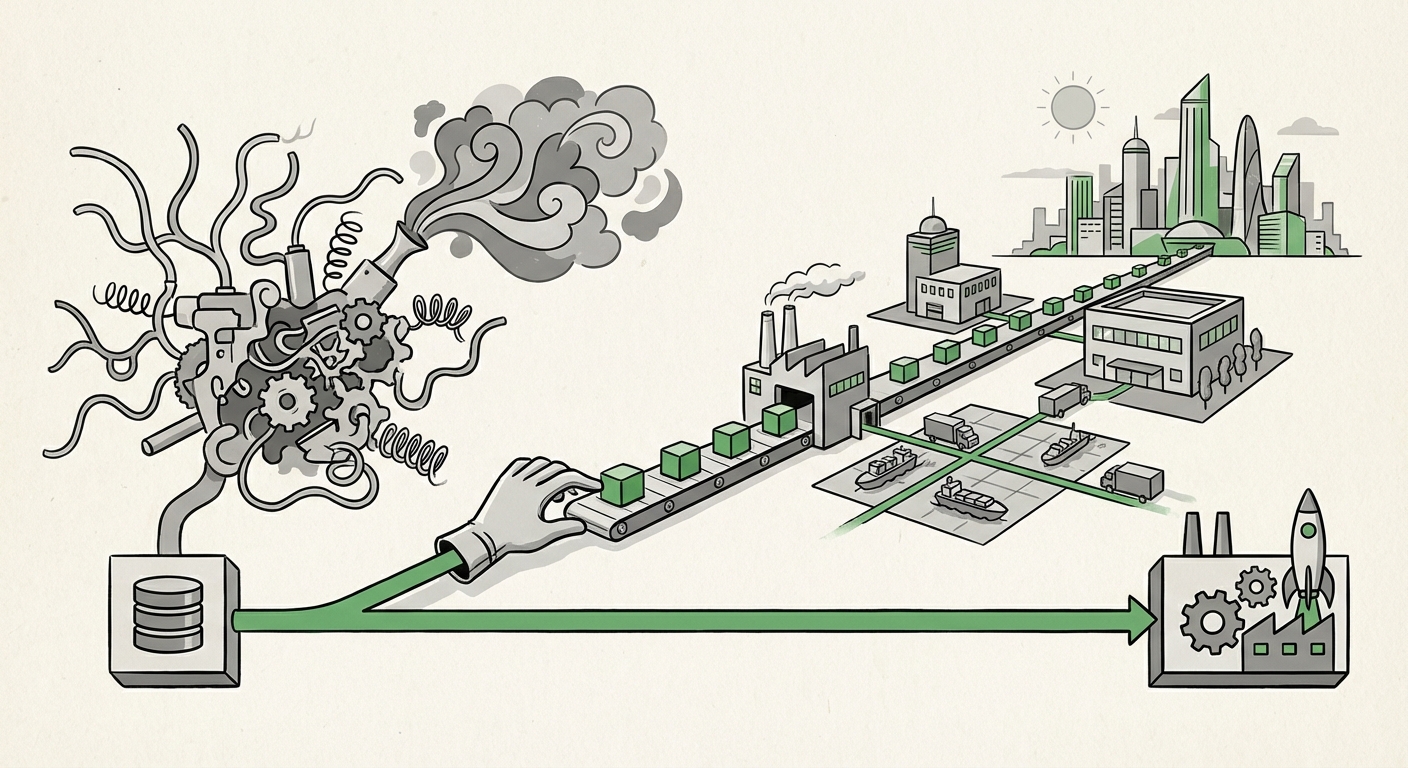
VLA Models Need Real MLOps: How Production Pipelines Will Decide Who Wins the Robot AI Race
Everyone is talking about the models. Far fewer people are talking about the plumbing. That gap is about to become the most important story in applied AI.
New work on building a production-grade MLOps pipeline for VLA models points to a shift that seasoned engineers have seen coming for a while. Vision-language-action models, the class of AI systems that look at the world through a camera, understand a plain-English instruction, and then output physical actions, are moving out of research labs and into real operations. And the moment that happens, the hard question stops being "can the model do the task?" and becomes "can we run, watch, fix, and improve this model every single day, at scale, without breaking anything?"
That is an operations question. It is also, increasingly, a business question. Because the companies that build the strongest pipeline around their VLA models will be the ones that actually ship them.
What Makes VLA Models Different From Everything Before
A standard chatbot takes text in and sends text out. A VLA model takes in pixels and words and sends out movement. That single difference ripples through every part of the engineering stack.
Think about what a pipeline team has to handle:
- Video and sensor data instead of clean text files. Massive, messy, and expensive to store and process.
- Actions as outputs, which means a wrong answer doesn't produce a bad sentence, it produces a dropped object, a damaged part, or a safety incident.
- Real-time pressure. A robot arm can't wait several seconds for a thoughtful reply. Inference has to be fast and it often has to run on the device itself, not in a data center.
- Endless variation. Lighting changes. Objects get moved. Surfaces differ. The physical world does not hold still the way a test set does.
Put simply: normal MLOps was built for a world of documents and predictions. VLA models live in a world of motion and consequence. The tooling has to grow up.
The Anatomy of a Production-Grade VLA Pipeline
A serious pipeline for these models is not one system. It is a chain of connected systems, each with its own failure modes. Here is how the pieces fit together.
1. Data Collection and Curation
This is where most projects quietly die. VLA training needs large amounts of demonstration data, recordings of tasks being performed, often paired with language descriptions. Collecting it is slow and costly. Cleaning it is worse. You have to detect bad recordings, remove duplicate segments, standardize formats, and tag everything so it can be found later.
The teams that succeed treat data as a product, not a byproduct. They version it. They track which data went into which model. They make it easy to answer the question: what exactly did this model learn from?
2. Training Orchestration
VLA training is heavy. It involves large models, large datasets, and long runs that can fail halfway through. A production pipeline needs checkpointing so work isn't lost, automatic restarts, resource scheduling so expensive hardware isn't sitting idle, and strict experiment tracking so results can be reproduced.
The key discipline here is reproducibility. If a model works, you need to be able to build it again. If it breaks, you need to know what changed.
3. Evaluation, The Hardest Problem
How do you grade a model whose job is to fold a shirt or pick a part off a conveyor? There is no single right answer, and no simple accuracy score. Text benchmarks won't help you.
Strong pipelines attack this with layered testing. There are offline checks that replay recorded scenarios. There are simulation environments where risky behaviors can be tested without risk. And there is staged real-world testing, starting in controlled settings and expanding only when results hold up.
The most valuable evaluation asset a team can build is a regression suite of real tasks, a fixed set of scenarios that every new model version must pass before it goes anywhere near a customer. Without it, every update is a gamble.
4. Deployment Across Very Different Hardware
VLA models often have to run in two places at once: on the robot or edge device, where compute and power are limited, and in the cloud, where heavier processing and coordination happen. A production pipeline has to handle model compression, hardware-specific optimization, and safe rollout patterns like canary releases, where a new version runs on a small number of units before going wide.
It also needs a fast, reliable way to roll back. When a model update causes a problem in the physical world, "we'll fix it in the next release" is not an acceptable answer. Reverting has to take minutes, not days.
5. Monitoring and Observability
Traditional monitoring watches for crashes and slow responses. VLA systems need something deeper: behavior monitoring. Are success rates on specific tasks dropping? Are certain environments producing more failures? Is the model hesitating more than usual?
This is where the physical world's messiness shows up as data drift. A warehouse gets rearranged. A new product line arrives. A season changes the lighting. The model that worked in March may struggle in September, and without behavior monitoring, nobody knows until a customer complains.
6. The Data Flywheel
Here is where the pipeline turns into a competitive advantage. Every real deployment generates new data: successes, failures, edge cases nobody predicted. A well-built pipeline routes that data back into curation and retraining, so each deployment makes the next model better.
Companies that close this loop get stronger every month. Companies that don't are stuck shipping the same model forever while the world around it changes.
7. Governance and Safety
Because these systems act in the real world, pipelines need hard limits built in. Access control on who can push a model. Audit logs of what changed and when. Approval gates before deployments. Emergency stop mechanisms. Safety checks that run regardless of what the model wants to do.
This isn't bureaucracy. It's what makes it possible to deploy at all in regulated industries.
Why This Matters More Than the Model Itself
There's a pattern in AI history. The first phase of any new model class is a research race. The second phase is an engineering race. And the second phase is almost always where the real market gets decided.
VLA models are entering that second phase. The core capabilities are becoming understood. What's not yet solved, and what will separate winners from losers, is everything around the model: the data engine, the evaluation suite, the deployment pipeline, the monitoring layer, the feedback loop.
Two companies can start with the exact same model weights. One ships a reliable product that improves every week. The other gets stuck in a loop of demos that never quite reach production. The difference won't be the model. It will be the pipeline.
This is also a warning for organizations that think of MLOps as an afterthought, something to bolt on once the model "works." For VLA systems, that approach fails. The pipeline is part of the product.
What This Means for the Future of AI
Three big implications stand out.
Robotics Will Follow the Software Playbook
For decades, robots were programmed with fixed rules. Change one thing on the factory floor and an engineer had to rewrite the code. VLA models plus a strong pipeline change that. You show the system what to do, and you improve it with data instead of rewriting logic.
That makes physical automation behave more like modern software: continuous updates, faster iteration, shorter adaptation cycles. The barrier to automating a new task drops sharply, and that opens up smaller, more varied tasks that were never worth automating before.
Evaluation Becomes a Core Competitive Skill
As models get better at generating plausible outputs, the ability to measure real performance becomes scarcer and more valuable. For VLA systems, evaluation is partly a physical infrastructure problem: you need test spaces, test objects, and consistent protocols. Companies that build great evaluation harnesses will ship faster and safer than those that rely on vibes and demos.
Edge AI Gets a Serious Upgrade
Running capable models on constrained hardware is a challenge the pipeline has to solve, not the model alone. Expect more investment in compression, hardware-aware optimization, and deployment tooling. As that matures, capable physical AI spreads from big industrial setups to smaller operations.
Practical Takeaways for Businesses
If you're evaluating or building with VLA models, here's where to focus.
- Start with the task, not the tech. Pick a narrow, high-value, repetitive physical task. Prove the pipeline end to end on something small before scaling.
- Budget for data, not just compute. Collection and curation will likely cost more than teams expect. Plan for it.
- Build the regression suite early. Even ten well-chosen real-world test scenarios will save you from painful surprises.
- Design for rollback from day one. Assume some updates will fail. Make reverting trivial.
- Instrument for behavior, not just uptime. Track task success rates by environment, object type, and condition.
- Treat safety as a system property. Hard limits outside the model are non-negotiable in physical settings.
- Close the feedback loop. If deployment data doesn't feed back into training, you're leaving your biggest advantage on the table.
The Bottom Line
VLA models are exciting because they let AI act in the physical world. But excitement doesn't ship products. Pipelines do.
The story here isn't about a single breakthrough. It's about a maturing discipline, the recognition that for AI that touches the real world, the unglamorous work of data curation, evaluation, deployment, monitoring, and governance is where value is actually created. The teams that take that seriously will be the ones whose robots show up on time, do the job right, and get better every month.
The model gets the headlines. The pipeline gets the results.