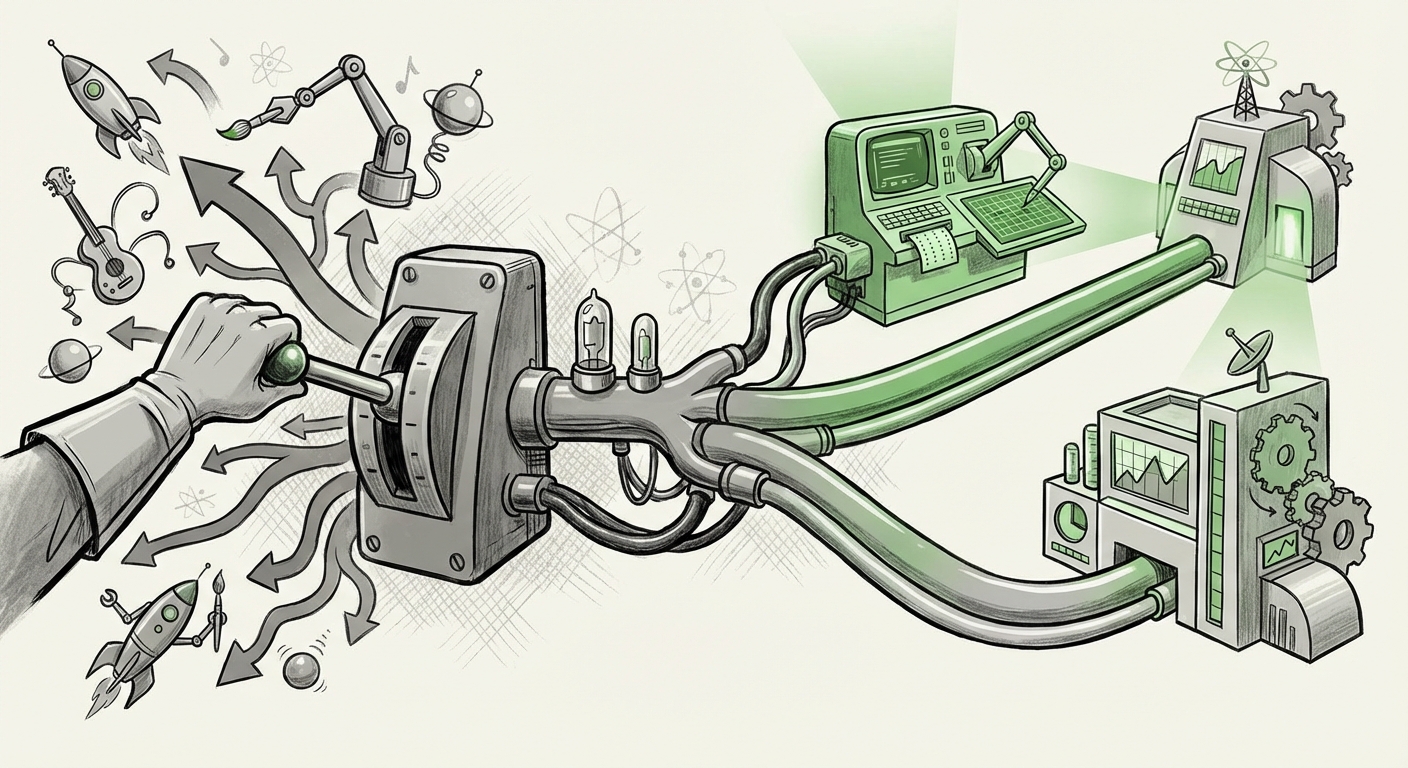
AI in 2026: Why Autonomous Agents Are the Next Big Shift, and What It Means for Your Business
For the past few years, most people have experienced artificial intelligence in one narrow way: they type a question into a chat box, and an answer comes back. It feels a little like magic, but it is also passive. The AI waits. You do the work of deciding what to ask, checking the answer, and then actually doing something with it.
That era is quietly ending. The defining story of AI right now is the move from chatbots that answer to agents that act. Instead of producing a paragraph, a system can now be given a goal, book the travel, reconcile the invoices, hunt down the bug, draft the report, and then take a series of steps on its own to reach that goal. It can use software tools, read files, send messages, and check its own progress along the way.
This is a much bigger deal than it sounds. It changes who gets value from AI, how that value is measured, and what can go wrong. Below is a clear-eyed look at where this is heading, what it means for the future of AI, and, most importantly, how to prepare.
The Big Shift: From Answering Questions to Taking Action
The old model of AI use was a conversation. The new model is a task. That single change reshapes almost everything downstream.
When an AI only talks, mistakes are cheap. A wrong sentence costs you a second of reading and a mental note to double-check. When an AI acts, mistakes have consequences. A badly filled form, an email sent to the wrong person, or a purchase made without approval is a real-world event, not a bad paragraph.
This is why the most interesting engineering work in AI has shifted away from simply making models smarter and toward making them reliable operators. The questions being solved now are practical ones:
- How does the system know it succeeded?
- What is it allowed to do without asking a human first?
- How do we record what it did, so we can check later?
- How do we stop it when it goes off track?
These are not research questions anymore. They are product and policy questions, and they are being answered in real deployments right now.
Why Agentic AI Changes the Economics of Work
The reason businesses care is simple: the unit of value changes. A chatbot saves you minutes. An agent can save you an entire workflow.
Consider a common back-office task like processing incoming invoices. Historically, AI could help by reading a document and pulling out the numbers. That was useful but small, a person still had to check the extraction, match it to a purchase order, chase discrepancies, and enter it into the finance system. The AI handled maybe ten percent of the job.
An agent-based approach targets the whole chain. It reads the invoice, matches it, flags a mismatch, drafts a query to the supplier, updates the ledger once approved, and logs everything it did. A human becomes the reviewer rather than the doer. That is a fundamentally different return on investment, and it is why so many organizations are restructuring their automation plans around agents rather than around chat interfaces.
There is a catch, though, and it is a big one. Agents amplify both competence and incompetence. A process that is sloppy will now be executed sloppily at high speed and at scale. The organizations that win with agents will be the ones that first clean up the process they want automated.
The Trust Problem: Verification Becomes the Bottleneck
Here is the uncomfortable truth about the agent era: the hard part is no longer generation. It is verification.
If an AI can produce ten thousand words, a hundred emails, or fifty completed tasks in the time it used to take to do one, then human attention becomes the limiting factor. Someone still has to decide whether the output is right. And human attention does not scale the way software does.
This is driving several practical trends that will define the next phase of AI:
1. Confidence and self-checking
Systems are increasingly expected to report not just an answer but how sure they are, and to verify their own work using tools, running a test, checking a database, re-reading the original request. An agent that can catch its own error is worth far more than one that is merely fast.
2. Narrow scope beats broad ambition
The agents that work well today are specialists. They do one job in one system with clear rules. General-purpose agents that roam freely across an entire company remain fragile. The winning design pattern is a team of small, well-bounded agents rather than one all-powerful assistant.
3. Human-in-the-loop as a design choice, not an afterthought
Rather than asking "can we remove the human?", teams now ask "where must the human stay?" High-stakes or irreversible actions, payments, deletions, public statements, legal commitments, get an approval gate. Low-stakes, reversible actions run free. This tiered approach is becoming standard practice.
Smaller, Cheaper, Closer: The Push Toward Efficiency
A parallel trend is reshaping the technology itself. For a while, the assumption was that bigger models were always better. That assumption is softening.
Much of the recent progress has come from making models smaller, faster, and cheaper to run while keeping them good enough for specific tasks. This matters enormously for how AI gets used, because it changes where the work can happen. A task that once required sending data to a distant data center can increasingly be handled on a laptop, a phone, or a device on a factory floor.
That shift has three practical consequences:
- Cost falls. Cheap inference means you can run AI on tasks that were never worth automating before.
- Privacy improves. Data that never leaves the device cannot leak from a server.
- Reliability improves. Local processing works when the network does not.
The likely future is a mix: large, powerful models in the cloud for hard reasoning problems, and small, specialized models at the edge for fast, private, repetitive work. Companies that plan for only one of these will overpay or underdeliver.
The Quiet Constraint: Data and Infrastructure
Every conversation about AI eventually runs into the same wall: the data underneath it.
Agents are only as good as the systems they can reach and the information they can trust. In most organizations, the knowledge needed to do a job well is scattered across old databases, shared drives, spreadsheets, and the heads of experienced employees. No amount of model improvement fixes a messy, fragmented information environment.
This is why so much of the real work now happening inside companies is unglamorous: cleaning up data, connecting systems, documenting processes, and setting permissions. These projects rarely make headlines, but they determine whether AI initiatives succeed or stall. The organizations pulling ahead are treating data readiness as a core AI capability rather than an IT chore.
There is also a physical dimension. Running AI at scale requires computing power, electricity, and cooling. As demand grows, questions about energy use, cost, and infrastructure capacity move from the engineering team to the boardroom. Efficiency gains from smaller models help, but they are partly offset by the fact that cheaper AI gets used far more often.
Governance Grows Up
As AI moves from answering questions to taking actions, oversight stops being theoretical. You cannot manage what you cannot see.
The emerging expectation is straightforward: every automated action should be traceable, attributable, and reversible where possible. That means logs of what the system did and why, clear ownership of each automated process, and a documented plan for when something goes wrong.
This is not just a compliance exercise. Good governance is a competitive advantage. Companies that can confidently explain what their AI does, and prove it, can deploy it in more sensitive areas, and they recover faster when something breaks.
What This Means for Businesses: Actionable Steps
If you are deciding what to do next, here is a practical path that does not depend on any particular product or vendor.
Start with the process, not the tool
Pick one workflow that is high-volume, well-documented, and low-risk. Map it honestly. If the process is messy, fix it first. Automation multiplies whatever you already have.
Design for review, not for blind trust
Assume the system will sometimes be wrong. Build checkpoints where a human confirms anything irreversible. Track how often the system is right, and use that number to decide how much freedom to grant over time.
Measure cost per completed task, not cost per query
The old metrics flatter AI. The honest measure is whether a finished piece of work now costs less, takes less time, and has fewer errors. If it does not, you have not found real value yet.
Invest in the boring foundations
Clean data, clear permissions, connected systems, and documented processes are what turn a promising demo into a dependable operation.
Retrain people for the reviewer role
The most valuable skill in an agent-heavy workplace is judgment: knowing what good looks like, spotting subtle errors, and knowing when to stop. Train for that explicitly.
Keep a kill switch
Any system that can act must be stoppable. Test that ability before you need it.
What This Means for Society
Zoom out, and the implications go beyond business efficiency.
If AI increasingly handles routine execution, drafting, searching, scheduling, summarizing, filing, then the human contribution shifts toward deciding what should be done and judging whether it was done well. That is a different kind of work, and it is not evenly distributed. Some roles will expand. Others will shrink. Most will change.
The most likely near-term outcome is not mass replacement but recomposition: fewer people doing the mechanical parts of a job, more people overseeing and improving systems. That transition is manageable if it is planned for, and painful if it is not. The organizations that handle it well will invest in training early, be honest with staff about what is changing, and give people a real role in shaping how the tools are used.
There is also a public trust dimension. As AI systems make more decisions that affect people, about applications, eligibility, scheduling, or content, the demand for explanation and appeal will grow. Systems that cannot explain themselves will face resistance, regardless of how well they perform.
The Road Ahead
The most important thing to understand about this moment in AI is that the story has moved from capability to deployment. The question is no longer "what can AI do?" It is "what can we safely and reliably hand over, and how do we know it worked?"
That is a harder question, and a more useful one. It forces clarity about processes, data, accountability, and people, the things that actually determine whether technology creates value.
For businesses, the opportunity is real but uneven. The winners will not be the ones with the flashiest demos. They will be the ones who pick the right tasks, build the right guardrails, clean up their foundations, and treat AI as a system to be governed rather than a magic trick to be admired.
The chatbot era taught us that AI can talk. The agent era will show us whether we can manage it. That is the challenge worth preparing for now.